




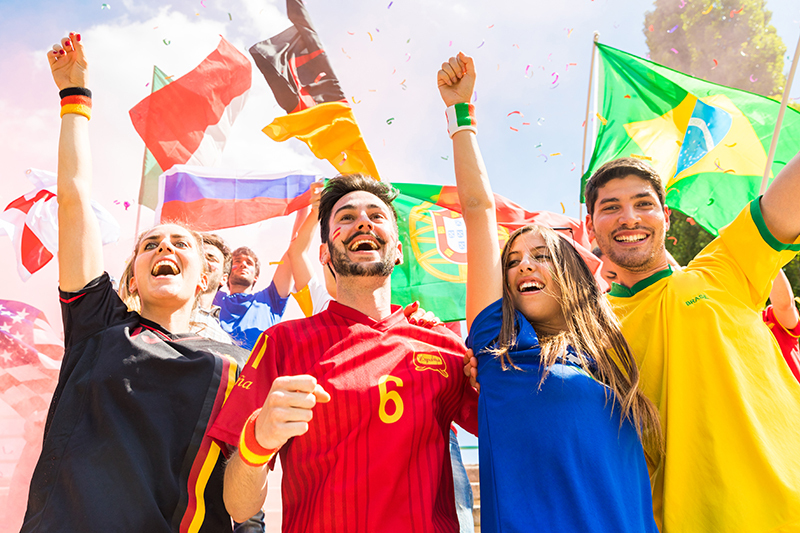
How the World Cup unites fans across the globe
Photo by Shutterstock July 08, 2026
Lerner faculty examine how the 2026 FIFA World Cup is bringing people together, inspiring future generations and creating memories that last long after the final whistle
From Scottish supporters in kilts filling New York’s Times Square to Dutch fans in bright orange marching through city streets and international visitors gathering in neighborhood pubs across North America, this summer’s 2026 FIFA World Cup has transformed the United States, Canada and Mexico into the world’s largest soccer celebration.
Now as the tournament heads into the knock-out phase and competition heats up, faculty in the University of Delaware’s Alfred Lerner College of Business and Economics say it's the connections that are created, not just the matches themselves, that illustrate the World Cup’s greatest impact.
“I overheard someone say this: It’s like we’re celebrating America’s 250th birthday, and we invited all of our cousins over to share,” said Matthew Robinson, professor of sport management. “The world is here to celebrate with us.
In a world where there are so many forces trying to tear us apart, sport has the power to unite. Watching fans from around the world embrace America, and Americans embrace different cultures, has been inspiring.
professor of sport management
Robinson, whose research examines the legacy of mega sporting events, said the analogy captures what makes this year's tournament unique. More than three decades after the United States first hosted the men’s FIFA World Cup in 1994, the event reflects not only the remarkable growth of soccer in North America, but also the sport’s ability to bring people together across cultures.
"In a world where there are so many forces trying to tear us apart, sport has the power to unite," Robinson said. "Watching fans from around the world embrace America, and Americans embrace different cultures, has been inspiring.”
Staging the world’s largest sporting event
When the United States hosted the men’s World Cup in 1994, many questioned whether the country where soccer was still considered a niche sport could successfully stage the world’s largest sporting event.
Instead, Robinson said, that tournament became a catalyst for the sport’s growth in the country.
"The sport has come so far since we were awarded the 1994 World Cup," Robinson said. "The tournament generated revenue that was reinvested into the future of soccer in the United States. It is a true American success story.”
In the years since, the United States has established men's and women's professional leagues (in 1996 and 2012, respectively), a player development pipeline (2007) and a passionate fan base.
“There was a time when simply qualifying for the World Cup was considered a success for the U.S.,” Robinson said. “Now we expect to advance. Eventually, we will expect to compete for the title for the men just like we do for the women.”
For Robinson, those changing expectations show how far the sport has come and signal the impact this year’s tournament could have on future generations.
“I am excited about what will come in the next 30 years for soccer in our country,” he said.
Why shared experiences matter
For Amit Kumar, professor of marketing, the World Cup illustrates a finding that has emerged repeatedly in his research: Experiences create stronger and more lasting connections than possessions.
“Experiential purchases tend to create more enduring satisfaction than material purchases,” Kumar said. “The event itself may only last for a few hours, but it continues to live on in our memories, the connections we make and in the stories we tell.”
Experiential purchases tend to create more enduring satisfaction than material purchases. The event itself may only last for a few hours, but it continues to live on in our memories, the connections we make and in the stories we tell.
professor of marketing
Kumar's research finds that people who share experiences, even with strangers, feel a stronger sense of connection than those who simply own the same possessions. That helps explain why international sporting events create such powerful emotional responses.
“If you and I both own the same watch, that’s an interesting coincidence,” Kumar said. “But if we both attended the same World Cup match, we would likely feel a much stronger sense of connection because experiences become part of who we are.”
Fans may support different countries, speak different languages or come from opposite sides of the world, but sharing the same experience creates common ground.
“The similarities become more important than the differences,” Kumar said.
His research also suggests those benefits continue long after the event ends. Reflecting on meaningful experiences increases people's sense of belonging, encourages future social interactions and can even inspire greater generosity toward others.
“People actually report feeling more connected to humanity in general after reflecting on these kinds of shared experiences,” Kumar said.
Building a legacy beyond the final whistle
For John Allgood, instructor of sport management, the World Cup’s legacy is unfolding on the field and in communities across North America.
Allgood believes one of the biggest impacts may be felt by the next generation of players.
Just as the U.S. Women’s World Cup victory in 1999 inspired thousands of young girls to take up soccer, Allgood believes the visibility of this year’s tournament will encourage more children to lace up their cleats.
“I think we’re going to see a huge bump in participation,” he said. “Parents are watching these matches with their kids, and those kids are going to want to go play.”
The life lessons kids learn through sports — teamwork, resilience, leadership — you can’t put a price on those.
instructor of sport management
He also hopes the tournament sparks broader conversations about making youth soccer more accessible.
Unlike many countries where youth development receives substantial public support, American families often shoulder the costs of club fees, travel and equipment. Greater investment, Allgood said, could make the sport more inclusive while allowing more young athletes to benefit from the life lessons soccer provides.
“The life lessons kids learn through sports — teamwork, resilience, leadership — you can’t put a price on those,” he said.
The tournament could also influence the business of sports.
Allgood points to the use of hydration breaks in this year’s tournament as one example. Designed to protect players competing in summer heat, the pauses also create additional advertising opportunities for broadcasters.
“In sports business, we call them best practices,” Allgood said. “No one has an original idea. If something works and generates revenue, other leagues are going to copy it.”
He expects similar innovations to spread throughout professional soccer long after the World Cup concludes.
Both Allgood and Kumar believe access should remain part of the conversation. While ticket prices have placed many matches out of reach, Kumar said communities and policymakers should continue creating opportunities for people to share experiences together.
“The more we can encourage people to engage in these experiences, the more we’re likely to benefit as a community,” Kumar said.
The real winners
When asked who the biggest winners of the 2026 FIFA World Cup will be, Robinson didn’t name a country.
“Humanity.”
Kumar's research helps explain why: Shared experiences strengthen belonging, create lasting memories and foster community long after the final whistle.
For Allgood, the winners also include host cities like Philadelphia, which have welcomed visitors from around the world while showcasing their culture and hospitality.
Whether it's a child picking up a soccer ball for the first time, fans celebrating together at a neighborhood pub or visitors discovering a new city, all three faculty members agree the tournament's greatest achievement won't be measured solely by who lifts the trophy.
"I hope people leave with a better understanding of who we are," Robinson said, "and with memories they'll carry long after the final match."
Contact Us
Have a UDaily story idea?
Contact us at ocm@udel.edu
Members of the press
Contact us at mediarelations@udel.edu or visit the Media Relations website