





Solving the mysteries of tarot cards
Photos courtesy of Roxanne Radpour and the Morgan Library & Museum September 29, 2026
Art conservation faculty expertise in imaging science helps researchers identify pigments used in some of the earliest known tarot card decks
People have turned to tarot cards to answer questions about the unknown for centuries. For art conservators studying some of the oldest surviving decks, the cards can solve mysteries not about the future, but about the past and the artist techniques and pigments used to create them.
“Tarot cards weren’t created because they had anything to do with divination or the occult,” said Roxanne Radpour, University of Delaware professor in the Department of Art Conservation. “They are fine art, commissioned works of art with a function.”
Originally made for gambling and card games, some 15th-century Italian decks were commissioned as luxury wedding gifts. Now, advanced imaging techniques are revealing the artistry behind the miniature masterpieces.

Radpour’s research on the subject first began as a postdoctoral fellow in the Department for Scientific Research at the Metropolitan Museum of Art.
American institutions hold cards from two of the oldest known tarot decks in their collections: The Morgan Library and Museum has cards from the Visconti-Sforza Tarot deck (c. 1456-58) and Yale University has Visconti di Modrone cards (c. 1447). Conservators at these institutions realized that they didn’t know much about how the cards were produced and turned to colleagues at Yale University’s Institute for the Preservation of Cultural Heritage and the Met’s Department of Scientific Research.
“This is the type of work that drives me,” said Radpour, who began working on the tarot project in 2021 and continued her research after joining UD. “Doing this, understanding the history, the background, and the meaning, and contributing to the knowledge is a big part of my research.”
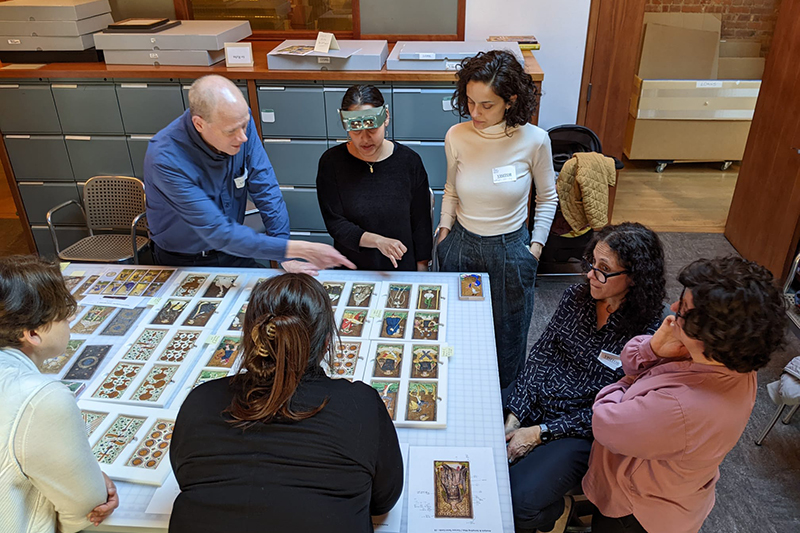
During the five-year project, she has collected imaging data from more than 50 individual cards while developing algorithms to identify patterns and produce pigment maps.
Radpour said that the cards were made with the same artistry and attention to detail as larger paintings of the same era.
“It is really important for folks who care about artistry to realize what true mini-paintings these are and how much effort was put into creating them,” Radpour said.

Reading the cards
Radpour, who holds a joint appointment in the College of Engineering, leads the Imaging Science Laboratory for Cultural Heritage (ISLα-CH), located in Evans Hall. Her lab specializes in reflectance hyperspectral imaging, an imaging technique that resembles conventional studio photography, but here the camera includes a spectrometer that provides chemical data about the colors and molecular makeup of the pigments in the object. That chemical data helps scientists and conservators identify the pigments.
Radpour worked with a global team of scientists and conservators who applied their expertise with multiple techniques and equipment to analyzing the cards in what they call an “iterative process.” Once one technique was applied, the team returned to visual examination to confirm or clarify findings, then applied additional techniques.

The collaboration between scientists across multiple institutions was critical to the success of the project. No single laboratory could have completed it, according to Radpour.
“I don’t know how any one or three scientists in one lab could have done all this work,” she said.
A surprising discovery
The analysis uncovered unexpectedly early uses of mosaic gold and lead-tin yellow, and Radpour identified folium, a natural medieval purple dye, in a figure’s stockings on the Viscont-Sforza King of Staves card. Radpour initially noticed that the purple’s spectral signature did not resemble a typical mixture of red and blue colorants used at the time. After researching other medieval pigments, she proposed folium as a possibility. Colleagues confirmed the finding using complementary spectroscopic techniques.
Discoveries like identifying folium offer more than a list of artists’ materials. They help conservators understand how the cards were constructed, how their components may age and how the fragile objects can be preserved. For example, organic pigments are more light sensitive than inorganic pigments and cannot be exhibited as often due to the risk of fading.

Differences among decks also provide clues about workshop practices, artists’ choices and regional access to materials. Radpour noted that pigments found in the Italian cards differed from those she observed in Spanish illuminations from the same century, with different pigment sources and artistic choices.
She hopes the overall project and a current tarot exhibition at the Morgan Library & Museum, focusing on past and modern uses of tarot decks and their development, will encourage museums and libraries to reconsider playing cards and other objects that have received less scientific attention, like dyed needleworks. The lesson for emerging conservators is especially powerful: Even familiar objects can contain unexplored histories.
“Look what you can learn from doing this,” she said. “There’s actually quite a bit of information that’ll come out.”
Contact Us
Have a UDaily story idea?
Contact us at ocm@udel.edu
Members of the press
Contact us at mediarelations@udel.edu or visit the Media Relations website