




Windows to the world
Photos by Kathy F. Atkinson July 06, 2026
A Guggenheim Fellowship celebrates a historian whose research on Iran invites students to discover new perspectives through the study of the past
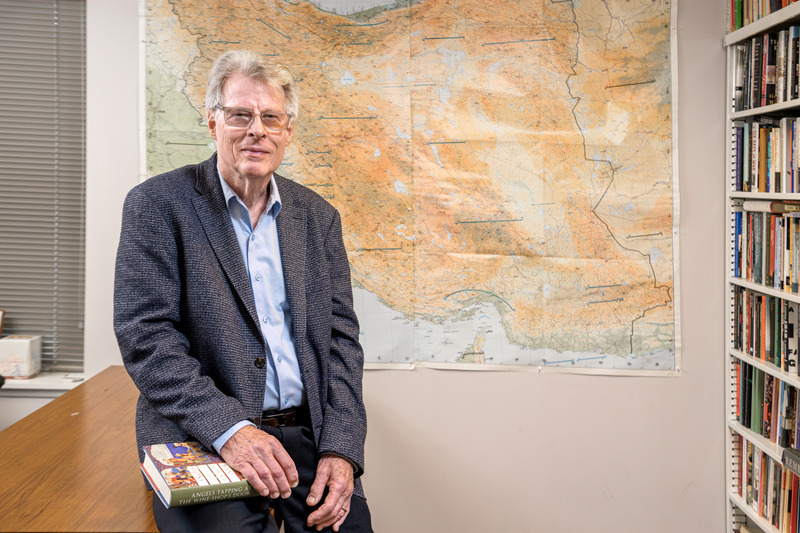
A renowned scholar of early modern Iran and the Persian Gulf, Rudi Matthee has researched an array of topics including the history of money in Iran and the history of alcohol in the Islamic world.
Throughout his career, Matthee has sought to present the country’s history and culture through an Iranian lens, rather than Western or European points of view. His current project explores these perspectives by examining political connections between early modern Iran and Christian Europe.
Matthee, John and Dorothy Munroe Distinguished Professor in the Department of History, will devote the next academic year diving deeper into this aspect of Iranian history as a member of the 101st class of Guggenheim Fellows. Since 1925, the John Simon Guggenheim Memorial Foundation has supported exceptional individuals in the pursuit of knowledge across more than 50 fields including creative arts, humanities, natural sciences and social sciences.
I remind students that as citizens of the strongest and most consequential country in the world, they have a responsibility to know about the rest of the world and not simply about their own history.
John and Dorothy Munroe Distinguished Professor in the Department of History
Previous Guggenheim Fellows include 25 Nobel laureates, members of all the national academies, and winners of the Pulitzer Prize, Fields Medal, Turing Award, Bancroft Prize and the National Book Award.
In 2026 the fellowship selected 223 recipients from a pool of almost 5,000 applicants.
“It is the ultimate accolade,” Matthee said. “It feels fantastic, like a total validation of my work.”
Discovering a passion
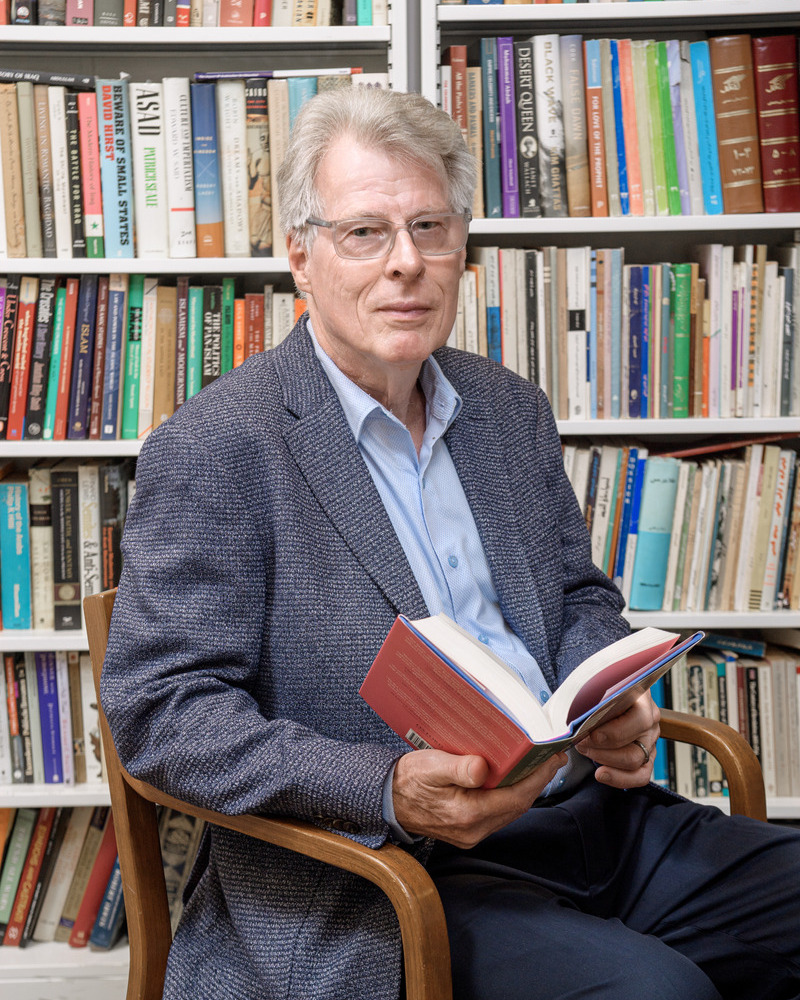
Matthee first became interested in Iran as a student at a classical high school in the Netherlands, where he studied Greek and Latin in addition to French, English and German.
He read about the Greco-Persian wars in Greek, which meant learning about the conflict from the Greek perspective.
“As Westerners, we don’t often realize how much our historical view is really informed by a self-evident Western sense of superiority,” he said.
Matthee’s views changed when he studied in Iran for a year as an undergraduate student.
“Iran totally grabbed me because of its cultural depth and heritage; its long civilization and its wonderful people,” he said. “It awakened my interest in exploring the Iranian element in the Islamic world. I learned Arabic as well, and in the early 1980s I lived in Egypt for two years, but Iran has always remained my true interest.”
Reframing history
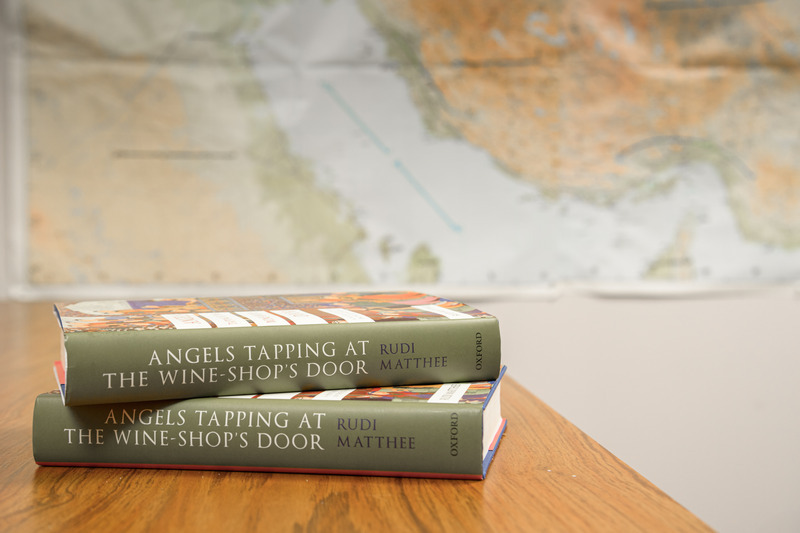
As a Guggenheim Fellow, Matthee will be relieved of teaching and administrative duties so he can devote his time to researching and writing his next book, Keeping the Turks at Bay: Safavid Iran and the Eurasian Attempts at Anti-Ottoman Coalition Building, 1500-1700, including traveling to archives around the world to examine primary sources.
From the European perspective, the Ottoman Turks were the invaders or imperialists of the early modern period; they besieged Vienna in 1683, though they failed to capture the Austrian capital city.
Matthee explained that this instilled a lot of fear in Christian Europe and fueled a push for a coalition with Iran to contain the Turkish influence.
While many of his sources are in European archives, written by visitors, missionaries, merchants and diplomats, and not necessarily by Iranians, Matthee strives to balance his historical interpretations.
“I pull the center of gravity away from Europe toward Iran to see why the Iranians would be interested in these propositions being suggested by European adversaries or potential allies,” he said.
A pivotal moment
To grasp why Iran would or would not be interested in joining this coalition, it is necessary to first understand Iran’s place as a minority Shi’a Islam country surrounded by Sunni Islamic powers: the Ottoman Empire to the northwest, the Uzbeks in central Asia and the Moguls in India.
The Sunni-Shi’a split began in 632 C.E., but the emergence of the Safavid Empire in 1501 marked the separation of Iran as a Shi’a state, and it is still the only country in the world that proclaims Shi’ism as the state religion.
“It was a pivotal moment in Iranian history,” Matthee said. “It gave Iran a very particular and unique position within the Islamic world, by immediately creating a sense of being unique, but also vulnerable and exposed to hostile neighbors.”
This also meant that what Iran feared most was a coalition of its Sunni adversaries.
Then, as now, diplomacy and intrigue played roles in international relations, and Matthee explained that even as they discussed a coalition, Europe and Iran were secretly working against each other.
“Europeans were interested in having the Iranians and the Ottomans fight it out, because that would mean stability on their front,” he said. “But the Iranians tried to egg on the Ottomans to fight in Europe, because that left them in peace.”
Details of modern political conflict are quite different 500 years later, but understanding Iran’s history and Western cultural assumptions can help today’s diplomats and historians parse the complexities of our time.
Matthee explained that we tend to look at diplomacy as originating in early modern Europe, which perpetuates the stereotype of non-European diplomacy being of lesser quality.
“Not everything is informed by religious principles and sentiments,” Mathhee said. “But the mindset spills over into how Iran positions itself in the world.”
Matthee strives to make this history accessible to readers and to his students.
“I remind students that as citizens of the strongest and most consequential country in the world, they have a responsibility to know about the rest of the world and not simply about their own history,” he said.
Contact Us
Have a UDaily story idea?
Contact us at ocm@udel.edu
Members of the press
Contact us at mediarelations@udel.edu or visit the Media Relations website