




Megawatts and middle‑class jobs
Photos by Kathy F. Atkinson April 23, 2026
Carper Collaborative launches with policy conference focused on climate, energy and workforce
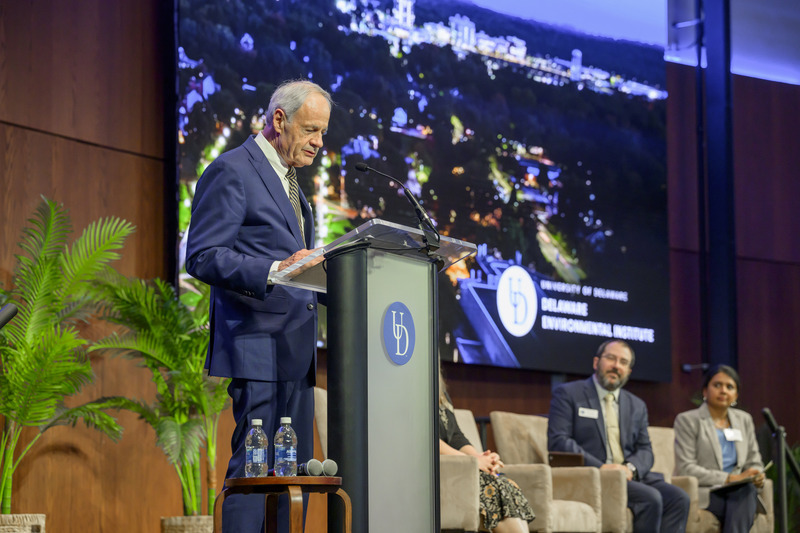
Experts from government, academia, industry and the community gathered April 20 at the University of Delaware to confront one of the nation’s most pressing challenges: how to ensure affordable energy while protecting the environment and sustaining middle‑class jobs.
The daylong policy conference marked the launch of the Carper Collaborative on Climate and Jobs, a new initiative housed at the Delaware Environmental Institute (DENIN) at UD and led by former U.S. Sen. Tom Carper, now a Distinguished Fellow at the institute. The inaugural event, held at UD’s Science, Technology and Advanced Research (STAR) Campus, drew an audience approaching 200, including the entire Delaware Congressional delegation.
From rising household energy costs and growing infrastructure needs to workforce shortages and supply‑chain constraints, speakers emphasized that the energy transition is no longer a distant scenario but a present‑day economic and policy reality.
A career bridging environment and economy
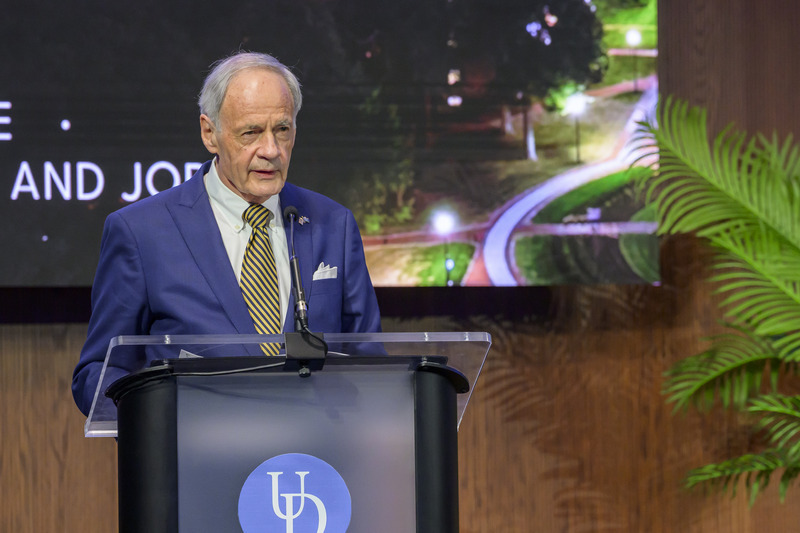
Carper, who was elected to statewide office a record 14 times and is the only person in U.S. history to serve as state treasurer, U.S. representative, governor and U.S. senator, has long argued that environmental stewardship and economic prosperity must advance together.
“There is no greater challenge — or opportunity — facing us as a nation and as a planet than addressing climate change while strengthening our workforce and creating good‑paying jobs,” Carper said. “I want to continue to make a difference by bringing people together to solve big problems, even when we don’t always agree.”
Senior U.S. Sen. Chris Coons pointed to Carper’s career as defining “the Delaware Way,” crediting his ability to convene diverse interests around difficult issues.
“If you think of the most intractable challenges facing us today — climate and jobs — I can’t think of a better person, given his history and values, to bring people together and focus on building durable, sustainable solutions,” Coons said.
U.S. Sen. Lisa Blunt Rochester, who now serves on the Senate Environment and Public Works Committee that Carper once chaired, described the Collaborative as “a beacon of hope.”
“Our challenges are big, and that means we have to be bold,” she said. “This is about the future of our country and our planet.”
U.S. Rep. Sarah McBride agreed, adding, “It is wonderful to be here in a room full of Delaware doers, people who bring their creativity and their expertise to solve the big problems facing our state, and to celebrate Tom Carper and the new Carper Collaborative.”
Convening across sectors
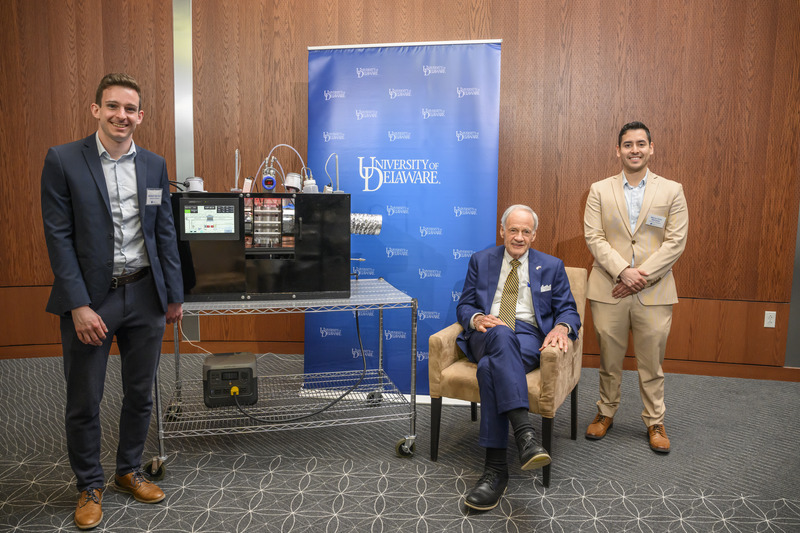
The Carper Collaborative focuses on pragmatic solutions at the intersection of climate, energy and workforce policy. The conference convened voices from energy systems, economics, labor, environmental science and governance, alongside leaders responsible for implementing policy on the ground.
“As a research university, UD has a responsibility to bring disciplines and sectors together, ground decisions in evidence, and help translate complexity into practical paths forward,” said Fabrice Veron, UD vice president for research, scholarship and innovation. “The Carper Collaborative reflects our commitment to public‑engaged research and policy‑relevant scholarship.”
Speakers noted that electricity demand is rising far faster than expected, driven in part by data centers and advanced manufacturing, even as infrastructure development struggles to keep pace.
Sunita Chandrasakaran, director of UD’s First State AI Institute, said the reliability and resilience of the nation’s energy systems are being tested, with real consequences for households and industrial competitiveness.
“The question is not whether solutions exist,” Chandrasakaran said. “It’s how quickly and effectively we can implement them.”
Despite challenges, panelists highlighted significant progress. Fred Krupp, president of the Environmental Defense Fund, emphasized that clean energy costs have fallen dramatically over the past decade.
“Affordability is at the forefront of everyone’s mind,” Krupp said. “The good news is that the price of clean energy has come down significantly.”
According to Lisa Jacobson, president of the Business Council for Sustainable Energy, more than 90% of new energy capacity added nationwide last year came from solar and storage.
“What we need now is collaboration — how the private sector and public sector work together — and speed, which is critical to national security,” Jacobson said.
Panelists also cited hurdles, including supply‑chain constraints for critical equipment, tariff complications and the need for bipartisan agreement on long‑term energy policy.
Workforce challenges
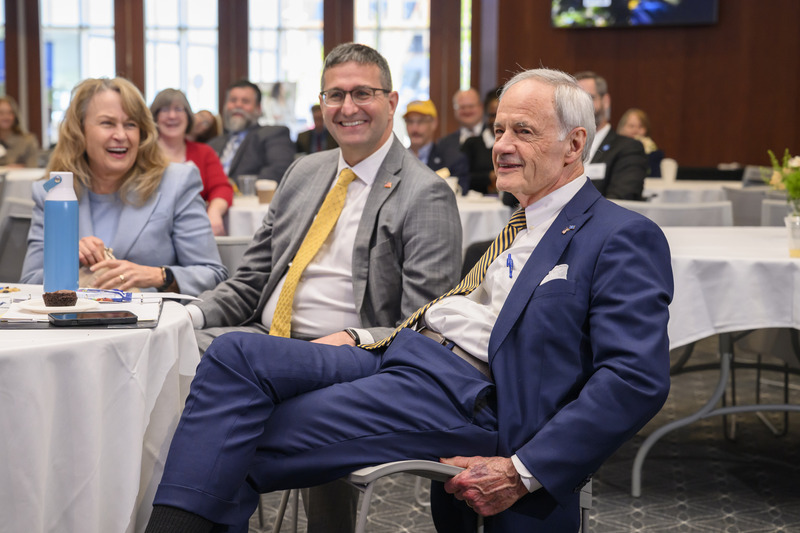
Alongside infrastructure, speakers stressed the urgent need for a trained workforce.
“Creating the next generation of leaders and giving them the skills they need is what will turn much of this around,” said former Maryland Gov. Larry Hogan.
Universities, trade schools and apprenticeship programs were identified as critical to closing the talent gap. UD initiatives such as the Mangone Climate Change Hub and its undergraduate Climate Scholars program were highlighted for preparing students across disciplines to address climate challenges through education, community engagement and applied problem‑solving.
Still, gaps remain. Todd Fryatt, CEO of ECA Solar, said required apprenticeship pipelines are constricting workforce growth.
“Even when people complete training, they need apprentice hours to qualify,” Fryatt said. “If apprenticeships aren’t available, it slows everything down.”
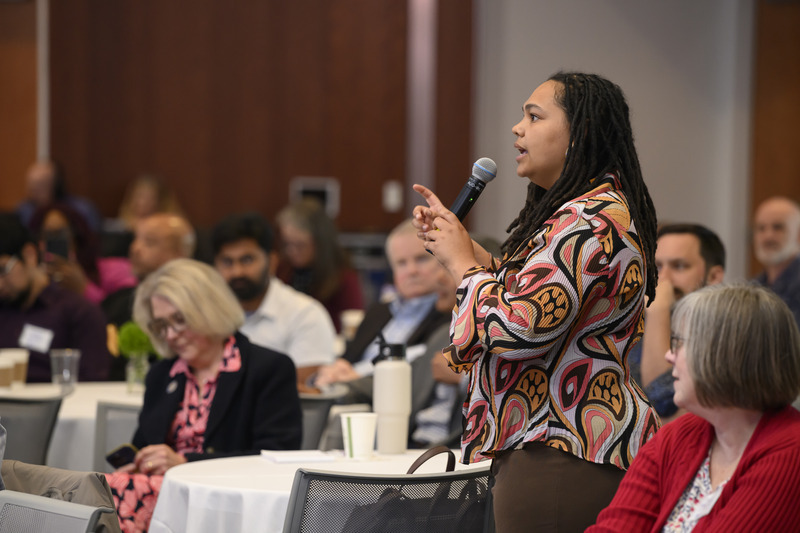
Artificial intelligence is also reshaping workforce needs, said Robert DeNight, vice president of nuclear energy at PSEG.
“We need the right talent to use these tools,” DeNight said. “If we solve that, we can build large things again — faster and more efficiently.”
A Delaware focus
Delaware’s vulnerability to climate change sharpened the urgency of the discussion. As the nation’s lowest‑lying state, Delaware faces increasing risks from coastal flooding and sea‑level rise.
“In Delaware, we see the impacts of climate change every day,” Gov. Matt Meyer said. “That means we have an opportunity — and a responsibility — to act quickly and lead.”
For Carper and others, the Collaborative is designed to serve as a long‑term convener — a place where ideas, research and practical solutions meet.
“This work is about ensuring our children have a planet to grow up on and a planet to grow old on,” Carper said.
Contact Us
Have a UDaily story idea?
Contact us at ocm@udel.edu
Members of the press
Contact us at mediarelations@udel.edu or visit the Media Relations website