



Galileo Lab shows power of undergrad research
Photo by Kathy F. Atkinson June 01, 2018
Students gain valuable experience in study of devastating brain cancer
Camryn Bernheimer isn’t going to lie.
“I felt pretty scared my first year here,” she said. “You don’t know anything about anything.”
But someday, when scientists find a way to arrest an aggressive, devastating brain cancer such as glioblastoma, the work Bernheimer and other undergraduate students did in the lab of University of Delaware neurobiologist Deni Galileo will have played a part.
Galileo, associate professor of biological sciences, is on a quest to understand how glioblastoma cancer cells move and spread in the brain. Understanding the mechanics of that process could help scientists find ways to interrupt and perhaps arrest the aggressive disease.
Research has suggested that rare glioblastoma stem cells are the drivers of this cancer’s malignancy. But information was limited mostly to what could be gathered from decades-old cancer cell lines that have been grown in a laboratory (in vitro), which may not behave the same way as cancer cells found in patients (in vivo).
Working with Dr. Pulak Ray, a neurosurgeon at the Helen F. Graham Cancer Center and Research Institute, and the Graham Center’s Tissue Procurement Center, Galileo is able to analyze the behavior of cancer cells extracted from patients, who have given consent. These glioblastoma stem cells are isolated by growing brain cancer cells in special material that supports only those cells. Once isolated, experiments can be done to see how they behave and grow and how they differ from each other.
“Every brain tumor is molecularly different from another in what genetic mutations they have, which means that the cells could act differently when they come from one patient versus another,” Galileo said. “That's another thing that makes it so hard to fight, and it’s why you have to isolate and do experiments on cells from multiple patients to see if the molecular mechanisms that make these cells invasive are different from patient to patient.”
A recent grant from the National Institutes of Health will support Galileo’s work to understand the characteristics of the glioblastoma stem cells, measure the differences in their motion when stimulated by a molecule of interest—known as L1CAM—and track the direction of the cancer cells’ motion through tissue. He believes L1CAM stimulates these glioblastoma stem cells to leave the main tumor and begin their rapid spread throughout the brain. Surgery may capture the main tumor but it cannot capture all of the dispersed cancer cells. Tumor regrowth is inevitable.
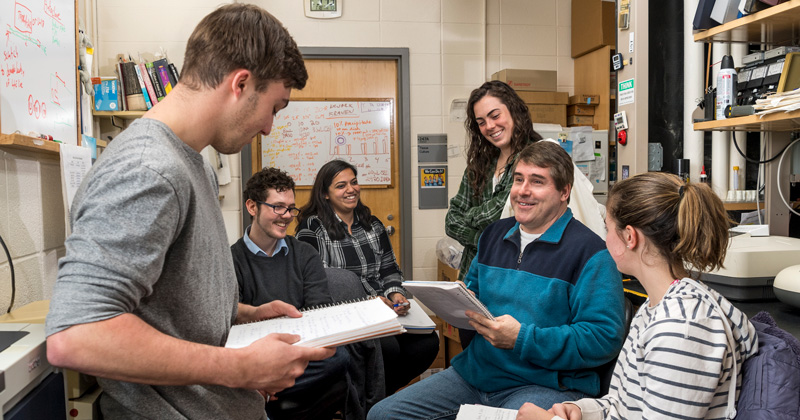
It’s front-line research and the students in his lab are doing it. Their work contributed greatly to gathering the preliminary data needed to obtain this NIH grant, Galileo said.
“We don’t always know the reason behind the results we’re getting,” said Kyle Plusch of Middletown, Delaware, who plans to go to medical school. “But the majority of stuff – if we see results, it’s a novel result. Everything we’re doing is helping in some way.”
Not every college student can say such things. But UD champions the involvement of undergrads in research and has built an extensive, interdisciplinary enterprise of such work.
Alex Stubbolo of Clayton, Delaware, plans to pursue graduate studies in genetic counseling after graduation, work that will be informed by his experience in Galileo’s lab.
“Working in a brain cancer lab has been really fascinating,” he said.
And often frustrating, as all researchers at every level of expertise will attest.
“To do this kind of work takes passion,” Stubbolo said. “You have to care about what you’re doing. It can take months of working on something and then the results you get are the opposite of what you expect. The experiment completely fell through.”
Some might see that as failure, but surprising results or a collapsed experiment provide valuable information—sometimes for the science, sometimes for the student, sometimes for both.
“That can tell you what not to pursue in the future as well as point you in a new direction,” Galileo said.
“You have to step back and not get too frustrated,” said Bernheimer, of Lewes, Delaware. “You may spend hours and hours looking at computer stuff and it doesn’t feel like cancer research. And then you go to him and say, ‘This didn’t work.’ And he says, ‘Any result is something we can talk about. It’s something we didn’t know before.’”
Getting a spot in Galileo’s lab isn’t easy. It’s competitive. But students soon understand why. The work is hard, precise and valuable. As trust is earned, they take on increasing responsibility and work with less direct supervision.
“He helps us learn the information,” Stubbolo said, “and lets us determine our own path.”
Now they will pass the work they have done on to other students, including Michaela Scanlon of Longport, N.J., who will be a senior next year and work toward her senior thesis.
Bernheimer, Plusch and Stubbolo all wrote and successfully defended their senior theses on their work in Galileo’s lab before graduation. Now they will pursue careers in the health professions with deep insight about research and cellular mechanics.
Plusch said his goal is to be a surgeon with a research focus, to continue contributing to the quest for answers. Bernheimer is interested in gynecological oncology.
And Stubbolo said this research and science background will be valuable in his work as a genetic counselor, where he hopes to empower people with knowledge about their genetic risk factors.
“You always miss students who have worked so closely with you when they leave your lab,” Galileo said, “but they go on to do bigger and better things and you focus on the new group that joins you. Working with bright students in my lab—that’s what makes this such a great job year after year.”
Contact Us
Have a UDaily story idea?
Contact us at ocm@udel.edu
Members of the press
Contact us at mediarelations@udel.edu or visit the Media Relations website