
Tiny robots, big questions
Photos by Evan Krape September 09, 2026
Microrobot demonstrations inspired young students at UD’s Early Learning Center and reminded researchers of the curiosity that drives discovery
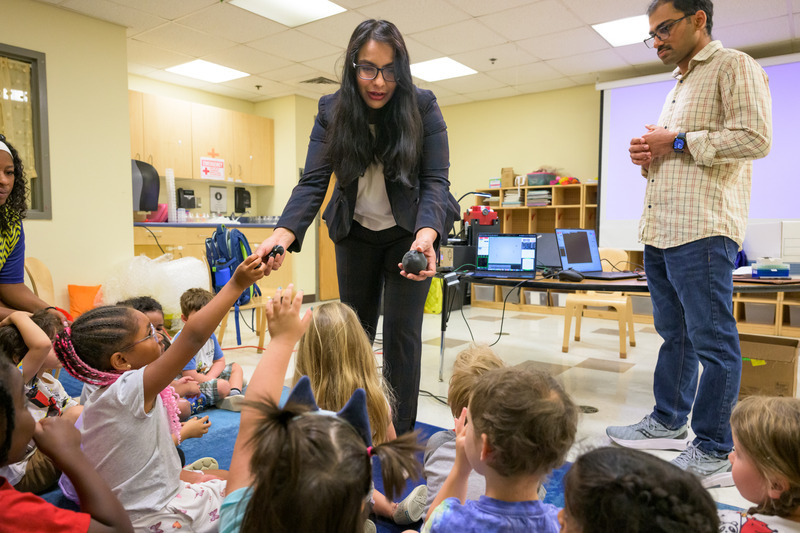
“Can you see germs?” a researcher asked.
“No, you can’t see germs!” the students shouted.
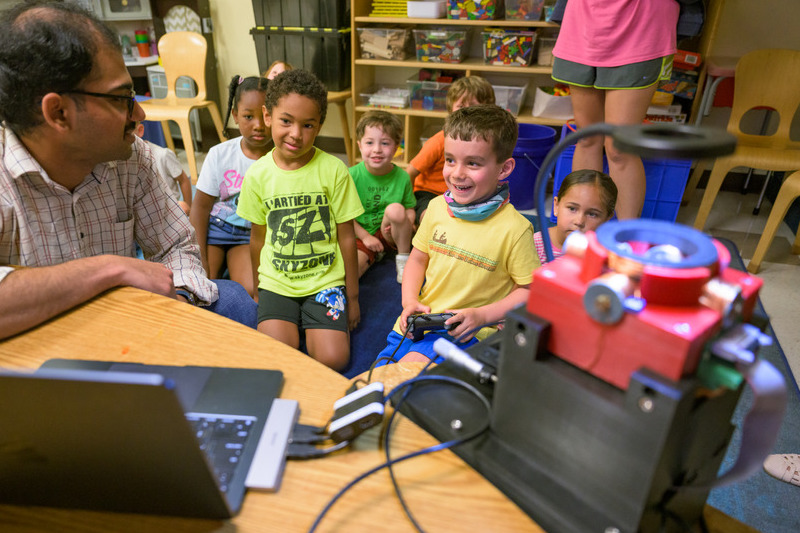
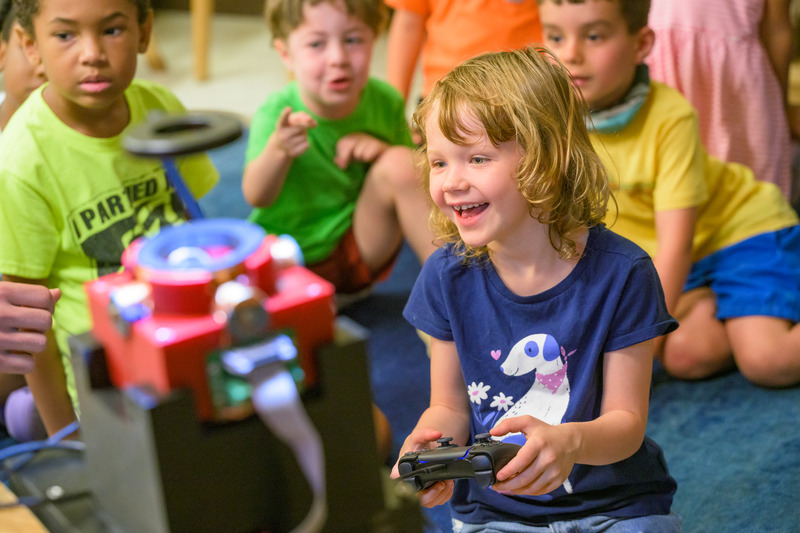
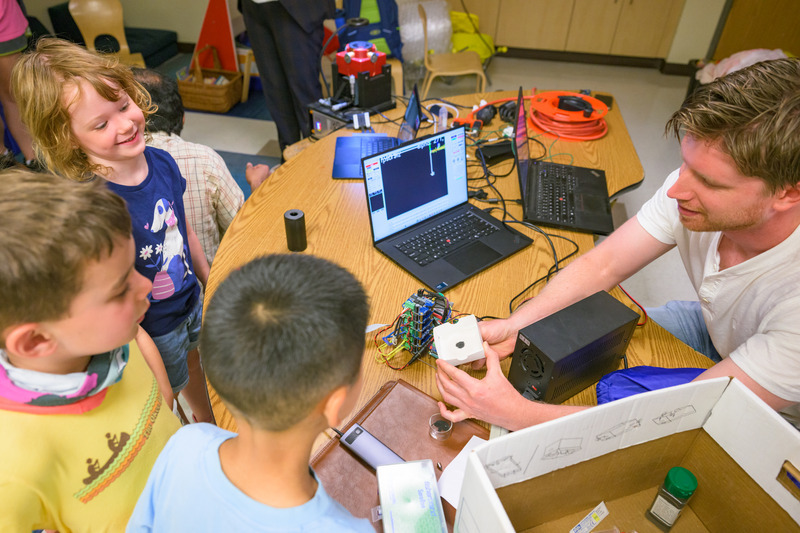
Expanding on that idea, University of Delaware researchers introduced students at the Early Learning Center (ELC) to microrobots, tiny machines about one-hundredth to one-tenth the thickness of a human hair. This summer, the students got a chance to interact with the microscopic devices using a tool they recognized: a PlayStation 5 controller.
The ELC demonstration extended outreach efforts that Sambeeta Das, assistant professor of mechanical engineering, and her team began in 2022, when collaborators at Nemours Children’s Health first invited them to participate in an annual science fair for children and families affected by sickle cell disease.
The idea to bring the microrobot system to the ELC came from Das' own family. After attending a Nemours science fair, Das’ daughter, who was then preschool-age, became fascinated by the technology.
"She learned concepts from it, like 'this is a magnetic field,' and she would talk about it at home and with her friends," Das said.
Seeing her daughter's enthusiasm, Das reached out to the ELC, housed in UD's College of Education and Human Development, to bring the demonstration to more young children.
"For younger kids, the goals are very basic: cause and effect, motion, what light is, what magnetic fields are, what a robot is and the idea that there are things too small to see," Das said.
Beyond the lab bench
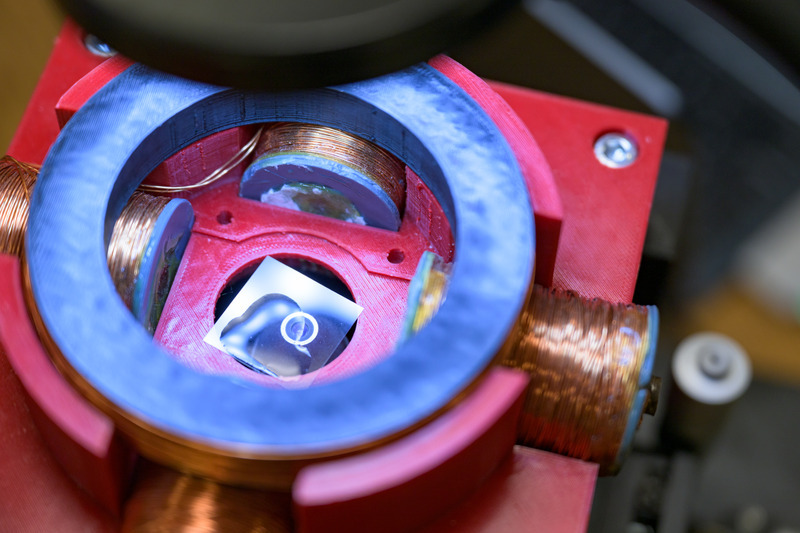
The Das laboratory designs microrobots that can move through biological environments and deliver therapies precisely where they are needed, with potential applications in personalized medicine, drug delivery and biotechnology research.
One project focused on vision complications caused by sickle cell disease, a group of inherited disorders that cause red blood cells to become rigid and crescent-shaped. These misshapen cells can restrict blood flow through tiny vessels in the eye, leading to vision loss. Microrobots could one day help track these changes before permanent damage occurs.
Das' team is also exploring applications in tissue engineering, artificial organs and cancer research.
To make microrobots more accessible for research and training, Das and her team developed a portable, low-cost control system that combines a microscope, computer and modular light, sound and magnetic field controls into a single device.
Lessons that go both ways
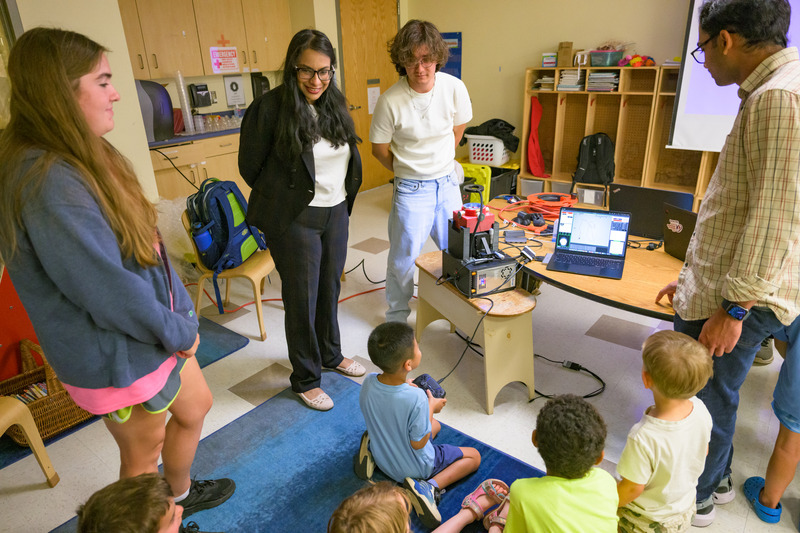
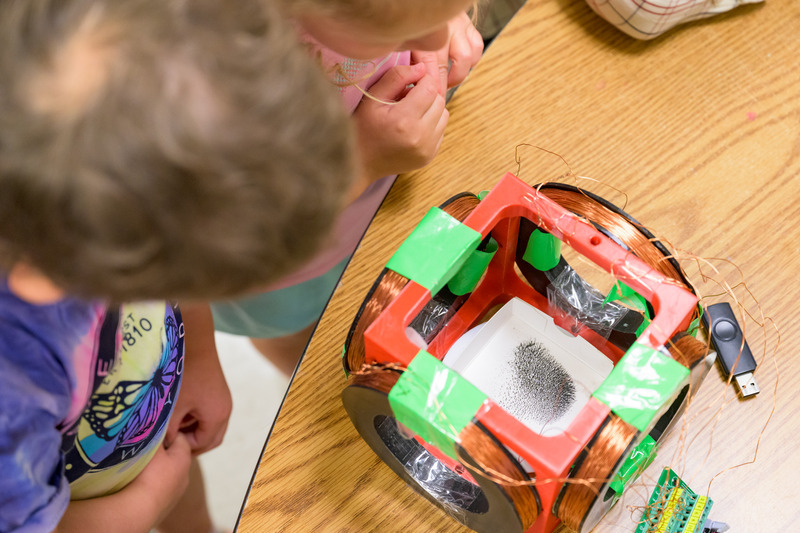
For the ELC demonstrations, the researchers projected the microrobots onto a screen so the entire class could watch as each student took a turn controlling them with a joystick. Activities with iron filings and 3D-printed soft robots reinforced concepts like magnetism, motion and design.
As they worked to spark curiosity among the young students, the researchers rediscovered some of their own.
Doctoral student Zion Lee said the experience underscored how differently children approach the world. The students peppered the team with questions: Why was one particle dark while another was white? Why did some robots move differently than others?
“It's a new perspective that brings your own thinking back to a more curious and open mindset,” he noted.
Watching the children marvel as iron filings danced through a magnetic field reminded him how extraordinary that once seemed.
“To us it's normal,” Lee said. “But to them, it is magic.”
Doctoral candidate Subrahmanyam Cherukumilli said microrobotics can be unfamiliar to many adults, even those with technical backgrounds. Explaining the work to children pushed the researchers to rethink how they communicated it. With young students, he found it best to start with something familiar: the video game controller used to steer the microrobots.
"When you're talking with young kids, you have to explain everything at a much more basic level," he said. "It helps you become a better communicator."
For postdoctoral researcher David Rivas, the demonstrations offered the rare experience of immediate feedback. The lab's research may take months to generate data and years to reach patients, but watching children become captivated by invisible robots, magnets and light provided a different kind of reward.
"Our ultimate goal is to use our research for biomedical applications to help people," Rivas said. "But we don’t see those results right away. It's nice to get something meaningful out of our work in the meantime."
For the researchers, the demonstrations were a reminder of where scientific discovery begins: with curiosity. Lee said he wants the students to remember those moments of wonder: controlling a robot with a video game joystick or watching tiny particles move in response to a magnet.
"That curiosity is what matters," Lee said. "No matter where they go — to school, into a career, wherever life takes them — I hope they keep that sense of curiosity."
Contact Us
Have a UDaily story idea?
Contact us at ocm@udel.edu
Members of the press
Contact us at mediarelations@udel.edu or visit the Media Relations website