
Trails over textbooks
September 04, 2026
UD initiative inspires environmental lessons to take high schoolers beyond the classroom
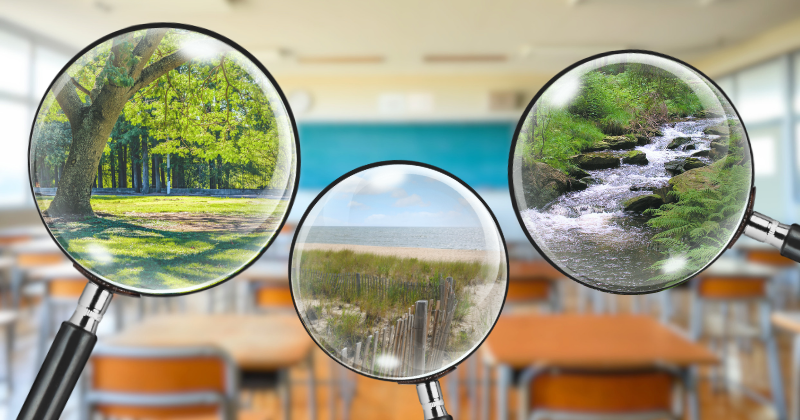
As Delaware high school students head back to class, this fall’s science curriculum may take them farther outside the classroom than ever before, thanks to efforts by University of Delaware’s John Jungck, professor of biological sciences and mathematics.
Jungck knows a thing or two about developing lessons and activities to create connections and help students retain information. He has dedicated decades to helping enrich science education. Through workshops, seminars, and educator communities like BioQUEST, he’s helped professors and teachers translate scientific knowledge into programs with real-world connections and impact.
Last year, the Delaware Environmental Institute (DENIN) welcomed Jungck as a Faculty Fellow. DENIN’s Faculty Fellowship supports professor-led projects connecting their interests to environmental solutions, and Jungck’s initiative, Crowdsourcing Conservation, brings together UD faculty and dozens of local high school teachers to design engaging science activities that highlight environmental issues. Jungck has previously used this workshop model to help educators incorporate topics such as mathematics and social issues into science lessons.
Now, Jungck is helping to equip Delaware STEM educators with interactive lessons that build environmental awareness.
He and collaborator Jon Manon, president of the Delaware Foundation for Science and Mathematics Education, hosted their first DENIN-funded workshop earlier this year. High school teachers discussed education plans alongside UD researchers, who’ve studied Delaware’s environment to expand our understanding of biodiversity, human environmental interactions, climate change, coastal hazards and soil science.
Teachers left equipped with a diverse toolkit of instruments and resources that they could build into lesson plans for the new school year.
For instance, Kevin Brinson, director of the Center for Environmental Monitoring and Analysis, supplied teachers with weather sensors and rain gauges for schoolyard lessons on climate change and weather patterns. Dan McDevit, associate professor of biology in UD’s Associate in Arts Program, shared how collecting plant, insect and fungi samples can start educational conversations on DNA, regional biodiversity and species loss.
Participants also learned about best practices and available funding resources for activities from experts in Delaware Sea Grant, Delaware Space Grant Consortium and the College of Education and Human Development.
“It was a great day,” shared a participating teacher, “and I really enjoyed learning about resources I can use to not only better teach my students, but get them better at collecting and analyzing data.”
Education through action
Jungck is a long-time advocate of citizen science — the active participation of the public in data collection and environmental monitoring. When used in the classroom, citizen science has been proven to increase scientific literacy and help students understand how STEAM (science, technology, engineering, arts and mathematics) manifests in the world around them. Rather than exclusively reading textbooks and doing lab work, students could also gain hands-on experience collecting and analyzing soil samples, surveying animal and plant populations, testing local water quality or tracking night-sky light pollution. These activities gather data that can be used in student lessons and wider publicly sourced datasets that inform local environmental changes.
Jungck’s initiative comes at a crucial moment for Delaware. From frequent severe storms to urban heat islands, residents are feeling the impacts of a changing climate. As clean energy and climate resilience job opportunities increase across the state, leaders have recognized a growing need for an environmentally literate future workforce to protect our ecosystems. Students who can think critically about environmental impacts and necessary mitigation measures across a variety of industries will stand out in the job market.
The Delaware Department of Education now prioritizes environmental literacy in state curriculum, especially in career-technical education. By incorporating environmental citizen science into the syllabus, Jungck is helping give Delaware’s students memorable ways to better understand today’s environment, how they can have an impact and how they can foster positive change.
Later this fall, Jungck and Manon plan to host a follow-up workshop for teachers to share results, new lessons and find more ways for students to deepen their connection with our planet.
Contact Us
Have a UDaily story idea?
Contact us at ocm@udel.edu
Members of the press
Contact us at mediarelations@udel.edu or visit the Media Relations website