




Moving to a More Perfect Union
Photos by Maria Errico October 12, 2026
DSU President Tony Allen calls for meaningful partnerships between Delaware’s neighboring institutions
In 1995, two years after he graduated from the University of Delaware with a degree in political science, Tony Allen made a list of 10 goals. One of the items: to become president of Delaware State University (DSU).
Allen achieved that goal in 2020, becoming the 12th president of one of the country’s top-ranked historically Black colleges and universities (HBCUs).
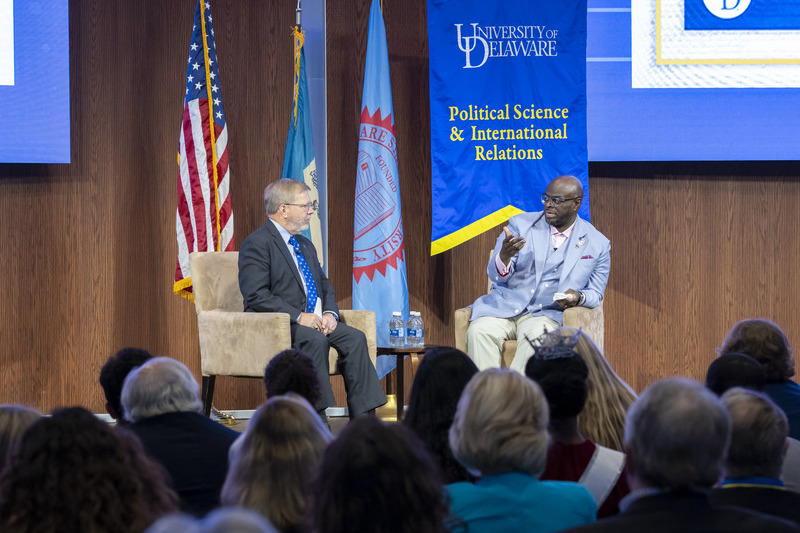
On Wednesday, Sept. 23, he returned to his alma mater as the speaker for this year’s James R. Soles lecture on the Constitution and Citizenship. A student of the beloved political science professor, he recounted how experiences in inequality that defined his path as an advocate and civic leader, and the complicated history of both institutions, pushed him to accomplish his goal.
As higher education faces mounting challenges, Allen, who captivated the audience throughout the lecture, said the path forward depends on institutions working together. He called for UD and DSU to create meaningful, equal programs and partnerships that achieve "something greater than its own self-interest.”
“It's not a ‘go it alone’ kind of society right now,” Allen said. “People want you to think that, but the real successes come from mutual, deep, authentic relationships, and I can't think of one more interesting to have than Delaware State University and the University of Delaware. It’s how we can get more students finding their place of usefulness and honor in the world.”
UD and DSU currently have a dual-degree partnership in engineering. Students in the program study a STEM field for three years at DSU, then attend UD for two years to earn either a bachelor’s or master’s in engineering from UD. The dual-degree program takes five years, while completing the two degrees separately would typically take at least six years.
The program includes a summer research experience with UD faculty at the Newark campus, which helps students prepare for future careers and connects them to leaders in their field.
A more perfect union
Allen connected his vision for new partnerships to part of the first sentence of the U.S. Constitution, which cites as its first objective “to form a more perfect union.” He reflected on the complicated history connecting the two schools that pushed both institutions to serve their students equally — making both schools better.
Delaware State College, as DSU was first known, was founded in 1891 because UD did not admit Black students. In 1950, Wilmington attorney Louis Redding sued UD on behalf of a group of Del State students who were refused admission to UD, arguing the educational opportunities at Del State were not equal to those at UD, as required by law. Judge Collins Seitz agreed. The ruling was the first time a state-funded undergraduate institution was ordered to desegregate. UD admitted its first Black students the following year, and Seitz’s ruling was a pivotal part of the landmark 1954 Supreme Court decision Brown v. Board of Education, which struck down segregation in public schools.
“Both schools were strengthened by being pushed to do something hard,” Allen said. “And they went on to be a benefit that has helped generation after generation after generation.”
As DSU’s president, Allen continues to work for change and expanded opportunities for students. It’s a passion that began when he was a sophomore at UD and participated in a peaceful sit-in at Smith Hall. The 200 Black students, some of whom were in the lecture audience last month, protested race relations on campus and called for new programs and activities focused on multiculturalism and inclusion.
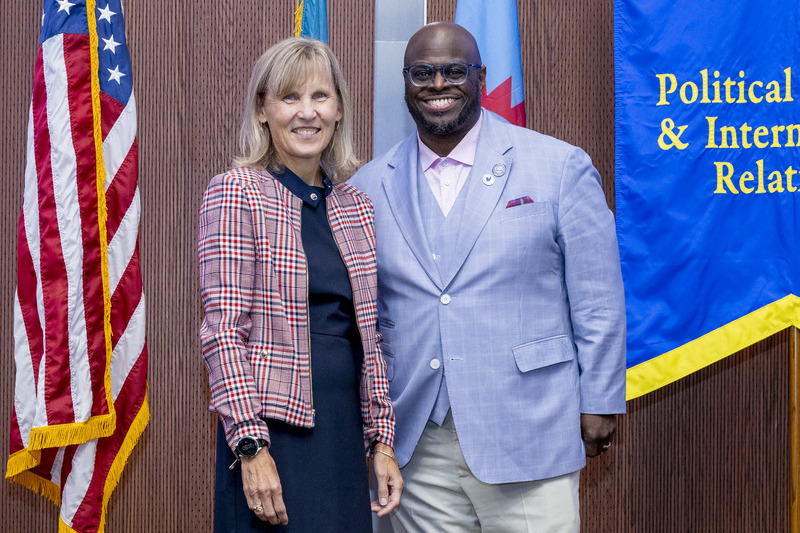
Looking ahead, he praised UD President Laura Carlson, saying she embodies “what Delaware needs for the University.”
“Given the path, moving ahead is as hard now as it's ever been in our country's history, and we have to work really hard together,” Allen said.
Medal of Distinction
Just before the event, the Board of Trustees presented the University’s Medal of Distinction to alumnus Ray Jacobsen, another student of Jim Soles.
Jacobsen graduated in 1971 and became a highly accomplished antitrust and corporate attorney. Throughout his career, he has mentored Blue Hen students considering law school, reviewing essays and providing career advice. He and other alumni created the Legal Professional Preparatory Program, also known as LP3, which connects current students with alumni mentors.
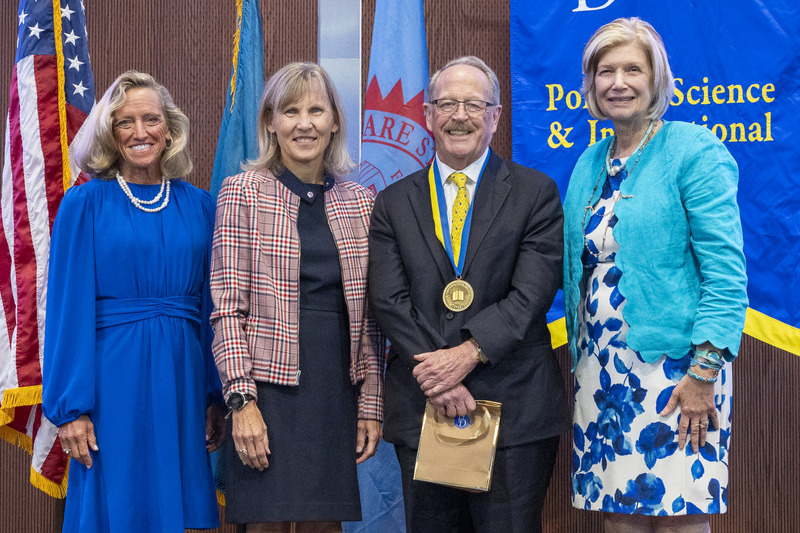
He is currently a member of the President’s Leadership Council, and previously served on the College of Arts & Sciences Dean’s Council, and helped found the Parent and Family Leadership Council. He received the Outstanding Alumni Award in 2024.
“Like Dr. Soles, his contributions have influenced the lives of our Blue Hen students in countless ways,” said UD Trustee Claire DeMatteis. “His support created mentor programs, funded internships and career experiences, and eased the tuition burden for students, many of whom went on to pursue careers in public service.”
With this honor, Jacobsen became the only UD alum to be a member of the UD Wall of Fame, honored as the Outstanding Alumni of the Year, and to receive the Medal of Distinction.
Contact Us
Have a UDaily story idea?
Contact us at ocm@udel.edu
Members of the press
Contact us at mediarelations@udel.edu or visit the Media Relations website