




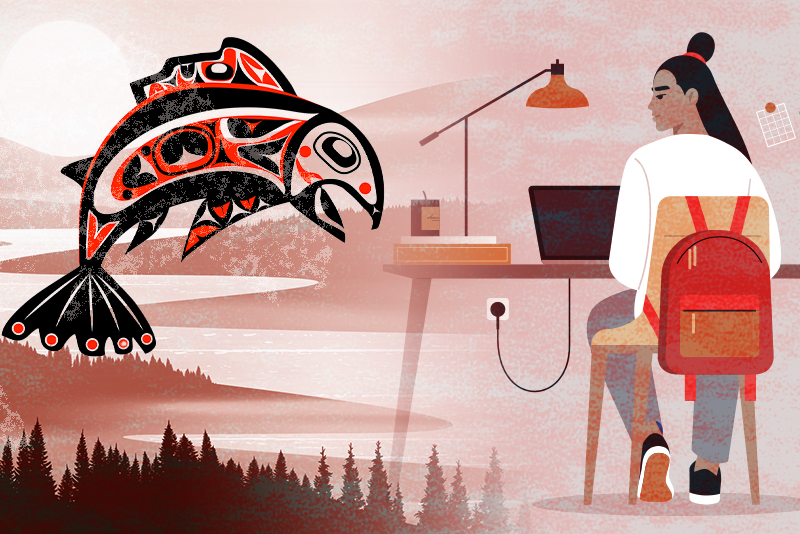
Supporting Indigenous communities
Illustration by Jeffrey C. Chase. Photo courtesy of Abram Lyons November 24, 2026
University of Delaware Assistant Professor Abram Lyons examines policies and programs supporting Indigenous children, drawing from personal and professional experience
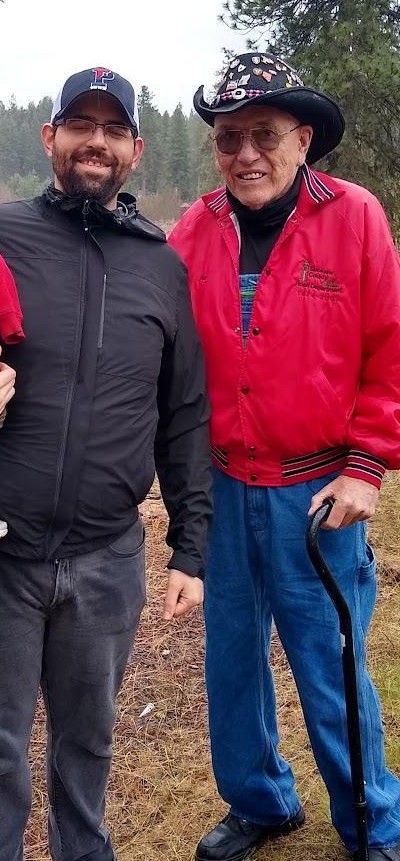
Assistant Professor Abram Lyons grew up in a rural community near Spokane, Washington, where he learned about his family lineage from his grandfather, a member of the Spokane Tribe of Indians. As a volunteer at a nearby summer camp and nonprofit organization, Lyons also learned about community-based social services, observing social workers as they supported children from low-income and Indigenous families — vital work in Washington, where more than 190,000 people identify as Indigenous.
“I’m not a citizen of the tribe, but my grandfather always made sure that we maintained that relationship since he was a tribal member,” said Lyons, who specializes in social work within University of Delaware’s College of Education and Human Development (CEHD). “He always made sure we knew where we came from and how social policy has shaped our history.”
These early interests in family history and social services came together during Lyons’ time as a social worker at a state-run child welfare agency in Spokane, where he observed the federal Indian Child Welfare Act (ICWA) in action. This special policy within child welfare requires that social workers keep Indigenous children under state care connected to their tribes. But Lyons couldn’t find any data on the policy’s successes or challenges.
“ICWA was built through the experiences of Indigenous peoples and their want to maintain a connection to their children, who are, essentially, their futures,” Lyons said. “It represents a very unique policy within the U.S. landscape — one that I call Sovereignty-affirming because it reinforces a tribe’s right to self-govern. But there was no data on whether it actually keeps children close to their tribes or whether the outcomes are different between the children served under ICWA and the general population.”
Now, Lyons is working to fill that gap. His award-winning research examines the historical and ongoing impacts of colonialism on Indigenous families and how Sovereignty-affirming policies can improve outcomes for Indigenous communities. He has examined the implementation of ICWA across states, studied the effects of a financial intervention among families involved with the child welfare system and explored caregiver perceptions of a cash-assistance program, among other topics.
In September 2026, Lyons received the inaugural Doctoral Student Paper Award from the Social Welfare History Group for “Indigenous Children and the Settler’s Pursuit of Land: Tracing Structural Colonialism Through the Child Welfare System,” completed as a doctoral candidate in 2025.
“The initial exploratory research I've done shows that state-level Indian Child Welfare Acts may reduce the amount of time Indigenous children spend in foster care and generally keeps the child connected to their communities,” Lyons said.
Lyons’ research also takes a closer look at the overwhelming number of Indigenous children in the foster care system — a phenomenon that may be related to an overall misconception about Indigenous communities in the U.S.
“The number of Indigenous children in the child welfare system is around three times greater than what it is in the general population,” Lyons said. “So, I’m asking ‘Where are the places where that is happening? And, is there some sort of bias within the decision-making tools [that social workers] are using that leads to more Indigenous children in the system?”
Lyons brings this critical framework to his teaching in CEHD’s master of social work program. The program works to address the urgent need for more social workers in Delaware — the home of the Lenape and Nanticoke People.
“In the classroom, I think about providing another perspective on Indigenous peoples that is not just about enduring Western, racialized images of these Peoples, but something very modern and something very ongoing,” Lyons said. “The Lenape and Nanticoke People are a thriving people in the state of Delaware, and developing an awareness of their ongoing presence and legacy is really important.”
“We are extraordinarily fortunate to have a scholar like Dr. Lyons who is committed to skillfully articulating how policies influence the lived experiences of Indigenous nations,” said Raphael Travis, Jr., CEHD professor and faculty director of the master of social work program. “Dr. Lyons’ research is poised to help policymakers and social workers make decisions that are equitable and just in preserving family connection within Indigenous communities.”
Now a resident of Claymont, Delaware, Lyons describes himself as a “naturalized Delawarean,” excited by the state’s close-knit communities and UD’s community-engaged scholarship.
“Part of doing Indigenous-centered research is doing things locally, doing things that are directly in front of you and helping your community,” Lyons said. “And that's the cool thing about UD — we have a really great relationship with the surrounding community, with nonprofits and a large network of alumni working in these spaces.”
To learn more about CEHD research in family policy and services, visit its research webpage. To learn more about related CEHD programs, visit its webpages for human services and social work.
Contact Us
Have a UDaily story idea?
Contact us at ocm@udel.edu
Members of the press
Contact us at mediarelations@udel.edu or visit the Media Relations website