




Bringing the heat
Photos by Monica Moriak May 15, 2026
UD seniors help establish Delaware’s first Heat Awareness Week
In April, temperatures in Delaware soared over 90 degrees, setting new records in some areas of the state. If that is a portent of things to come, the First State could be in for an incredibly hot summer.
Students in ENSC/ENVR 450 Proseminar in the Environment, a senior capstone course taught by Vaishnavi Tripuraneni, worked with leaders and organizations across the state to help Delaware residents prepare for the approaching heat.
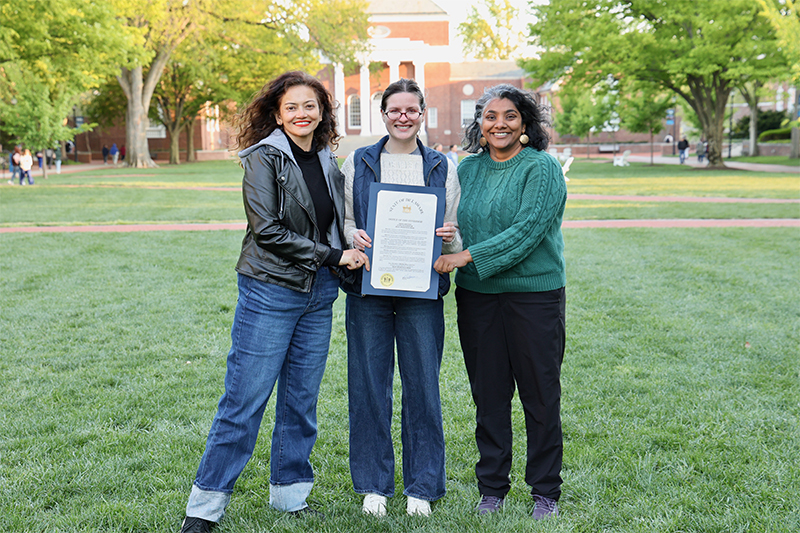
Thanks to the students’ efforts, Gov. Matt Meyer signed an official proclamation declaring May 18-22, 2026, as “Delaware Heat Awareness Week.”
The students worked on the community-engaged project with Shweta Arya, vice president of the Mid-Atlantic Alliance for Climate and Health, who served as the community collaborator.
Arya said that while organizations have been working throughout the state to raise heat awareness for the past few years, there has always been a need for a task force that could bring together those stakeholders.
“This kind of initiative brings partners together and helps make the health impacts of extreme heat visible,” Arya said. “Heat is often underestimated; people think of it as just part of summer, but it’s one of the leading weather-related causes of death. We need to shift that perception and ensure people understand that prolonged exposure to high temperatures can be dangerous, especially for children, older adults and people with pre-existing conditions — and that with the right awareness and community protections, many of these impacts are preventable.”
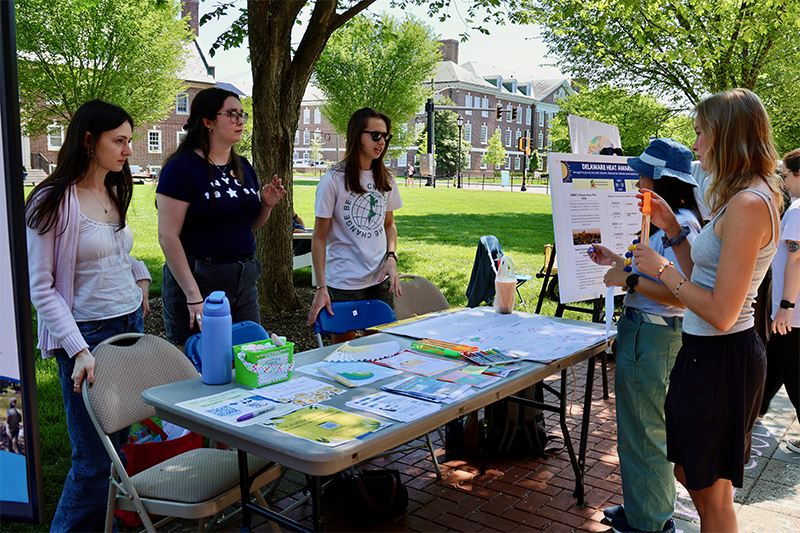
UD students raise awareness
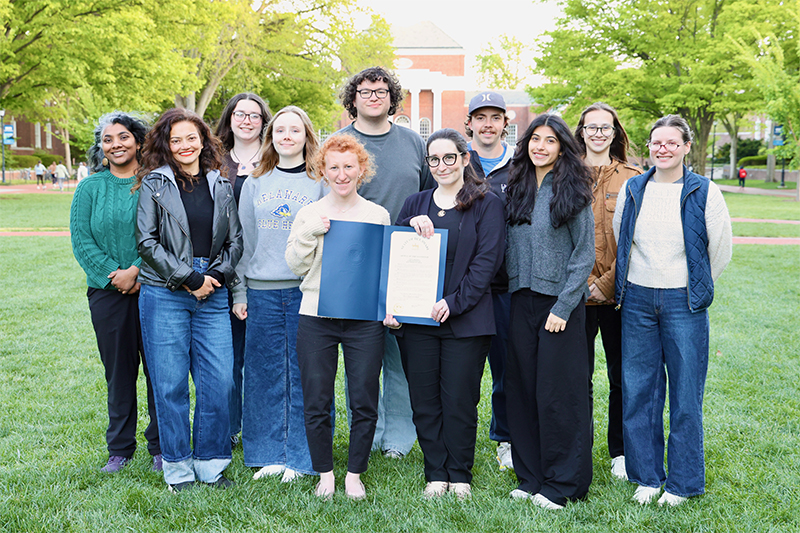
Two cohorts of undergraduate students, one in the fall of 2025 and one in the spring of 2026, worked on the project. They included Jennifer Barbour, Chloe Gentry, Savannah McMullen, Ariana Rodriguez and Katherine Turner in the fall and Olivia Bennis, Cassandra Christoffel, Marina deLeeuw, Ryan Gellner, Owen Rader and Ella Reifsneider in the spring. Doctoral student Nora Lucas, the teaching assistant of the capstone course, provided guidance to both the cohorts.
The week will kick-off with an event on Monday, May 18, from 8:30 a.m.-12:30 p.m., at the Gateway Conference Center in the ChristianaCare Wilmington Campus.
During Delaware Heat Awareness Week, organizations throughout Delaware will focus awareness events on a variety of topics, such as outdoor worker safety, youth and school safety, and how to keep pets and vulnerable populations safe during extreme heat.
Tripuraneni, assistant professor in the Department of Geography and Spatial Sciences, said seeing the students’ hard work culminate in an official proclamation from the Governor was phenomenal.
“The students were happy to see that their work can lead to real change,” Tripuraneni said. “Overarchingly, the students were excited to work on real-world issues and to see change actually happening on the ground.”
Turner, a senior environmental studies major with minors in environmental humanities, history and political science, said the fall students continued to contribute their time and effort during the spring as they all felt attached to the project.
To help them get a better sense of extreme heat initiatives across the United States, Turner and the team spoke to representatives in South Carolina and Arizona, two states that already have heat awareness weeks in place.
“We took inspiration from how they organized the weeks in their states, and we also learned about the challenges they faced,” Turner said. “Specifically, with South Carolina, we learned how their first year went with their heat week, and we learned about possible problems we would face. It was nice to learn about their efforts and hear about what worked and what didn’t.”
Barbour, a senior majoring in environmental science and earth science with a minor in coastal and marine geoscience, said that since Delaware is projected to be one of the fastest heating states in the United States, increasing heat will be an issue over time.
“Particularly in Wilmington, we saw a lot of hospital visits for heat-related health issues,” Barbour said. “A big part of it is that if somebody is overheated and they have symptoms of something like a stroke, they're not going to assume it's the heat. The heat is the underlying main cause of that, but that goes underreported because that's not what is physically happening to the patient.”
During the spring semester, students worked on the implementation of the Heat Awareness Week as well as spreading the word and trying to get more organizations involved. In the fall, there were 10 organizations on board and that number has now risen to over 30.
The spring team held a virtual kick-off meeting on March 17, with over 30 participants.
Reifsneider, an environmental studies major with a concentration in planning and design, and a minor in insect and wildlife conservation, has attended events such as Wilmington Earth and Arbor Day and the DENIN Environmental Research Symposium, working with the team to spread the word about heat awareness.
“We're trying to increase awareness of extreme heat in Delaware because it has become more prevalent,” Reifsneider said. “A big goal is to connect people with resources and make sure they know where they can go if they're experiencing the impacts of extreme heat. This week is going to allow us to help people share information on extreme heat with their communities.”
Supporting partners for the initiative include the Delaware Environmental Institute (DENIN), the American Red Cross, ChristianaCare, the Delaware Libraries, DE's 1st Resilience Hub, Resilient Wilmington, the Delaware Department of Natural Resources and Environmental Control (DNREC) and UD’s Gerard J. Mangone Climate Change Hub, among many others.
For more information on Heat Awareness Week, visit the website: https://sites.google.com/udel.edu/ud-heat-awareness-week/home
Contact Us
Have a UDaily story idea?
Contact us at ocm@udel.edu
Members of the press
Contact us at mediarelations@udel.edu or visit the Media Relations website