




Carrying the dream forward
Photos by Kathy F. Atkinson March 30, 2026
UD alumnus leads Delaware’s Office of New Americans
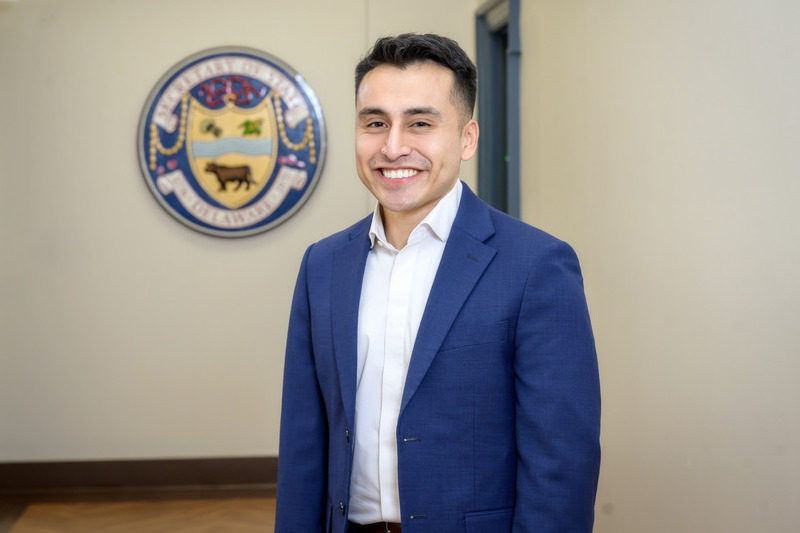
When Rony Baltazar-Lopez reflects on what it means to be an American, he thinks of his father. Fleeing Guatemala’s brutal civil war in the early 1990s, the elder Lopez learned the language and culture of his new land while working at a Milford, Delaware, chicken plant, eventually becoming a small-business owner himself.
Today, Baltazar-Lopez carries that legacy forward as the newly named director of the state’s Office of New Americans, a role that aims to assist Delaware’s immigrant community, which represents about 11.5% of the state’s population and accounts for more than $1 billion in local, state and federal tax contributions.
As the son of immigrants, he considers the appointment “a full-circle moment.”
“I’ve been in this space, informally, my whole life,” the three-time UD alumnus said. “I grew up confronting racial biases and indifferences, making sure my parents had the resources, rights and dignity that belong to us all as human beings. This isn’t my success. It’s theirs.”
His grandmother never learned to read. Just two generations later, Baltazar-Lopez marvels at how far his family has come, a journey he credits in part to his Blue Hen roots.
In high school, he dreamed of leaving Delaware for Washington, D.C.’s political scene. But as the eldest of three sons, he chose a practical and supportive path closer to home. UD’s Associate in Arts Program allowed Baltazar-Lopez to stay in Dover, help care for his younger brothers, avoid student loan debt and benefit from small class sizes and individualized attention.
“It was the best decision,” he said. “No one in my family had gone to college, so this was new territory. I didn’t know what to expect, but my teachers became mentors who really cared. They gave me the footing I needed to be successful.”
After transferring to UD’s Newark campus, Baltazar-Lopez was struck by the diversity of the student body.
“People from every corner of the globe come here to study,” he said. “It’s a place of opportunity and belonging, not unlike the vision for America.”
As an undergraduate political science major, he participated in UD’s Spring Semester in Washington, D.C. program, where he interned with then-Senator (and fellow alumnus) Tom Carper.
“It exposed me to everything at the federal level,” he said. “The experience opened so many doors.”
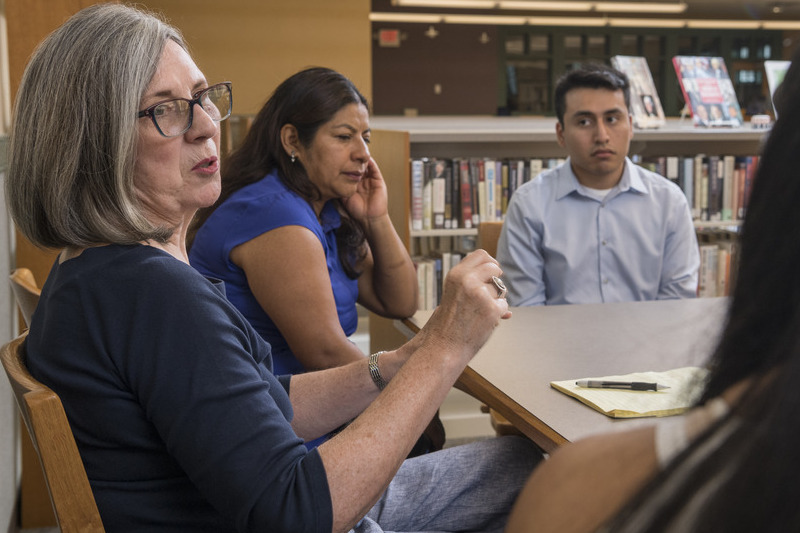
Baltazar-Lopez would go on to serve as a communications staffer for the Attorney General’s office and as policy and communications director for the Delaware Department of State. He would also earn a master’s degree in public administration and serve on numerous boards, including the federally qualified La Red Health Center in Sussex County, where he serves as board president.
Now, as director of the Office of New Americans, Baltazar-Lopez plans to conduct listening tours statewide, expecting to field more questions than comments.
“People want reassurance that the government is there for them,” he said. “That they can send their kids to school or call the police in an emergency without fear.”
In a small, close-knit state like Delaware, those assurances matter deeply. Baltazar-Lopez acknowledges that anti-immigrant rhetoric is real and that fear is rising, an atmosphere he admits is painful to witness. Still, like many who enter public service, he finds hope in education and genuine human connection.
“Immigrants come here for a purpose — to build better lives for themselves and their families,” he said. “They’re regular people: small business owners, professionals, teachers, working-class folks who contribute far more to our society than they ever take from it.”
When Baltazar-Lopez looks at his parents, his neighbors and the communities he now serves, that is who he sees: hardworking people, deeply committed to the American dream.
Contact Us
Have a UDaily story idea?
Contact us at ocm@udel.edu
Members of the press
Contact us at mediarelations@udel.edu or visit the Media Relations website