




Opening the rails to future engineers
Photos by Kathy F. Atkinson March 06, 2026
UD’s $14.5 million federal grant will expand access to live rail training and create a shared data resource
Most aspiring rail engineers learn in classrooms, far removed from the massive machines they will one day help design, inspect and operate.
“Until you see a 14,000-ton freight train in person, you have no idea how powerful, dangerous and demanding it is,” said Allan Zarembski, professor of practice and director of the University of Delaware’s Railroad Engineering and Safety Program. “It’s a mile and a half long, the equivalent of about 150 double-bottom tractor-trailers.”
Student access to live rail environments is rare due to safety considerations and the proprietary nature of rail operations. UD seeks to help close that gap with a $14.5 million grant from the Federal Railroad Administration’s Consolidated Rail Infrastructure and Safety Improvements (CRISI) program.
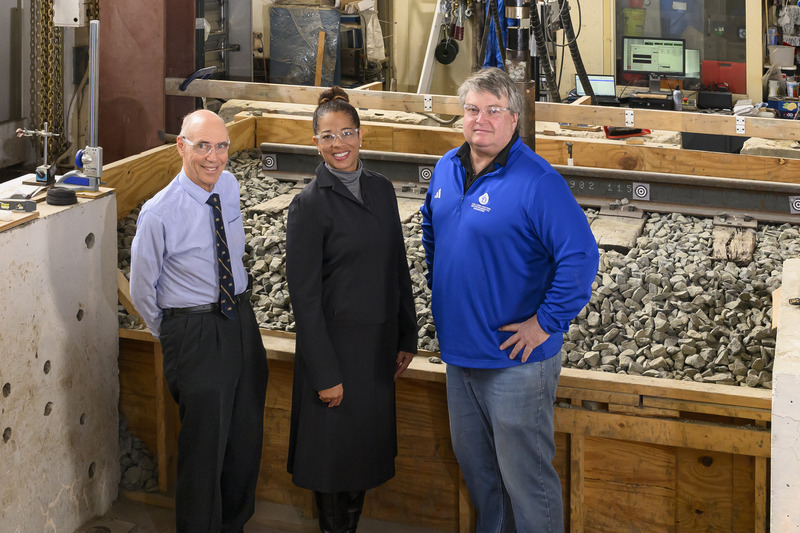
Led by Monique Head, associate dean of the Honors College and professor in the Department of Civil, Construction and Environmental Engineering, the initiative will prepare the next generation of railroad technical professionals through hands-on training at the High-Tonnage Loop (HTL) at the Transportation Technology Center (TTC) in Pueblo, Colorado. Zarembski and research assistant professor Joseph Palese serve as co-principal investigators on the HTL Center project, which also seeks to improve data sharing across the rail industry.
“One of my hopes is that this work shows that railroad engineering isn’t a closed space. There is room for people from different engineering and research backgrounds to contribute in meaningful ways,” said Head, who entered the rail field from a structural engineering background.
Delivering hands-on training at a national rail test facility
“The railroad industry is aggressive, difficult and potentially very unsafe if you don’t know what you’re doing,” Zarembski said. “This program will take theoretically trained students and give them hands-on experience in the real world.”
The team plans to begin offering four-week summer sessions for undergraduate students in 2027. Classroom instruction will be combined with field training and hands-on work at the TTC in Pueblo.
“It’s very difficult to get a feel for how massive and how dirty and how involved everything is through videos alone,” Palese said. “Students in the program will walk out the door and see it live. They’ll inspect the track and work in a real operating environment.”

Operated by ENSCO under contract to the Department of Transportation, the TTC serves as a “laboratory in the field,” allowing researchers and trainees to study rail systems as they operate continuously in real time, rather than trying to recreate them in controlled settings.
Students at academic institutions across the country will be eligible to apply for the HTL Center summer sessions. Those accepted will have their housing costs covered and will receive a small stipend.
“In many ways, it will be like a study abroad experience, but here in the United States,” Palese said. “Students will be immersed in a place and an environment they would never normally have access to. Plus, they’ll be supported so they don’t have to go into debt to do it.”
Head hopes that the program will attract students from different technical backgrounds, ranging from engineering mechanics to data analytics, to contribute to the rail industry.
“We’re really thinking in terms of pathways into the rail industry,” she said. “Rail research has expanded beyond its traditional boundaries. We need people with backgrounds in data analytics, structural engineering and other fields. This program will give them a way in, while also strengthening the industry with new skill sets and perspectives.”
Building a national rail data resource
Beyond workforce development, another major goal of the HTL Center initiative is to compile comprehensive data from active rail operations.
“One of the biggest issues researchers face is access to data. Railroads simply don’t open their tracks and data to outsiders,” Zarembski said.
UD will create and maintain a repository of data gathered at the TTC’s 2.7-mile track, including information about track condition, degradation, maintenance needs and safety performance. UD, the Virginia Polytechnic Institute and State University, AP Sensing, Morgan State University, Michigan Technological University, OptiFuel, Global Rail Group, Loram and ENSCO will be the primary testbed users and collaborators on the project.
UD will serve as steward of the resulting data, helping ensure that they are curated, securely stored and made available to vetted researchers.
“By building this repository, we’re creating a shared resource that can serve researchers and industry partners across the country,” Head said.
The CRISI grant provides three years of support for the HTL Center initiative, but Head hopes its impact will last far longer.
“Success to me means that five or 10 years from now, this data repository is still active and the TTC is being used as a living laboratory for researchers, students and industry,” she said.
Contact Us
Have a UDaily story idea?
Contact us at ocm@udel.edu
Members of the press
Contact us at mediarelations@udel.edu or visit the Media Relations website