





Lessons from the negotiation table
Photos by Maria Errico March 06, 2026
UD alumnus Brian Feuer reflects on global deal-making during Chaplin Tyler Lecture at Blue Hen Innovation Fest
It was Brian Feuer’s first day at McKinsey & Company, a global management consultancy. The University of Delaware alumnus was still filling out paperwork when he was called into a conference room to meet one-on-one with “the founder of an early stage company” who wanted to talk about selling books — and eventually everything from car batteries to toothbrushes — on this new dot-com company’s website.
It was the fall of 2000, just months after the dot-com bubble peaked. The founder was seeking a multi-million-dollar in-kind investment from the global management consultancy. Feuer countered with cash and an equity risk premium. When that offer was accepted, Feuer pushed further, securing a warrant for additional millions in stock.
After several hours, they signed a deal. “I still have the piece of paper,” Feuer said.
The anecdote opened Feuer’s Chaplin Tyler Executive Leadership Lecture during the second annual Blue Hen Innovation Fest, hosted by Horn Entrepreneurship in December. Feuer discussed the tools and mindset required to negotiate successfully at the highest levels of business and leadership.
“High-stakes negotiations is like building a plane in flight,” Feuer said. “Preparation helps you to stay calm.”
Feuer, a member of the Class of 1988 who majored in business administration, reconnected with UD through Horn Entrepreneurship. Horn’s emphasis on experiential learning, student leadership and venture creation aligns closely with how he believes people negotiate and lead in real life. He also noted that his two teenage children are considering UD for college.
“I had a great experience and would love for my kids to have similar experiences,” Feuer said. “UD offers all the benefits of a large school but feels like a smaller one. The sense I get from Horn and Lerner is that if something doesn’t exist yet and a student has an idea, people are willing to help create it.”
Feuer reflected on formative classroom experiences with Donald Puglisi, MBNA America Professor Emeritus of Business.
“He created real-world scenarios so students could relate to theory, and he backed everything up with academic rigor,” Feuer said. Puglisi also offered guidance following the 1987 Black Monday stock market crash. “Staying calm under pressure is a skill I still use in volatile business environments.”
Insights on leadership and negotiation
Before the lecture, Feuer met with students in Horn Entrepreneurship’s Siegfried Fellows program to share insights on leadership and learning. During his two decades at McKinsey & Company, Feuer built the firm’s portfolio management group, leading special situation investments across venture capital, private equity and public markets.
“The reward for hard work and success at McKinsey is more hard work — and you better be successful,” Feuer said. He encouraged students to read people, listen carefully and learn from mistakes. “Work. Learn. Make mistakes. Own them. Wisdom comes from making a lot of mistakes.”
Feuer’s career has included negotiations with Fortune 500 CEOs and world leaders, sometimes in what he described as “scary situations with armed guards.”
Although he initially aspired to become a mergers and acquisitions banker, his work quickly expanded into global, high-stakes negotiations. Today, Feuer advises multifamily offices, is a partner in an AI engineering company and a mergers and acquisitions firm, and directs a venture investment group.
One of the most effective strategies, Feuer told students, is simple: “I talk, ask a question or two, and then shut up and listen.” He also advised letting the other side make the first offer — and resisting the urge to accept it immediately.
When junior Jonathan Dogas, an entrepreneurship major and professional selling and sales management minor, referenced hostage negotiator Chris Voss, Feuer emphasized tone and storytelling.
“Try not to make arguments,” Feuer said. “Tell a story. If you’re a good storyteller, you’ll probably be a good negotiator.”
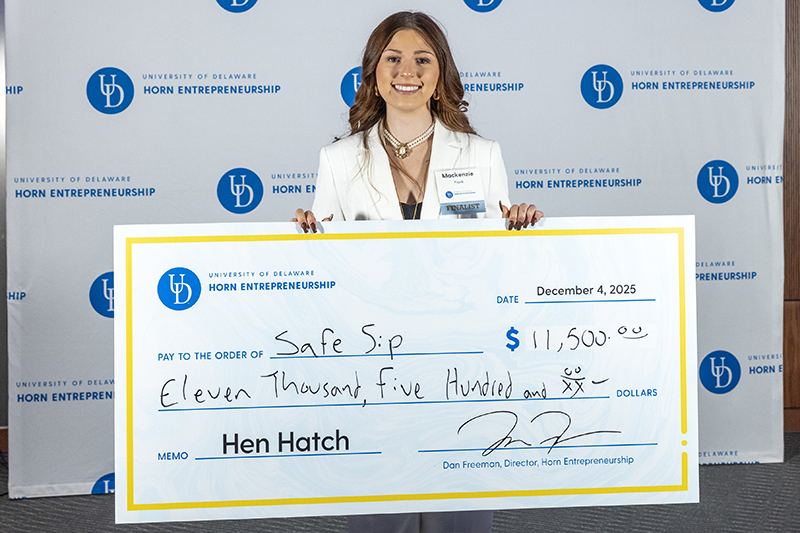
During the discussion, junior Mackenzie Frank, an entrepreneurship major and a finalist in Hen Hatch, a UD start-up funding competition, asked how investors balance confidence in an idea with confidence in the team behind it.
“Brian explained that it’s both,” Frank said. “Investors look for strong ideas, but they’re also investing in the people who will execute them. Leadership matters.”
Later that evening, Frank’s company, SafeSip, was named the top award winner in UD’s premier startup funding competition.
The power of preparation
In his lecture, Feuer referenced a pivotal scene from the movie Air, in which Deloris Jordan negotiates royalties for her son Michael’s shoe line, showing how preparation and leverage can shift power dynamics.
Preparation, Feuer emphasized, is essential before any negotiation begins. He urged students to gather as much information as possible: Who is on the other side? Who makes decisions, and how? What is their organizational and national culture? Are they early in their careers, newly promoted or under pressure?
Early in his McKinsey career, Feuer embedded himself in the company’s Moscow office for a few weeks to better understand Russian business culture. Asked about negotiations related to the war in Ukraine, Feuer suggested that Russian President Vladimir Putin “is trying to buy time,” noting that impatience can sometimes lead parties to concede more than intended.
Feuer also discussed how Japanese business leaders may need to consult executives not present in the room, a practice that can create strategic pauses during negotiations. Another preparation technique is role-playing scenarios multiple times, ideally with someone outside the core team who can pose difficult questions and challenge assumptions.
No matter how prepared a negotiator may be, Feuer said, both sides must be ready to walk away.
“Negotiations can resume hours, days or even months later,” he said.
So, how much time should be devoted to preparation? “As much as needed,” Feuer said. “There’s no equation for that.”
Despite his experience, Feuer acknowledged that his teenage children remain formidable negotiators. “I’m a world-class negotiator,” he said, “and they still beat me.”

About the Chaplin Tyler Lecture
The Chaplin Tyler Executive Lecture Series brings leaders from business, nonprofit organizations and government to campus to share experiences and insights with students, faculty and the broader community.
Supported by the Chaplin Tyler Endowment Fund, the series honors the legacy of Chap and Elizabeth Tyler and their commitment to education and helping young people succeed in the business world.
Contact Us
Have a UDaily story idea?
Contact us at ocm@udel.edu
Members of the press
Contact us at mediarelations@udel.edu or visit the Media Relations website