



Research in motion
Photos by Ashley Barnas Larrimore, Mary Oteri and courtesy of Emma Beisheim-Ryan August 18, 2026
How a UDPT and BIOMS education led to a career in wearable health technology
Emma Beisheim-Ryan remembers playing with her older sister in occupational and physical therapy (PT) sessions at a young age. While her sister, Ellen, who has Down syndrome, benefited greatly from the sessions, for Beisheim-Ryan, it was mostly fun and games. She didn’t know it then, but those play-based exercise sessions would inspire her career path.
“A lot of people enter PT after a sports injury, but I had a totally different view of PT through the lens of a younger sister who got to play with her big sister more,” Beisheim-Ryan said.
That early experience eventually led Beisheim-Ryan to the University of Delaware’s #1-ranked physical therapy program in the College of Health Sciences, and, ultimately, to a career at the intersection of research, rehabilitation and wearable health technology.
“At UD, there’s this constant infusion of the latest research with a focus on being more progressive in evaluating and treating patients as the field evolves,” Beisheim-Ryan said.

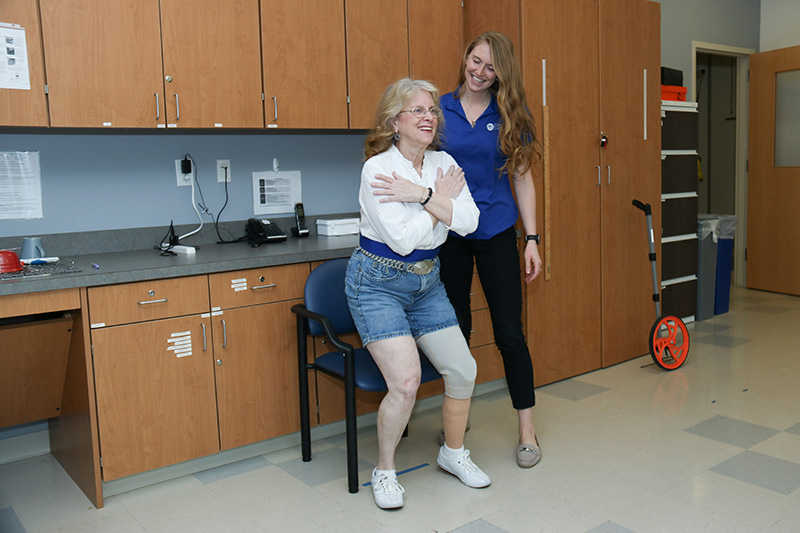
After earning her Doctor of Physical Therapy degree in 2017, Beisheim-Ryan stayed at UD to pursue a doctorate in biomechanics and movement science (BIOMS). During that time, she worked as an instructor in the UDPT Clinic and with patients in UD's Limb Loss Studies Laboratory under Jaclyn "Megan" Sions — an experience that would reshape her career.
“Working with such a fascinating, understudied patient population was an eye-opening experience that had a lasting impact on my career trajectory,” she said.
After earning her BIOMS doctorate, Beisheim-Ryan pursued a postdoctoral fellowship in implementation science at the University of Colorado School of Medicine, where she studied how to better translate research into clinical practice.
She then took a position as a musculoskeletal research scientist at the Department of Defense’s Extremity Trauma and Amputation Center of Excellence. There, she applied lessons from Sions’ lab to improve outcomes for service members and veterans recovering from injuries ranging from strains and sprains to amputations and complex limb salvage.
“My pain research in the limb loss population at UD inspired me to look at patients more holistically to see if and how we could change clinical care in a military healthcare setting,” she said.
After nearly three years, Beisheim-Ryan was ready to apply her research in a faster-paced environment where discoveries could reach consumers more quickly.

She now works as a senior research project manager with ŌURA, a health technology company that makes popular smart rings that monitor dozens of health metrics, from sleep stages and heart rate variability to temperature and stress levels. In the role, she leads early validation efforts that shape and establish new features before they are launched to millions of users worldwide.
"Working at Ōura combines my interests in clinical care and research by helping people better manage their own health,” she said.
One of her favorite aspects of the job is collaborating across disciplines.
"I'm constantly working with algorithm scientists, data scientists and user experience researchers to develop the science behind products and establish the marketing claims that support them,” she said.
Although she's no longer treating patients one-on-one, she still approaches product development through the lens of a physical therapist.
“My movement science background has been helpful because what I suggest and recommend is different, geared toward what a patient might value,” she said.
While Beisheim-Ryan had always wanted to become a physical therapist, UD showed her there was more than one way to make an impact.
“UD was so supportive and empowered me to determine what I love,” she said. “That messaging constantly comes across in the classes, coursework and clinical rotations. Between DPT and BIOMS, the breadth of exposure prepares you to thrive in a variety of environments.”
She encourages current UD students to think beyond traditional PT career paths.
“Don’t limit your mindset to what you thought you wanted to do,” she said.
She still carries advice from former Physical Therapy Department Chair Stuart Binder-Macleod, who once shared his philosophy: “If you don’t love it, it won’t be fun.”
“There’s so much you can do with a PT degree,” Beisheim-Ryan said. “Have an open mind and challenge yourself to think of different ways to contribute. You might discover something you love.”
Contact Us
Have a UDaily story idea?
Contact us at ocm@udel.edu
Members of the press
Contact us at mediarelations@udel.edu or visit the Media Relations website