
Filling a gap in local news coverage
Photos by Kathy F. Atkinson June 16, 2026
Statehouse News Fellows Program gives student journalists a front-row seat to Delaware government
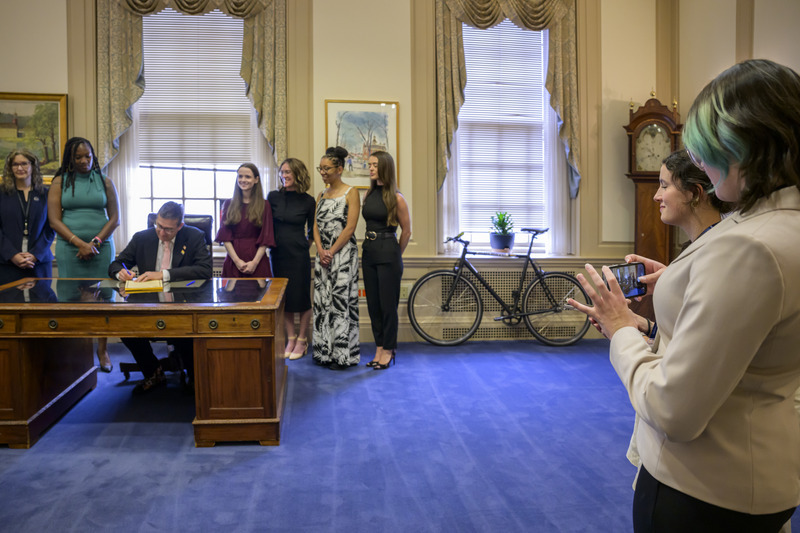
The three University of Delaware student journalists stood patiently in the hallway on the second floor of Delaware’s statehouse, waiting for the door to Gov. Matt Meyer’s office to open, notebooks ready, yellow press credentials hanging from lanyards around their necks.
“I haven’t covered a bill signing before,” one said.
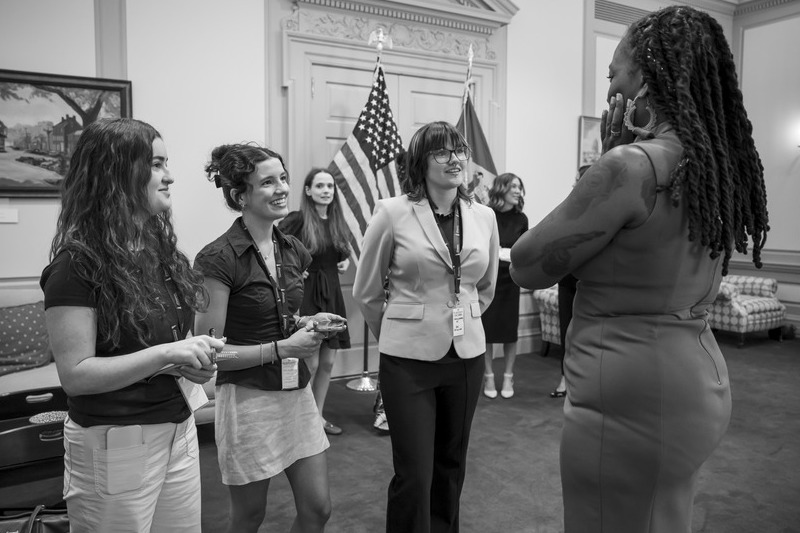
The students — senior communication majors Alexis Hollinger, Gia Joella and Darcy Rohman — took notes, photos and video as Meyer put his signature on copies of Senate Bill 250, which updates an existing law that legally defines parent-child relationships to include language about children born to same sex-couples, or via a surrogate or donor. After the ceremony they surrounded the bill’s primary sponsor, state Sen. Marie Pinkney, peppering her with questions.
It’s all in a day’s work for UD’s inaugural group of Statehouse News Fellows, six journalism students who have spent the last six months covering Delaware’s government in partnership with Delaware Public Media (DPM). As local news coverage continues to shrink across the country, the Fellows program is helping fill that gap, while preparing the next generation of political reporters.
Plugging the information deficit
The initiative came from research Nancy Karibjanian, director of UD's journalism program in the Department of Communication, conducted for her master's degree in journalism education. Her work examined how declining local news coverage can leave communities less informed about state and local issues.
"News is now nationalized, and the public knows more about the actions in Washington than in Dover," Karibjanian said.
To address the need, Karibjanian worked with the Center for Community News at the University of Vermont and connected with other universities and colleges to start UD’s program, one of about 30 in the country.
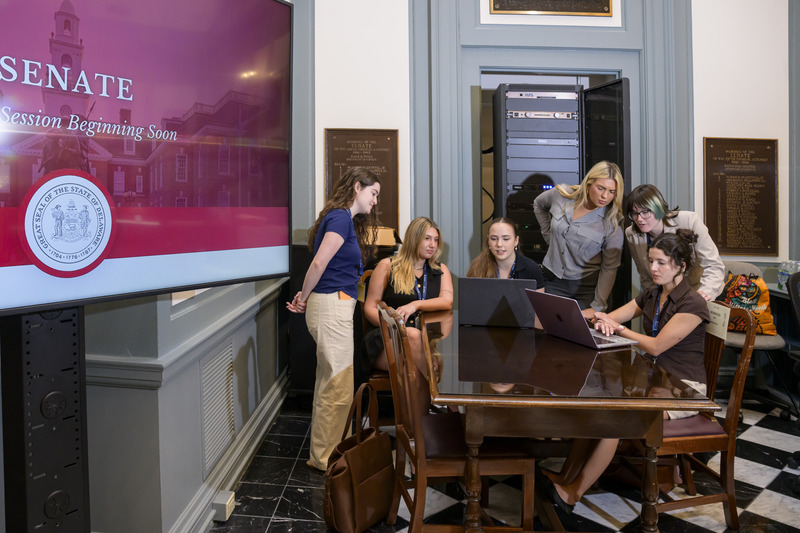
Since January, the team, which also includes senior communication major Sarah Cain and recent graduates Danielle Weinhofer and Lily Grossberg, has covered committee hearings, floor debates and policy discussions, feeding information to DPM news staff. The arrangement gives the station’s sole legislative reporter valuable support and broadens the station’s coverage of the issues that matter to Delaware residents.
“I’ve always followed politics, but there’s so much more to this than I ever thought,” Hollinger said. “Local politics is so different from what you see on the news. It gives you a completely different viewpoint.”

Tom Byrne, DPM news director, said the fellowship gives students rare hands-on experience that is increasingly difficult to obtain. It also reinforces the value of on-the-ground reporting at a time when artificial intelligence is reshaping the media landscape.
"There's so much nuance to political reporting,” he said. "You've got to be in the building, talking to people, building contacts and building trust."

For Joella, an honors student who is double majoring in political science, that face-to-face interaction has increased her trust in local government, which surprised her.
“When you see these people all the time, you realize elected officials are people too and they ask questions because they really want to make sure what’s in a bill is right for the people they’re representing,” she said.
More than written words
After the bill signing, the full group met in the pressroom to discuss not only what to cover next, but what formats to use to tell the story. Karibjanian required the students to use multiple platforms to share their news. In addition to writing stories, taking photos and recording sound bites for radio, the students put together one- to two-minute video reports that are posted to social media. The videos have sparked an increase in engagement, especially among younger voters, who are often seen as apathetic.
“I've learned so much about how to make an interesting video that people want to watch, and to use language that people understand and are familiar with, so that you're not going over their heads,” Cain said. “I find that once you explain things in a digestible way, people want to learn more, and a lot of times they'll go research the bill and see what it's all about.”
While plans are underway to expand opportunities for future fellows, Karibjanian is pleased the program is helping students ensure that more Delawareans understand the decisions being made in Legislative Hall, and how those decisions affect their lives.
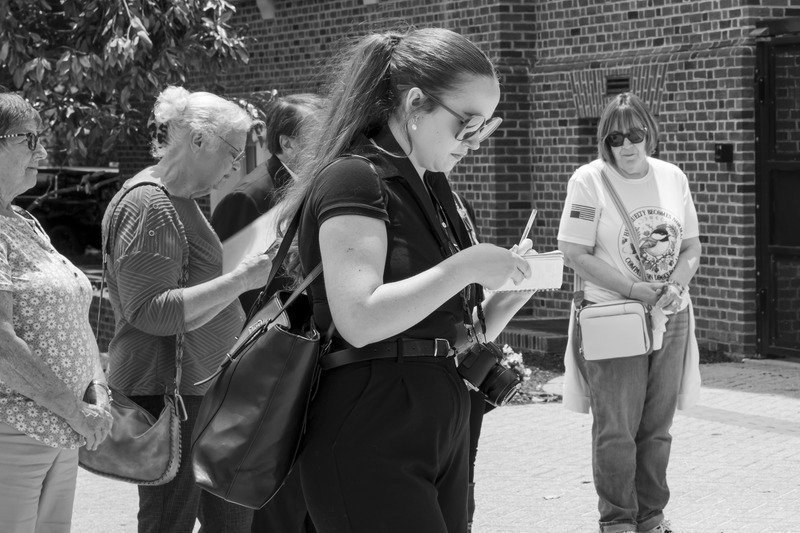
“It is rewarding to see this proposal come to life and to know our fellows are learning the craft of journalism while working as credentialed journalists. Without question, the experience takes what they learned in the classroom and puts it into practice,” she said.
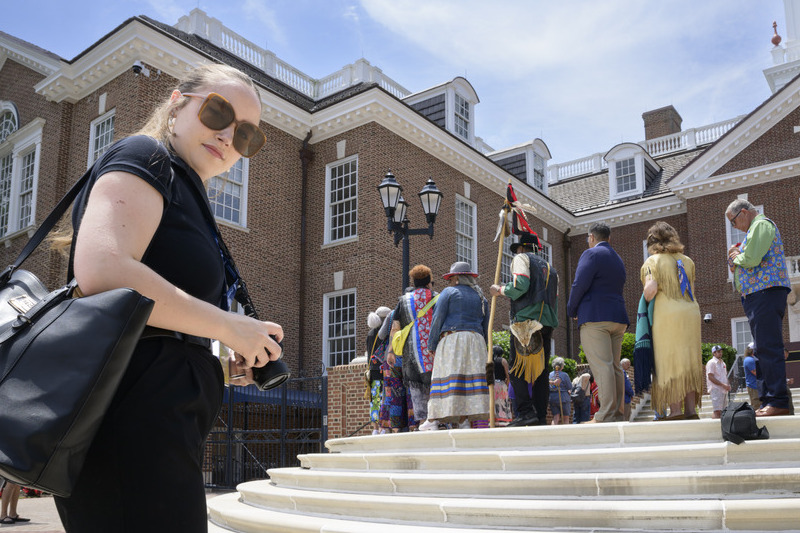
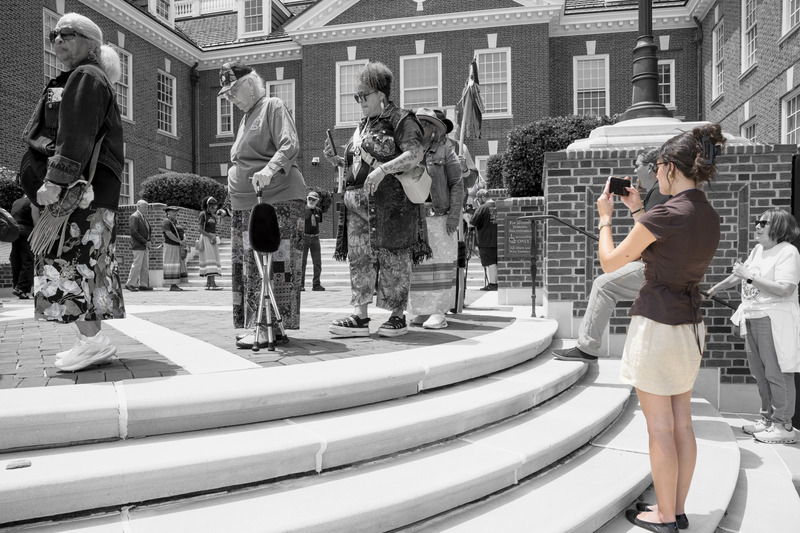
Packing up cameras and notebooks, the students left the pressroom to cover a peace walk and press conference local Indigenous tribe members and their supporters were holding in support of a bill that would establish a Commission on Indigenous Affairs. A short time later Cain, Grossberg and Weinhofer left for the House Appropriations Committee meeting.
“I hope we get to keep these when the program is over,” Rohman said, holding up her credential.
Contact Us
Have a UDaily story idea?
Contact us at ocm@udel.edu
Members of the press
Contact us at mediarelations@udel.edu or visit the Media Relations website