
Environmental solutions to community challenges
June 25, 2026
DENIN’s new Faculty Fellows support community-focused innovation
On any given day in Delaware, a farmer worries about changing weather patterns, a mayor examines floodplains in their coastal town and families grapple with rising expenses. As residents sit on the frontlines of environmental change, their experiences shape the work of researchers across the University of Delaware.
Across many UD units, work is underway to protect Delaware’s natural resources, engineer climate change resilience, improve environmental literacy and clean regional ecosystems, all of which is made possible by the input of neighboring communities and organizations. Delawareans play a central role in the development of these efforts; the challenges they face inspire initiatives and research projects, and their involvement helps create environmental solutions tailored to their needs.
Faculty and students regularly engage with Delaware communities all across their work, surveying residents to identify areas of focus, establishing collaborations with local experts and organizations, and sharing their findings throughout the process. Through continuous teamwork and outreach, this work reaches individuals who can best utilize Blue Hens’ knowledge and resources to make for more resilient, sustainable communities.
These shared efforts help UD provide resources, information and partnerships that prepare residents and local industries for long-term success in addressing environmental challenges well beyond the end of a project.
While plenty of projects continue to build environmental benefits for Delaware communities, there are always more problems waiting to be solved, and even more ideas brewing. For many professors, expanding this work often depends on one critical factor: funding.
Getting more projects up and running is part of the inspiration for the Delaware Environmental Institute (DENIN) Faculty Fellows program. This program gives professors up to $20,000 in funding to launch unique projects that foster environmental aid and innovation within their areas of interest and expertise.
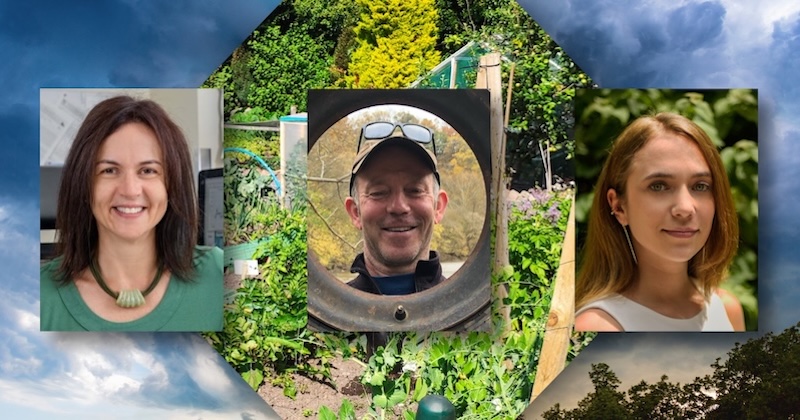
Three professors were recently selected for the Institute’s 2026 cohort, having pitched projects that foster environmental innovations, providing improved knowledge and resources to state residents and industries.
“I envision the University of Delaware as a leader in the progression toward a more climate-resilient, sustainable society,” said Kelsey Malloy, assistant professor in the Department of Geography and Spatial Sciences, and one of DENIN’s newest Faculty Fellows. “I applied to be a Fellow as an opportunity to challenge myself and other UD faculty to broaden perspectives on how climate information can be used for society’s benefit.”
Malloy is a regular collaborator with other disciplines and groups beyond UD, researching climate dynamics, prediction and risk assessments associated with extreme weather to better understand how these changes impact different markets and areas of study.
For her fellowship, Malloy intends to assemble teams of UD faculty to create climate risk assessments for three sectors: property insurance, public health, and renewable energy, all of which will involve partnerships beyond UD.
“This initiative requires co-production,” Malloy said. “Meaning that the initial question, methodology, interpretation and application of the research are all developed alongside the end users, to ensure the research is relevant, usable and actionable. As a climate scientist, I try to incorporate these interdisciplinary, co-production strategies into my own work. That way, the research becomes more societally relevant and innovative.”
Malloy’s assessments will help inform how local leaders in these sectors navigate necessary changes in the face of climate change’s ongoing impacts.
DENIN fellowship funding can also offer a significant boost to an existing effort, such as service work led by McKay Jenkins, an English professor who has been introducing UD students to environmental humanities and sustainable systems for the past 30 years.
“Over the last decade, and with DENIN’s ongoing support, I have worked hard to build relationships between the University and community leaders in Delaware and Maryland to support communities and train students,” Jenkins said.
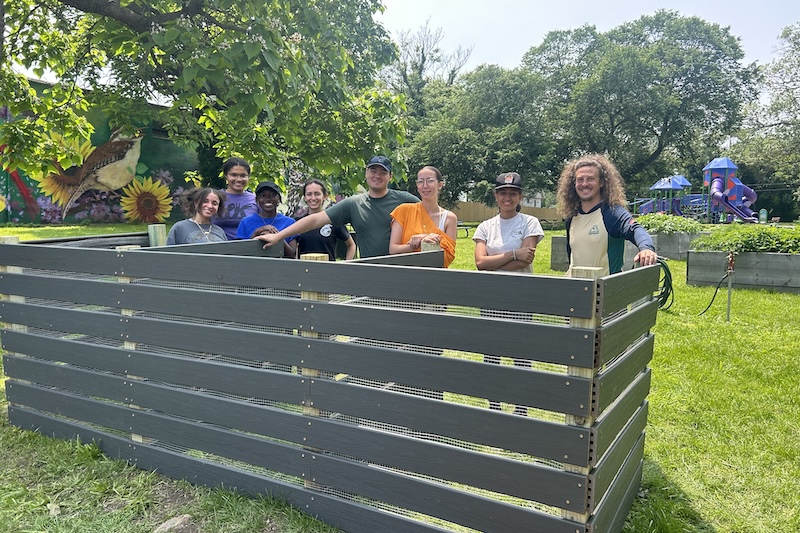
Jenkins’ work in environmental community engagement has led to longstanding partnerships with Baltimore’s nonprofit sector, work that he has introduced to many UD students. He has helped facilitate urban reforestation projects that have received national recognition, including an award from the U.S. Forest Service. Jenkins is also an active participant in food justice efforts, overseeing an urban farm that delivers one hundred pounds of produce to local food pantries weekly.
“Through their work on the farm, UD students get a close-up look at the history, politics and land-use policy that has left tens of thousands of Baltimore residents without access to healthy food, and study ways such structural problems might be sustainably repaired,” Jenkins said.
The DENIN fellowship will help support the next two years of Jenkins’ Community Engagement and Ecological Restoration Summer Scholars program. Jenkins’ interns connect with community partners, local non-profits and Lenape and Nanticoke tribal leaders on ecological restoration, equitable food and environmental education projects across Delaware and Maryland.
DENIN’s faculty fellowship has also inspired professors to act on passion projects, as is the case for Cristina Archer, the director of the Center for Research in Wind. Archer has observed that Delaware’s current forecasting infrastructure does not factor in subtleties in the state’s topography and is interested in creating a spatially aware system that would make for the state’s most accurate weather reporting infrastructure.
With her fellowship, Archer aims to bring this vision to life, creating an innovative weather prediction system that will generate new research opportunities for UD meteorology students, allowing them to incorporate new ideas and research techniques, including AI and machine learning.
Archer is enthusiastic about existing collaborations and connections that would bolster this effort, both within UD and beyond.
As a recent appointee to a joint faculty position at the Polytechnic University of Turin (PoliTO) in Italy, Archer also hopes to foster international environmental collaborations that provide unique learning and research opportunities for both students and faculty.
Extending research collaboration and environmental benefits is part of the core mission of DENIN. Since 2009, the Institute has been essential to UD’s growing impression on national efforts surrounding environmental conservation, resilience, and sustainability, assembling diverse teams of faculty, students, professionals and community members to help address crucial environmental issues.
“When you put together a bunch of experts in various fields and truly make the effort of going beyond what is normal to each, only then can you get an interdisciplinary team and really impactful research,” Archer said. “I think DENIN understands this very well, and that this approach takes time and resources that are not easy to access with normal funding channels.”
The work has already begun for the newest Fellows, with students hired for the summer to contribute to Archer’s weather forecasting system and Jenkins’ community projects.
“The DENIN team is grateful to work with faculty that are so enthusiastic about applying their knowledge to help Delawareans,” said DENIN Director Dr. Holly Michael. “We’re proud to sponsor such inspiring projects and I cannot wait to see the impact their work has.”
The 2026 cohort joins the previous 2025 cohort of Andong Cheng, John Jungck and Rosie Grayburn. Recruitment for the next cohort will begin in early 2027.
Contact Us
Have a UDaily story idea?
Contact us at ocm@udel.edu
Members of the press
Contact us at mediarelations@udel.edu or visit the Media Relations website