
A broader lens
Photos by Kathy F. Atkinson February 11, 2026
The first National Council for Black Studies graduate assistant gains deeper understanding of her culture and background
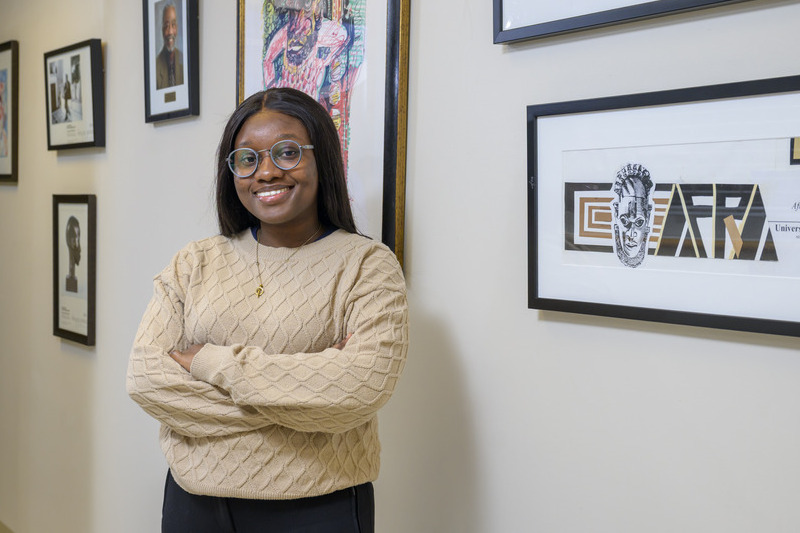
Growing up in Ghana, Lois Bilson didn’t know anything about the University of Delaware, but a Google search brought her to UD’s Department of Africana Studies in the College of Arts and Sciences.
“My background is in law, but I didn’t want another traditional legal program,” she said. “I was looking for a program that deals with culture, history and background, and Africana studies matched all of that.”
She didn’t know it at the time, but her decision to attend UD would also provide an inside look at the field of Africana studies itself, plus opportunities to connect with scholars across the globe. It would even help her learn something about her own Ghanaian culture.
Bilson, who is in her first year in the Africana studies master of arts program, also made history as the inaugural graduate assistant with the National Council for Black Studies (NCBS), which established its headquarters in the Department of Africana Studies in fall 2023 and is the discipline’s leading organization.
Meaningful work
The assistantship is designed to give students professional experience and a meaningful point of entry into the discipline’s network. Bilson’s application and legal background immediately stood out to Alica Fontnette, NCBS executive director and assistant professor.
“What impressed me was her lived experience as an attorney,” Fontnette said. “Lois is able to identify legalities and potential issues.”
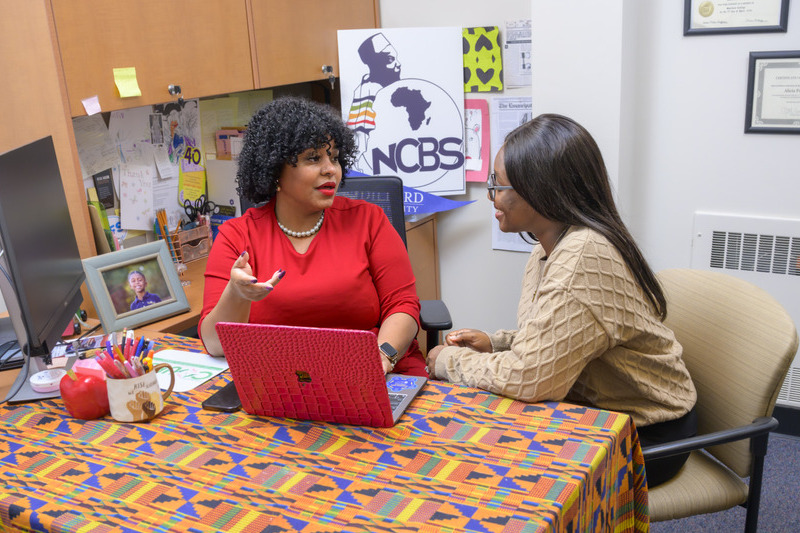
NCBS is currently planning its 50th annual conference, a milestone event set to take place in Baltimore this March.
Attending planning meetings gives Bilson a look at how a professional organization is structured, and it allows her to witness negotiations and be part of important conversations.
“Lois is in contact with our members worldwide, including major scholars in the field,” Fontnette said.
Bilson said working with NCBS is a meaningful way to enhance her academic experience.
“Working with NCBS, I see my studies come to life in our discussions and webinars,” she said. “It’s a different way to study and learn from scholars all over the country.”
Fontnette said that the assistantship also supports the importance of legacy, especially as NCBS plans to expand to international offices.
“We’re passing the baton to the next generation and instilling the importance and foundation of our work,” Fontnette said.
Bilson is poised to charter an NCBS Ghana community chapter when she returns after completing her degree.
Diasporic lens
The department began in 1971 as the “Black American Studies Program.” The name changed to “Africana studies” in 2017, reflecting a deeper understanding of the diasporic experiences of people of African descent throughout the world, not just in the United States.
“Blackness is not monolithic, and it is not something that Black Americans get to define,” Fontnette said. “There are characteristics that we may share globally with food, dance and storytelling traditions, but there are also many different experiences.”
As an international student, and a person from Africa, Bilson appreciates the global approach, and the department gives her the chance to explore topics tailored to the African context, including her own background as part of Ghana’s Fante community. This fall she worked on a project about Fante naming traditions, which include using specific names for the day of the week on which a child is born and the child’s birth order in the family.
“I’ve learned how Fante names were transformed during colonization, how certain things changed after the introduction of the English language,” she said. “I knew the names already, but I didn’t know the context.”
The Africana studies program also provides background for Bilson to understand how cultural and political systems came to be.
“I’ve learned how women, not just in America but also in Africa, have evolved, their fight for liberation and the unique positions they have historically found themselves in,” she said. “In Ghana, I looked at issues based on my environment, my perspective growing up, my family. Now being here, I have the opportunity to look at things from a different perspective. The diasporic lens has widened my scope and my ability to analyze and possibly solve the issues I want to work on.”
Getting to the roots
Bilson was encouraged to pursue her career, but she said there are places in Ghana where women still primarily remain in the domestic sphere, as well as areas where domestic abuse is common.
Before she attended law school, Bilson volunteered with local organizations, including Ohenewaa Advocacy, a group that visits schools to teach children that abuse comes in many different forms: physical, emotional, verbal and economic. She also volunteered with a church group called Kharis that supports unhoused mothers.
“I’ve always been passionate about humanitarian work and getting justice for women and children,” she said.
Her law practice focused on women and children’s issues, and she said that learning how systems are structured to either support or repress a population — something Africana studies focuses on — will help her represent clients and pursue justice.
She plans to return to her work in Ghana when she finishes her program at UD.
“If I don’t learn how an educational system started and how certain systems are in place, I will not be able to address the issues,” she said. “It would be like cutting the leaves of the tree when I’ve not gone to the roots.”
About the the National Council for Black Studies
Africana and Black studies departments began at universities as an intellectual extension of the 1960s era Civil Rights Movement, and NCBS was founded in 1975 to formalize the study of the African world experience, strengthen the academic discipline and promote social responsibility. Among the founders is Maulana Ron Karenga, chair of the Department of Africana Studies at California State University, Long Beach, and best known for creating the pan-African holiday Kwanzaa.
The council publishes the International Journal of Africana Studies and supports curriculum development for K-12 schools and higher education programs. The council’s annual conference hosts Africana scholars from institutions throughout the country.
Contact Us
Have a UDaily story idea?
Contact us at ocm@udel.edu
Members of the press
Contact us at mediarelations@udel.edu or visit the Media Relations website