





From problem to pitch
Photos by Evan Krape February 16, 2026
Nursing, athletic training students use design thinking to tackle real-world health challenges
It was well after midnight when Charlotte Rotter’s roommate was feeling sick. No one on their floor had a thermometer, and CVS had been closed for at least two hours.
“We felt helpless; there was nothing we could do,” said Rotter, a first-year nursing student.
In a first-year, honors-level nursing course, taught by Assistant Professor Michelle DePhillips and Associate Professor Xiaopeng Ji, Rotter had to identify a campus challenge — and immediately recalled that moment. As she collaborated with classmates, they realized:
“There’s nowhere after hours for students to access healthcare products,” said Jared Ramos.
Students were then tasked with devising a creative solution to their challenge — applying the concept of design thinking, a human-centered problem-solving approach that starts with empathy. Ji, a College of Health Sciences (CHS) Design Thinking and Innovation Ambassador, encouraged students to think outside the box.
“Nursing begins with listening to a patient’s concerns,” said Ji. “As healthcare providers, we must understand the end user’s lens and design interventions with and for them.”
After polling students on campus, a group of five honors students pitched a vending machine stocked with healthcare items, such as toothpaste, feminine hygiene products, ice packs and thermometers, on the first floor of every residence hall at the Big Ideas Challenge during the 2025 Blue Hen Innovation Fest. Students could scan a QR code for product and healthcare information and pay with credit, cash or flex points.
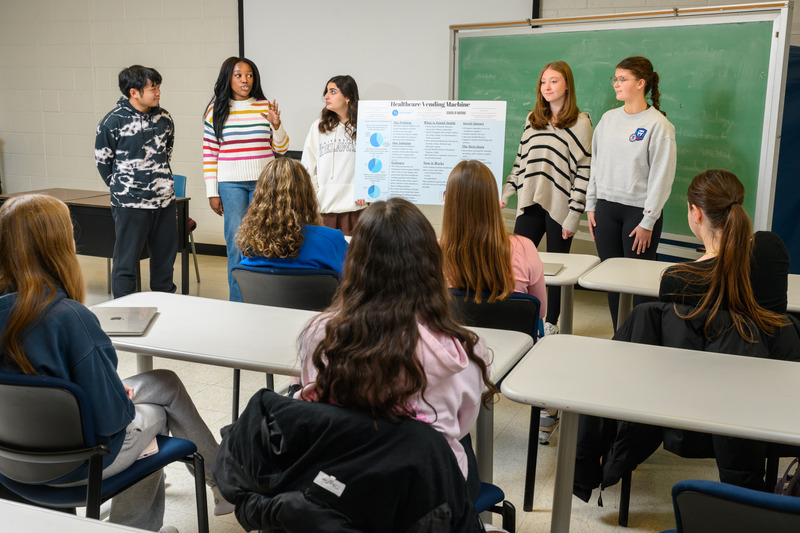
“This is a convenient and accessible way for students to get healthcare products 24/7,” said Ramos.
The students won second place and $250.
“It was intimidating going up against engineering and business majors,” said Kalisa Chambers, a Delaware native and first-generation college student. “But it was such a fun, rewarding experience.”
Their idea also caught the attention of Ted Foltyn, adjunct faculty in Horn Entrepreneurship at Alfred Lerner College of Business and Economics.
“Entrepreneurship is based on identifying and solving meaningful customer problems and telling a compelling story,” Foltyn said. “This group of freshman nursing majors focused on helping UD students gain access to much-needed items 24 hours a day — a need they identified and validated — and showed great enthusiasm in selling their idea. I immediately connected them with some of my entrepreneurship majors, who wanted to follow up and work on the idea.”
Students plan to repurpose existing vending machines on campus to save money and collaborate with Student Wellbeing to make their idea a reality. Student Wellbeing already operates a wellbeing vending machine with low-cost health supplies in Perkins Student Center, which is open until midnight every day.
“This experience showed me how much you can do with a nursing degree; we can help entire populations,” Rotter said.
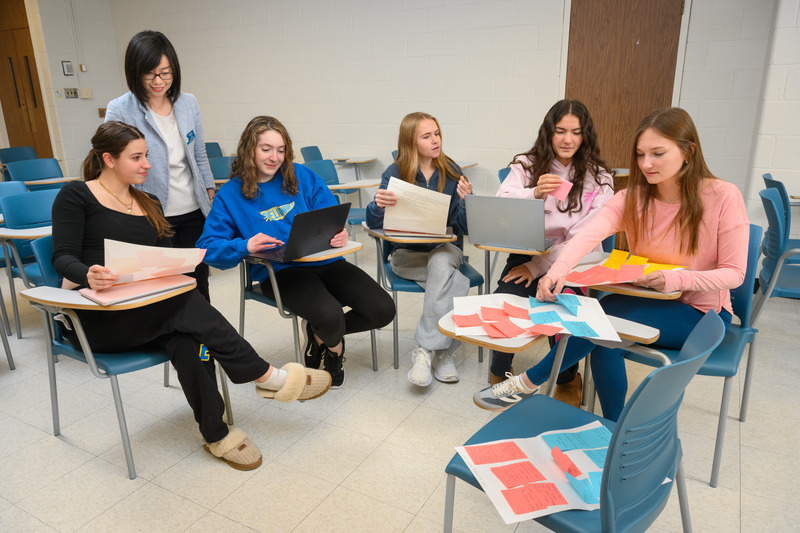
These students never considered themselves entrepreneurs. They were doing what nurses do every day on the front lines: helping others.
“Nurses are natural design thinkers,” said Ji. “While they need to implement evidence-based practices, nurses see what patients need and must have more say in tailoring interventions.”
Erin McCarthy and Alannah Crozier said design thinking will make them stronger nurses.
“Design thinking encouraged me to holistically look at patients and consider their family and background to see the whole problem,” McCarthy said.
“The experience built up my critical thinking skills,” said Crozier. “I plan to work at the bedside and will use design thinking to consider next steps and underlying issues.”
Applying design thinking in athletic training
CHS Design Thinking and Innovation Ambassador Saskia Richter, associate professor of kinesiology and applied physiology, is also employing the concept in graduate-level athletic training (AT) courses. In Senior Instructor Jeffrey Schneider’s fall practicum, which focused on emergency care, students spent a week tackling heat-related deaths in sports.

Students proposed ideas like “Smack-a-Towel,” a shake-activated cooling towel, and sweatbands that change colors as a player’s temperature rises.
“Design thinking primes your brain to think about various approaches and the best course of action. There may be more than one answer — but there’s always one better answer,” said Reilly Rhodes, a teaching assistant and second-year AT student.
Richter said students were so engaged in the process.
“They may be the only healthcare provider athletes see all year, and this got them thinking about creative solutions for the challenges they’ll face on the job,” said Richter.
Ji and Richter are working together to incorporate design thinking into the CHS curriculum.
“I would love to see a capstone option, where students from any health sciences major could work across disciplines to solve a real-world problem over a semester,” Richter said.
Contact Us
Have a UDaily story idea?
Contact us at ocm@udel.edu
Members of the press
Contact us at mediarelations@udel.edu or visit the Media Relations website