
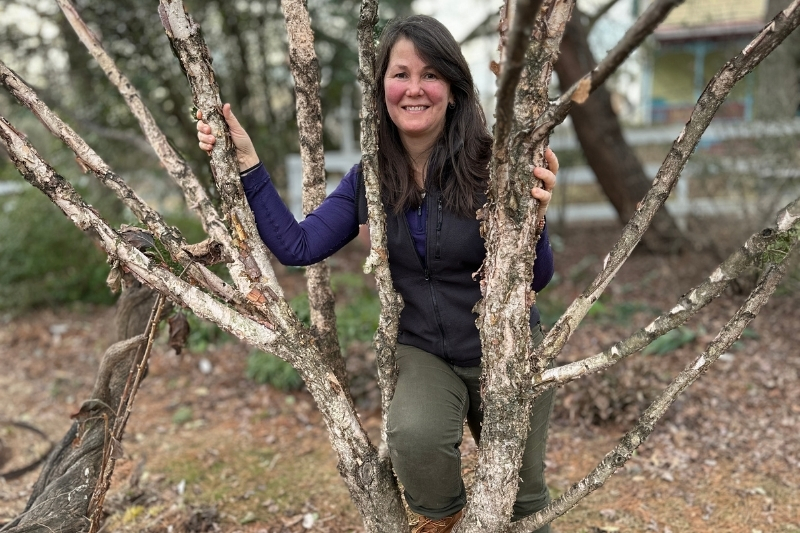
Growing resilience
Photos courtesy of Carol Long February 17, 2026
Alumna manages a century-old garden in the face of a changing climate
Nestled in the rolling hills of the Brandywine Valley, Winterthur’s wild gardens burst with exquisite color. Planted more than a century ago by horticulturist Henry Francis du Pont, the historic gardens date back to the early 1900s. This year, Winterthur celebrates its 75th anniversary; the estate was incorporated as a museum in 1951. Today, the 60-acre garden remains a place of verdant beauty, a testament to the resilience of the natural world.
The ability of some plants to adapt and recover in the face of adversity fascinates Carol Long, a University of Delaware Class of 1990 distinguished alumna. Long is the garden manager at Winterthur, where she’s worked in the gardens for 34 years.
“I’ve started focusing on plant resilience,” Long said. “Can a plant withstand what the environment is throwing at it? Of course, there’s still the issue of beauty — we are an ornamental garden, and all plants have their own version of beauty — but plant resiliency will be an important component in how we keep gardens green in the future.”
To design the gardens at Winterthur, H.F. du Pont worked with his friend, landscape architect Marian Cruger Coffin, who designed the campus plan for the University of Delaware. Three generations of the du Ponts have gardened at Winterthur since 1839.
A lot has changed over the last century. Today, the garden is facing challenges due to changing environmental conditions.
“There are a lot of environmental changes that we’re having to deal with — a lot of heavy rains,” Long said. “The velocity at which it comes down is difficult for the plants.”

Long oversees a staff of 10 horticulturalists and is responsible for Winterthur’s naturalist gardens, which are renowned as a masterpiece of color and design. She says resilient plants do not necessarily have to be native plants.
“It’s plants that work well with one another. They could be from Europe, Japan or the U.S., but they all kind of co-mingle,” Long said. “Many of the plants here at Winterthur have endured for over 100 years. They have a nice track record of longevity.”
Still, even resilient plants may not be prepared for climatic shifts. In 2023, the U.S. Department of Agriculture (USDA) released an updated version of its Plant Hardiness Zone Map (PHZM), based on 30-year averages of the lowest annual winter temperatures by region. Delaware, along with other areas, saw a zone change with the latest map, affecting which plants can thrive in the region.
“We’re now zone seven, a zone warmer than we used to be,” Long said. “We’re seeing that little bit of heat taking a toll on some of the plants.”
Long has a unique outlook on gardening. She thinks long-term, pivoting with whatever the season has in store. A rainy autumn may delay specific tasks until spring, but Long takes it all in stride at both Winterthur and in her expansive home garden, a pet project for 25 years and counting.
“I could garden 24/7. I love it,” Long said. “Part of the joy of gardening for me is the process of tending the garden, and the other part is just observing how wildlife use it. I feel as though I’m working along with nature.”
In addition to gardening for work and as a hobby, Long volunteers at the University of Delaware Botanic Gardens' plant sales. She has served as both president and vice president of the Friends Group for the UD Botanic Gardens.
One issue that has come to the forefront over the past year is beech leaf disease. First detected in the U.S. in 2012, the disease is now spreading rapidly in the region. Beech leaf disease is caused by a microscopic nematode. Portions of the Winterthur grounds are part of the Old-Growth Forest Network and home to some of the oldest trees in Delaware.

“It can take a major canopy tree maybe six years to die,” Long said. “Looking out my window now, I can see the light dancing on the beech leaves. Potentially, in 10 years, this view could change a lot.”
But Long has a resilient mind.
“I’d like to think that in this canopy of beech trees, maybe there is one that is resistant to disease,” Long said. “I think there’s always the little glimmer of hope.”
Long sees great hope in the horticulturists of the future. At Winterthur, she provides hands-on experience to UD student interns exploring careers in the field. Long also visited courses in the UD College of Agriculture and Natural Resources to speak about her career path or participate in student workshops. She suggests that UD students equip themselves to meet industry challenges by deciding how they can best contribute.
Long considers herself a generalist. She needs to have knowledge of many related topics, such as plant propagation, entomology and soil science.
“Whether a student is built like me and wants to be a generalist, or if that student wants to try and solve a specific problem, there’s a lot of research potential for students, and it just depends on what they’re interested in and how they want to be involved,” she said. “Every conflict is an opportunity for someone to try and figure out a solution.”
Long names conserving the native tree canopy, slowing floodwaters and mitigating disease as subjects in need of study and solutions.
“Maybe there is a student who wants to study beech leaf disease with the specificity of trying to find that disease resistance,” Long said. “I would love for a person to spend a lifetime figuring out how to keep our trees healthy from diseases.”
Whether you’re a generalist or a specialist, staying resilient in the face of changing environmental conditions is essential.
“You could look at what we’re being bombarded with and be upset about it,” Long said. “Or you could look at it and say, ‘I’m going to be a part of this solution.’”
Contact Us
Have a UDaily story idea?
Contact us at ocm@udel.edu
Members of the press
Contact us at mediarelations@udel.edu or visit the Media Relations website