




History-shaping museum exhibits
Photos by Kristopher Raser February 13, 2026
Explore the history of Black freedom, fashion, photos and quartz
The University of Delaware’s Library, Museums and Press invites you to explore exhibitions on view this semester in gallery spaces across UD’s campus.
Visitors will:
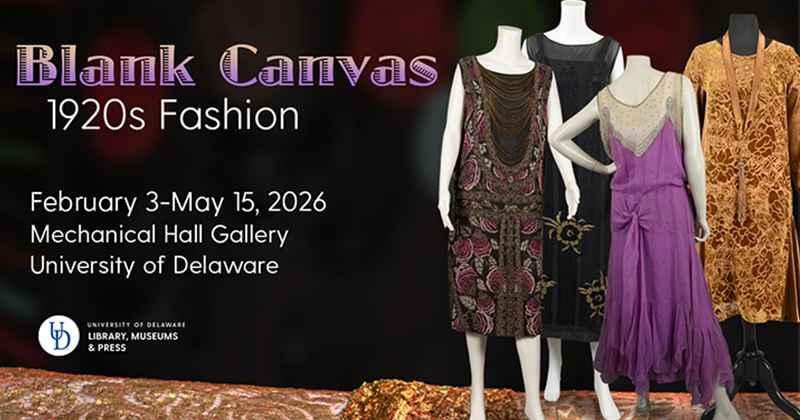
View more than 60 garments in the Blank Canvas: 1920s Fashion exhibition, drawn from the Fashion and Textile Collection in the Fashion and Apparel Studies Department, along with digital twins, virtual reproductions of selected fragile garments.
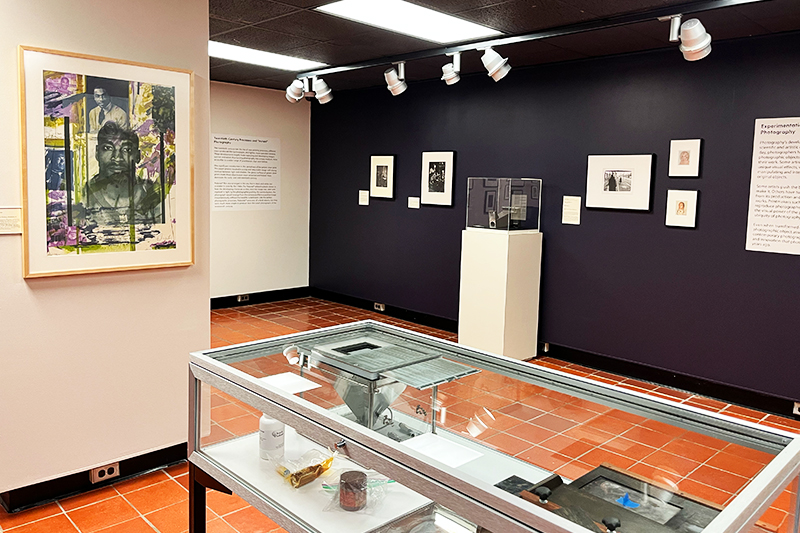
Be reminded by the Photo / Object exhibition, that in this era of quick digital photography captured on a daily basis with cell phones, photographs are real objects made from physical materials, enabling us to revisit our relationship with this artistic medium.
Celebrate the 250th anniversary of American independence through the Lifting As We Climb exhibition which chronicles the resilience of Black communities during the late 19th and early 20th centuries.
Marvel at the recent Quartz acquisitions and learn more about a “mystery” crystal given by Quaesita Drake, a chemistry professor, for whom Drake Hall is named.
Explore an array of stunning lead minerals from around the globe, including specimens from Australia, Namibia, Morocco and the United States in The Vibrant World of Lead Minerals exhibition.
View a unique installation of the UD Library, Museums and Press’ mineral and art collections in Old College’s Main Gallery and rarely seen treasures from an ancient art collection.
All exhibitions are free and open to the public. There are also many online exhibitions available for exploration and discovery.
Read on for more information about each exhibition.
Blank Canvas: 1920s Fashion
On view in Mechanical Hall Gallery from Feb. 3 through May 15, 2026
Blank Canvas: 1920s Fashion explores how the chemise silhouette offered limitless creative possibilities for conveying the 1920s zeitgeist. Described as tubular or vertical, the chemise hangs straight from the shoulders, generally fitting loosely, with occasional decorative emphasis at the hips. It emerged as armor for the new modern woman, providing a platform to communicate their identity and ideals.
In contrast to the restrictive Edwardian styles of the early 1910s, the chemise silhouette was more functional, offering women greater freedom of movement through its simpler shapes and rising hemlines. This simple silhouette and its variations provided a means of self-expression aesthetically, socially and culturally, as this period witnessed significant changes in women's clothing, driven by industrialization, women's suffrage and various artistic movements.
Fabrics and designs drew inspiration from Art Deco, jazz culture, Egyptian, African, Eastern European and Asian traditional dress, allowing women to convey their global awareness. At the same time, the expanding ready-to-wear industry made fashionable clothing more accessible than ever. Together, these forces cemented the 1920s as a pivotal moment in which clothing became a powerful medium for expressing individuality and freedom.
This exhibition was curated by Jan Gardner Broske, UD Museum's collections manager and curator; Belinda T. Orzada, professor in fashion and apparel studies; Dilia López-Gydosh, assistant professor in fashion and apparel studies and director of the historic costume and textiles collection; and Kelly Cobb, associate professor in fashion and apparel studies.
Mechanical Hall Gallery is open Tuesday through Friday from 10 a.m. to 4 p.m.
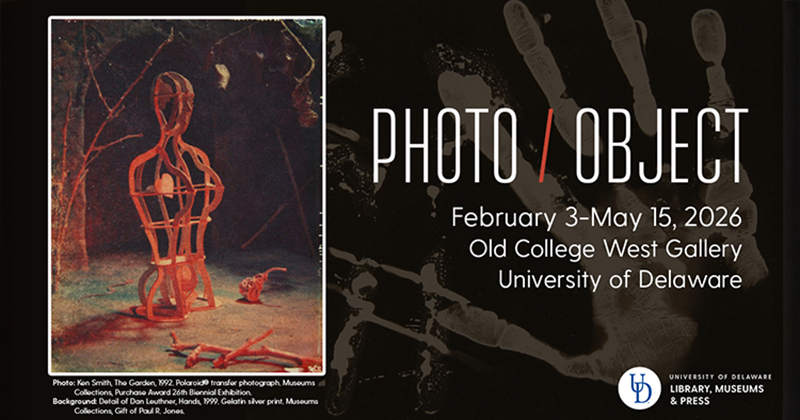
Photo / Object Exhibition
On view in Old College West Gallery from Feb. 3 through May 15, 2026
Since the invention of photography around 1839, it has become ubiquitous in our daily lives thanks to the availability of powerful instant cameras in our pockets. Photographs may literally be “written with light,” capturing a moment and place in an instant flash. Yet, they are also so much more: they are intricate material objects entangled in systems of extraction, motion and collection.
Photo/Object gathers a wide range of processes and formats from repositories across the University of Delaware’s campus. These photographs take up space and invite us to remember that they are real objects made from physical materials, enabling us to revisit our relationship with this artistic medium.
This exhibition was guest curated by Victoria S. Kenyon, a previous graduate research assistant for UD Museums.
Old College West Gallery is open Tuesday through Friday from 10 a.m. to 4 p.m.

Lifting As We Climb: Churches, Schools and the Formation of Delaware's Free Black Communities
On view in Morris Library’s Information Room from Feb. 2 through Aug. 7, 2026
Against a backdrop of limited rights and opportunities for Black Americans, this exhibition examines how churches and schools fueled the formation and development of Delaware’s free Black communities in the years leading up to and following the American Civil War.
Through photographs, books, pamphlets and event programs, visitors will explore the rich and dynamic history of the Black church as a foundational educational institution, as well as the remarkable influence and activism of Black women working to expand educational opportunities, often in partnership with the independent Black church. Recognizing that 1776 is the beginning, not the end, of our American story, we invite you to discover how African Americans in Delaware built community, promoted education and thrived at the turn of the century in their ongoing pursuit of life, liberty and the pursuit of happiness.
Credits: This exhibition is curated by Kallie Comardelle, doctoral student from the Department of English, and Dhazhea Freeman, graduate student from the Department of Africana Studies, with support from Hillary Kativa, associate librarian and department head, Special Collections. Comardelle and Freeman’s curatorial work was supported by a grant from Delaware 250.
This exhibition can be viewed on the first floor of Morris Library during the Library’s regular hours.

Quartz
On view in the Mineralogical Museum in Penny Hall from Feb. 3 through May 15, 2026
Quartz is the second most common mineral in the earth’s crust. It comprises the majority of sand beaches in the world due to its abundance, hardness and resistance to erosion. It also forms crystals which can be very large. Although often transparent or white, other color varieties include amethyst (purple), citrine (yellow-orange) and gray or black (smoky). This exhibition includes recent acquisitions, an important specimen from Pennsylvania, early DuPont collection examples, and a “mystery” crystal given by Quaesita Drake, a chemistry professor, for whom Drake Hall is named.
This exhibition was curated by Sharon Fitzgerald, curator of UD’s Mineralogical Museum.
The Mineralogical Museum is open Tuesday through Friday from 10 a.m. to 4 p.m.

The Vibrant World of Lead Minerals
Lead may be best known for its dull, gray appearance, but in the mineral world, it reveals a far more dazzling side. The Vibrant World of Lead Minerals invites you to explore the unexpected beauty of lead-based minerals — brilliant, colorful and captivating specimens that defy the element’s ordinary reputation.
From vibrant mimetite to sparkling galena, lead plays a surprising role in the formation of eye-catching minerals. Even in everyday objects, its influence is seen — like in leaded glass, or crystal, which owes its signature sparkle and weight to the presence of lead.
A highlight of the collection is a remarkable bright yellow mimetite from Mexico, sourced from the long-shuttered Congresso Mine. In 1968, mineral dealer Benny Fenn descended 900 feet into the abandoned site and discovered a hidden chamber, 40 by 20 feet, lined with vivid yellow crystals. After months of careful extraction, the mimetite specimens debuted at mineral shows by the hundreds — today, they are prized rarities.
The Mineralogical Museum is open Tuesday through Friday from 10 a.m. to 4 p.m.
In addition to these special exhibitions, visitors can view a display of objects from the Museums Collections in the Old College Main Gallery and selections from the Mineralogical Museum's permanent collection in the Mineralogical Museum in Penny Hall.
Contact Us
Have a UDaily story idea?
Contact us at ocm@udel.edu
Members of the press
Contact us at mediarelations@udel.edu or visit the Media Relations website