
Healing through words
Photos courtesy of Peggy Healy June 01, 2026
UD doctoral students bring the power of writing and storytelling to YWCA Delaware families
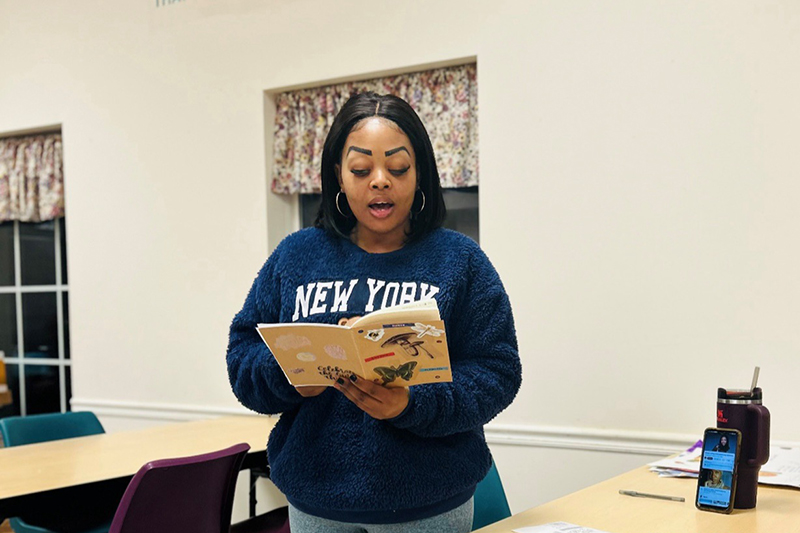
It’s 6 p.m. on a spring Thursday. The late afternoon sun filters through the windows of YWCA Delaware’s Home-Life Management Center, and the hum of quiet conversation slowly replaces silence as people file in for the final session of a five-week writing course.
Led by doctoral student Holli Flanagan, with assistance from English graduate students Jasmine McCray, Sara Rodia and Ashlan Stewart, the program uses creative writing as a pathway to reflection, healing and self-discovery for participants in the YWCA’s emergency and transitional housing program.
The organization serves thousands of Delaware women and families each year through education and employment classes, a 24/7 Sexual Assault Crisis Response Center and community housing programming, which allows families, including dads and partners, to stay together.
“We wanted to do something to support the broader community,” said Flanagan, who holds the 2025-2026 Doctoral Fellowship for Excellence in the Department of English in the College of Arts and Sciences. “A lot of our YWCA students are women who have experienced a lack of affordable housing, extreme poverty, who have survived domestic or sexual violence, or have been involved in the justice system. It’s a unique community.”
The YWCA’s mission, "Eliminating Racism, Empowering Women and Promoting Peace, Justice, Freedom and Dignity for All” resonated with Flannagan, whose research focuses on believability in women’s memoirs.
“Our current socio-cultural moment actively impacts our ability and desire to identify ‘truth’, especially when and how we believe women,” she said.

A classroom beyond campus
To develop the course, Flanagan drew on scholarship of writing practices in therapy and social justice and focused on themes of healing and joy.
“The goal isn’t to get a grade or get credit,” she said. “This is to help people discover if writing can be a good emotional outlet and provide comfort.”
That intention is evident in the room. During one session, participants reflected on Audre Lorde’s poem, A Litany for Survival, which they had read and written about the week before. One participant describes the poem as a kind of communal prayer, prompting a discussion about truth-telling and the courage to speak openly.
This is to help people discover if writing can be a good emotional outlet and provide comfort.”
-Doctoral student Holli Flanagan
Not every exercise was that successful. During an early session, a participant told Flanagan she hadn't written anything because the prompt was overwhelming and she didn’t know what to do.
“That challenged me as an educator to question what went wrong,” Flanagan said. “Sometimes we teach a lesson and just expect students to do the work. This experience taught me to pause and adjust to what the student needed.”
Flanagan said she will carry that flexibility into traditional classroom settings and encourage students to be themselves in their writing.
“Even in rhetoric or composition, students can explore their own experiences,” she said. “I reject the idea that academic writing has no place for that.”
Creating a safe space
YWCA Delaware family services manager Valerie Edwards said she encouraged clients to take advantage of the opportunity to enjoy the workshops and learn more about themselves.
“We all have hardships. We all have a story to tell. This is a safe space where we can heal through the power of writing,” she said.
Flanagan added that she emphasises privacy and autonomy for the class.
“The first night there was concern that we were there to just read about other people’s trauma,” she said. “So I made it clear that nothing is graded, and I would never read anything that they didn’t want me to read.”
She explained that making privacy a key element of the learning environment — removing the expectation to share — helped people feel more comfortable about being vulnerable and sharing their writing.
Flanagan worked closely with YWCA staff to find out what participants would benefit from and what writing styles would be helpful, and develop prompts.
“I’m so grateful for the guidance the YWCA gave,” she said. “It’s an important part of the program because part of writing is building community in and of itself.”
Listening to feedback from participants was important. One father, balancing a new job and caring for his son, declined to share, saying he was too nervous to read in front of people, and adding that he prefers rap to poetry. This sparked a conversation about rap as a form of storytelling and designing a future session to explore rap lyrics as poetry.
The power of empowering
The course embodies the YWCA’s commitment to education and empowerment, and it is a reminder of a long-standing UD connection: Hilda A. Davis, the first Black full-time faculty member at UD, was a longtime YWCA Delaware supporter. Davis’s legacy still inspires the organization’s mission, including helping clients rebuild their lives through the healing power of writing.
The initial five-week course was so successful, the YWCA is currently running an expanded 10-week session, and will offer another session in the fall, which will be led by Rodia, a second-year English graduate student, along with Stewart and McCay, who are first-year graduate English students and scholars in the African American Public Humanities Initiative.
By that time, Flanagan will have become a faculty member at Landmark College in Vermont, where she will apply her experience to teaching neurodiverse students and students who learn differently.
She also plans to develop writing-related programming for vulnerable communities in Vermont.
“Education doesn’t just belong in the four walls of the academy,” Flanagan said. “If we aren't taking it into the community, then what are we doing it for?”
Contact Us
Have a UDaily story idea?
Contact us at ocm@udel.edu
Members of the press
Contact us at mediarelations@udel.edu or visit the Media Relations website