




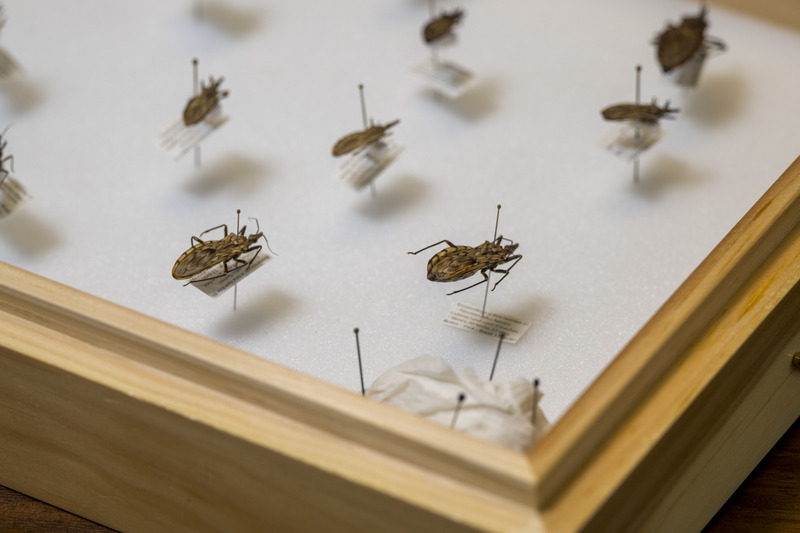
The mystery of a well-traveled kissing bug
Photos by Kathy F. Atkinson and courtesy of Jennifer K. Peterson August 28, 2026
University of Delaware study details the finding of the first known live kissing bug in Europe
On an August morning last year, an American couple soon to embark on a European river cruise awoke in a luxury hotel in Lisbon.
Staring back at them from the headboard was a bloodsucking insect.
It wasn’t a mosquito. It wasn’t a bedbug.
The couple captured the bug in a tissue. Suddenly, bright red blood oozed out, a sign that the insect had fed recently.
They wondered: Could it have bitten them while they slept?
Their alarm only grew when one of them noticed a dark brown streak on their arm and finger. The insect’s feces, perhaps?
They’d later learn the culprit was an adult female kissing bug.
More than half of all kissing bugs travel with an accomplice — a parasite called Trypanosoma cruzi. The parasite causes Chagas disease which can lead to serious heart problems. T. cruzi is transmitted through the insect’s feces rather than its bite.
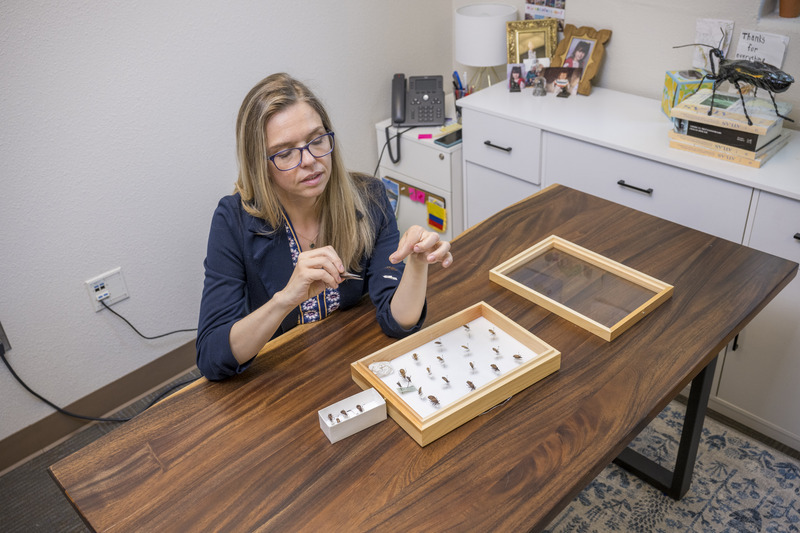
But how did this particular species of kissing bug, native to the southwestern U.S. and northwestern Mexico for its dry, desert-like climate, get to Portugal?
That question became the centerpiece of a scientific investigation led by UD assistant professor and medical entomologist Jennifer K. Peterson and her team of Blue Hen sleuths. Students in her Fall 2025 Medical Entomology (ENWC 410/610) class donned their detective hats and helped investigate what appears to be the first documented live kissing bug in Europe. Their findings were recently published in the journal Parasites and Vectors.
A bug’s life
When the couple returned to their East Coast home, they brought the now-dead specimen with them in a jewelry box. They reached out to Peterson for identification.
“When they first contacted me, I was super skeptical,” Peterson said. “My first response was, ‘Is there a Lisbon, Delaware? Because they can’t be referring to Lisbon, Portugal.’”
Peterson and colleagues identified the insect as a species of kissing bug, Hospesneotomae protracta, native to the southwestern U.S. and northwestern Mexico.
She brought the story to her Medical Entomology (ENWC 410/610) class and told her undergraduate and graduate students, “You’ll never believe this.”
The insect traveled a 5,000-mile transatlantic journey. Could it have stowed away aboard a cargo shipment? Did it hitchhike in somebody’s suitcase and take an international flight?
No one knows how it got to Portugal.
Portugal imports hundreds of millions of dollars in U.S. agricultural products each year, and more than 2 million American tourists visit the country annually. Any number of pathways could explain its remarkable journey.
“This case demonstrates they are hardy enough to survive that journey and then continue on to do what they biologically do, which is, basically, eating,” Peterson said.
Six weeks after the incident, the American couple was tested for T. cruzi antibodies, which would indicate exposure to the parasite.
The results showed the couple was not infected; their worries were over. But for medical entomologists like Peterson, the case was far from over.
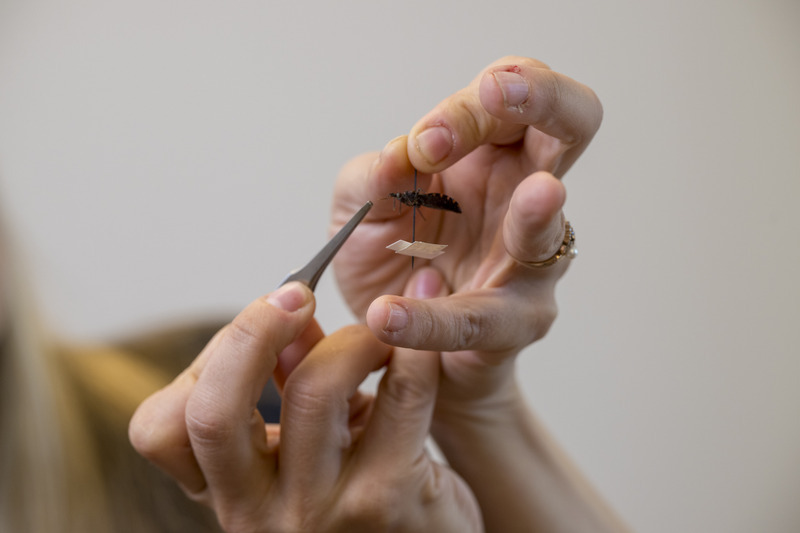
Medical entomologists in training
Rather than simply presenting the case to her students, Peterson turned it into a collaborative class research project.
She gave her class the basic facts and challenged students to investigate the insect’s biology, identify other hitchhiking cases and explore how the kissing bug might have reached Europe. She then combined the strongest elements of their work into one research paper.
“Writing, peer review and publishing are such a huge part of being a researcher,” Peterson said. “As university academics, it’s our bread and butter. I wanted students to experience that process from beginning to end.”
Sarah Sharp, a senior studying insect ecology and conservation, wasn’t familiar with kissing bugs before she took Peterson’s class.
“What stood out to me was how aware the people who found the insect were,” Sharp said. “They knew to send it somewhere like the University of Delaware, where we are actively studying this insect.”

To Hunt Kinnaird, a UD Class of 2025 environmental science graduate and current master’s entomology student in Peterson’s lab, the case was a great experience in “digital detective work.”
“Our job was to explain why this matters and investigate how the kissing bug could have traveled so far,” Kinnaird said. “I looked at global trade. It’s fascinating that either international commerce or human travel can move an insect thousands of miles beyond its natural range.”
Increasing awareness
The Lisbon case illustrates how easily this insect (and others) can travel across the globe.
It’s even a small reflection of the past.
The tiger mosquito, native to Southeast Asia, hitchhiked its way on a trade shipment to the U.S. in the 1980s. Now it’s pervasive across more than half of U.S. states, including Delaware. This kind of mosquito can carry pathogens that cause West Nile virus, Zika virus and other mosquito-borne diseases.
Peterson said when any insect that can transmit pathogens or parasites journeys outside of its usual range, there can be medical consequences. Especially if the insect is able to lay eggs and start an infestation. In the case of the adventurous kissing bug, it was not carrying the parasite that causes Chagas disease.
The next one might.
“This particular kissing bug was not infected with T. cruzi, but others could be,” Peterson said. “What we don’t want is to see kissing bug populations in places where they aren’t. Because once that takes off, they’re really tough to eliminate.”
She hopes customs officials, border patrol agents and others who monitor for agricultural pests will become more familiar with kissing bugs.
The paper, Live triatomine bug, vector of Trypanosoma cruzi, found engorged in Lisbon hotel room: A first for Portugal and for Europe was authored by Jennifer K. Peterson, Alexander R. Kelley, Trinity Antoszewski, Madeline Brown, Hanna Cortes, Peyton I. Easton, Grace Ferry, Thoburn Freeman, Cate Freiwald, Erik Hagen, Hunt Kinnaird, Luna Lewin, Malaki Lewis, Jessie McNulty, Natalie Moore, Erin Mullis, Stella Pettit, Luke Schultz, Sarah Sharp, William Stocker, Jillian Tunstall of the University of Delaware and Jader de Oliveira of the Department of Entomology, National Museum of Natural History, Smithsonian Institution.
Contact Us
Have a UDaily story idea?
Contact us at ocm@udel.edu
Members of the press
Contact us at mediarelations@udel.edu or visit the Media Relations website