
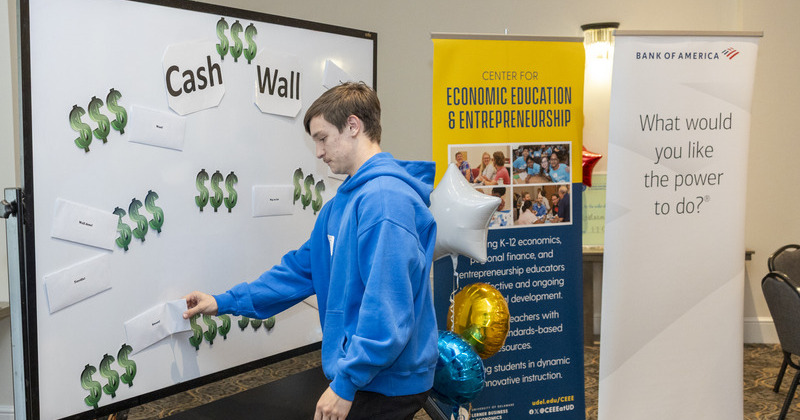
Preparing Delaware students for lifelong financial skills
Photos by Maria Errico and courtesy of Federal Reserve Bank of Philadelphia April 09, 2026
UD’s Keys to Financial Success program will support statewide rollout of financial literacy requirement with classroom materials and teacher training
When Delaware passed House Bill 203 (HB 203), it established a new graduation requirement guaranteeing students access to a core life skill: All students entering ninth grade in the 2026-27 school year and beyond must complete a financial literacy course aligned with state standards. For Delaware educators, the law signifies a commitment to their students’ futures, equipping them with personal finance knowledge and preparing them to become financially responsible citizens outside of the classroom.
The legislation formalizes work that has been underway in Delaware schools for decades, pioneered through programming by the University of Delaware’s Center for Economic Education and Entrepreneurship (CEEE) and supported by the efforts of teachers.
“As an educator, this bill validates the incredible work that has been happening up and down the state,” said Kylee Holliday, a personal finance teacher at Delaware AI duPont High School, member of the CEEE support team and a graduate of UD's economics and entrepreneurship for educators program. “It will also help to ensure that teachers have continued access to high-quality curriculum and professional development.”
Holliday’s own financial literacy courses have benefitted from Keys to Financial Success, a research-based personal finance curriculum developed with educators and implemented in classrooms statewide.
Created in 2001 through a partnership with the Federal Reserve Bank of Philadelphia, the Delaware Council on Economic Education and the Delaware Bankers Association, Keys has evolved alongside changes in research, policy and classroom practice. During the 2025–26 academic year, the curriculum is being updated as Keys to Financial Success 5.0 to support teachers and schools ahead of the statewide implementation of HB 203. The program combines classroom-ready materials with professional development, including summer training and ongoing instructional support.
A partnership rooted in local expertise
For Gail Colbert, CEEE’s personal finance coordinator and a graduate of UD’s master of arts in economics and entrepreneurship for educators program, collaboration with the Federal Reserve Bank of Philadelphia has been a defining feature of the program’s development.
“Working with the Philadelphia Fed allows us to align research, classroom practice and Delaware’s standards,” Colbert said. “That connection has shaped how the curriculum functions in real classrooms.”
The program is supported by UD alumni and educators, including Andrew Hill, assistant vice president at the Federal Reserve Bank of Philadelphia and a UD doctoral graduate in economics, along with a team of educators trained through UD programs. Their work draws on classroom experience as well as research expertise.
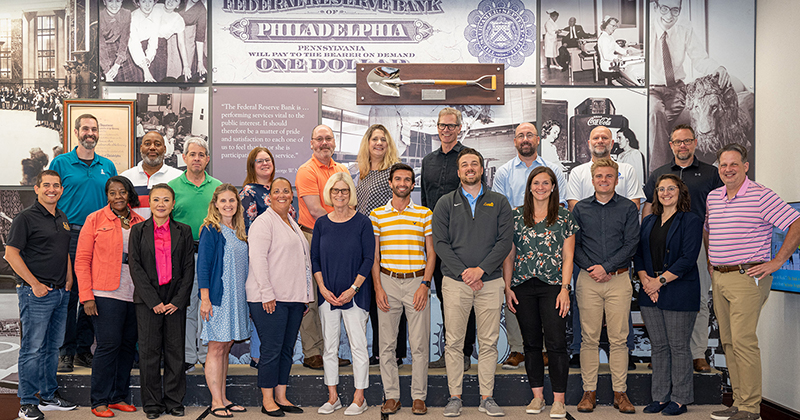
Todd Zartman, economic education manager at the Philadelphia Fed and a graduate of UD’s economics and entrepreneurship for educators program, said the curriculum’s flexibility is key to its classroom use.
“The lessons are designed to meet students where they are,” Zartman said. “They encourage students to make connections between economic concepts and decisions they see in their own communities.”
Barbara Emery, who joined CEEE when the program launched, said Keys was designed to emphasize application, not memorization.
“Understanding how to use financial information expands students’ choices,” Emery said. “That has always been central to the course.”
Connecting research and practice
Research by James B. O'Neill Director Carlos Asarta and Elementary School Program Coordinator Bonnie Meszaros of CEEE, along with Hill, published in the International Review of Economics Education, found that students demonstrate significant gains in personal finance knowledge when the Keys curriculum is taught as a semester-long course by trained educators. Additional research published in the International Handbook of Financial Literacy shows that the curriculum and training model also reduces gender gaps commonly found in financial literacy outcomes.
Rebecca Chambers, economic education adviser at the Philadelphia Fed and a UD doctoral alumna in economic education, said the program benefits from ongoing feedback between researchers and teachers.
“Classroom experience informs the research, and research informs the classroom,” Chambers said. “That exchange is essential.”
Preparing teachers for implementation
As the state moves toward full implementation of HB 203, CEEE and its partners are expanding professional development opportunities for teachers during the transition period. Training focuses on both content and instructional strategies, helping educators feel prepared to deliver the curriculum while also strengthening their own financial understanding.
Emery noted that the benefits of training often extend beyond student outcomes.
“Teachers frequently tell us they gain knowledge they hadn’t previously received formal training in,” she said.
Meaghan Vitale, an economic education specialist at the Philadelphia Fed and a UD doctoral student, said teacher feedback plays a critical role in refining the program.
“We listen closely to teachers about what works in their classrooms,” Vitale said. “That helps us adapt lessons to current school environments.”
Classroom impact
Holliday said the curriculum supports both conceptual understanding and practical application.
“Lessons like ‘A Tale of Two Savers’ help students see the long-term effects of everyday choices,” Holliday said. “They begin to understand how saving, spending and opportunity cost affect future outcomes.”
She added that the curriculum’s structure supports consistent implementation across classrooms.
“The materials are aligned with Delaware’s standards and ready to use,” Holliday said. “That consistency matters.”
As HB 203 moves from policy to practice, Keys to Financial Success 5.0 represents a transition from long-standing classroom work to statewide implementation. Built through sustained collaboration among educators, researchers and partners, the program provides a framework for financial literacy instruction as Delaware prepares to make personal finance education part of every student’s path to graduation.
Contact Us
Have a UDaily story idea?
Contact us at ocm@udel.edu
Members of the press
Contact us at mediarelations@udel.edu or visit the Media Relations website