
Building leaders, strengthening the workforce
Photos by Maria Errico and courtesy of Pinki Mondal and Gulni Ozbay April 29, 2026
EPSCoR, INBRE funding serve vital role in Delaware STEM research workforce and biomedical research
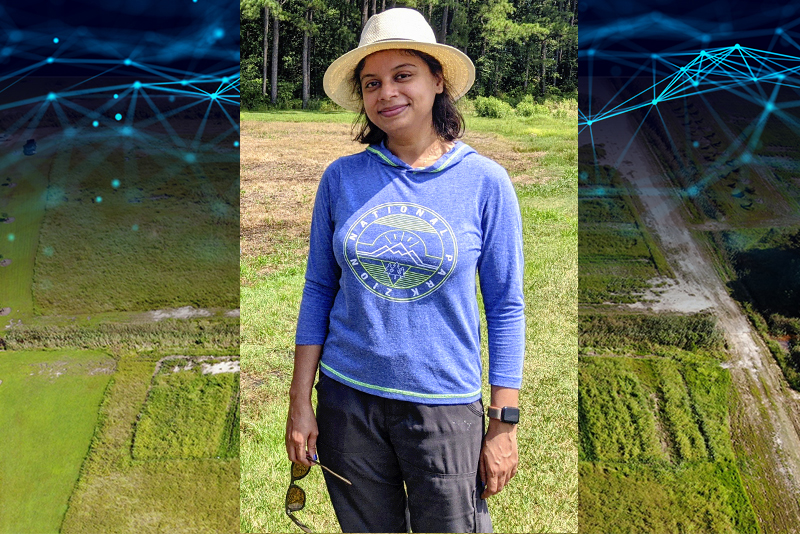
Using satellites orbiting hundreds of miles above Earth, Pinki Mondal is tracking changes on the ground.
An associate professor of geography and spatial sciences at the University of Delaware, Mondal uses remote sensing to study shifting landscapes in India, Vietnam and Sierra Leone — and now, through seed funding from the Established Program to Stimulate Competitive Research (EPSCoR), the creeping reach of saltwater in Delaware.
Saltwater intrusion is a global process that manifests locally, when fresh water and seawater meet in surface estuaries or underground, causing fresh water to become saltier. In a coastal state like Delaware, this can be particularly problematic for agriculture, leading to saltier soils and declining crop yields.
Mondal and a team of students collected images and data points to understand the problem from both a large- and fine-scale lens and ultimately developed an app to map salt patches that can occur when high salinity is present on coastal farmlands. She discussed the work, which has the potential to inform researchers, farmers and community members alike, at the inaugural statewide research symposium hosted by Delaware EPSCoR and the Delaware IDeA Network of Biomedical Research Excellence (DE-INBRE), held April 10 on UD’s Science, Technology and Advanced Research (STAR) Campus.
While the research is ongoing, the value of such seed funding for this project can be found in the data, Mondal said.
“If we look at just the numbers, this little pot of seed money supported five graduate students and eight new projects. It resulted in six journal articles and four data sets so far, as well as 19 media mentions and 35 conference presentations, mostly led by the graduate students,” said Mondal, who also is a resident faculty member in UD’s Data Science Institute.
According to Fabrice Veron, UD interim vice president for research, scholarship and innovation, these outcomes are a testament to the benefits of a strong research ecosystem.
“As a senior research leader, I see firsthand how these programs serve as on-ramps to bigger ideas, bolder collaborations, and sustained research trajectories — supporting early-career investigators, expanding access to research for students, and positioning Delaware to compete successfully on the national stage,” Veron said.
Over the past 20 years, Delaware INBRE has supported the research of more than 100 faculty members — leaders in Delaware’s biomedical research community — and over 1,000 undergraduate researchers. In fact, about 85% of INBRE summer research scholar alumni continue to work in biomedically relevant fields, and one in three has gone on to graduate school. These outcomes speak volumes to INBRE’s vital role in strengthening the biomedical workforce pipeline in Delaware.
The reach of Delaware EPSCoR is equally impressive. Since its inception in 2003, the program has engaged more than 1,600 students with the potential to become future environmental leaders. Among them are 45 graduate fellows who have gone on to serve as university faculty, business owners and scientists in government agencies, including the Environmental Protection Agency, the National Science Foundation and the National Oceanic and Atmospheric Administration.
Gulni Ozbay, associate dean of cooperative extension and applied research at Delaware State University, recalled her early EPSCoR-funded research on oyster gardening for ecosystem restoration with John Ewart, then the aquaculture and fisheries specialist with Delaware Sea Grant, which is housed in UD’s College of Earth, Ocean and Environment. It was a project that allowed her to build a collaborative network and participate in community engagement activities. That formative experience taught her a great deal about the power of EPSCoR to seed new researchers, collaborations and partnerships.

Today, Ozbay works with farmers of economically important species in the region, such as oysters and blue crab. She’s integrating environmental health with animal health and human health, as director of the One Health Laboratory at DSU, too. Witnessing the growth of students, however, is among her most prized activities.
Ozbay said EPSCoR funding has been critical in helping her secure needed instruments and tools that contribute to a robust laboratory infrastructure and expand access to research for DSU undergraduate and graduate students, as well as area high school students through lab studies, field research and experiential learning opportunities, locally and abroad.
"Over 500 students so far,” said Ozbay.
Hacene Boukari, DSU associate dean for research, pointed to ways that EPSCoR and INBRE funding have contributed to Delaware State University’s ability to develop doctoral programs and support increased core infrastructure needs on campus. Since 2010, DSU has developed six doctoral programs, Boukari said, helping to attract students and increase the institution’s research presence. DSU holds a Carnegie Classification as an R2 – Doctoral University with high research activity.
“INBRE, in particular, led to funding, and we have now the Center for Research and Education in Multiscale Bioengineering, Bioimaging, and Biosensing, a $7 million program fully funded from the National Institutes of Health,” said Boukari.
For Bill Farquhar, UD’s interim provost, this is good news that echoes his own experience as a researcher just starting out. Farquhar, a faculty member at UD for more than 20 years, is an internationally recognized researcher in cardiovascular and exercise physiology, and a trusted academic leader.
As a young investigator interested in blood pressure regulation, Farquhar received INBRE pilot-grant support for his work. This initial funding proved catalytic, leading Farquhar and colleague Dave Edwards to secure a multi-principal investigator R01 grant from NIH to study the effects of dietary salt on blood vessel function. The researchers found that high dietary salt negatively impacts the vasculature, even in those who do not have a salt-induced increase in blood pressure. The finding led to many publications and to many opportunities for student training as they moved these studies forward.

In these ways, programs like EPSCoR and INBRE are central to Delaware’s future.
“Through our partnerships with the state and with industry, UD and our higher-ed colleagues throughout the state provide meaningful biomedical research opportunities to our students, who can then leverage those skills to pursue future employment in these much-needed fields,” said Farquhar. “We provide valuable research and support for the state of Delaware that improves the lives of Delawareans and expands the state’s competitive advantages in securing research funding.”
Over the day, Delaware EPSCoR and Delaware INBRE network members presented over 100 research posters. Many of these included Delaware INBRE undergraduate students, who showcased their independent research conducted under a mentor through the Delaware INBRE Student Research Program, which provides paid internship opportunities and professional development workshops for undergraduates.
DE EPSCoR is supported by: National Science Foundation EPSCoR Grant No. 2438144. 2438145 & the State of Delaware. DE-INBRE is Supported by: NIH NIGMS IDeA Program Grant #P20 GM103446 & the State of Delaware.
Contact Us
Have a UDaily story idea?
Contact us at ocm@udel.edu
Members of the press
Contact us at mediarelations@udel.edu or visit the Media Relations website