




Advancing the global green hydrogen economy
Photo illustration by Jeffrey C. Chase | Photo by Evan Krape | Video by Jeffrey C. Chase and Sam Kmiec April 08, 2026
UD-developed hydrogen technology expands into India through new international partnership
A University of Delaware-born energy innovation is poised to play a significant role in India’s rapidly expanding green hydrogen sector.
Versogen — an advanced membrane and electrolyzer technology company founded by UD Professor Yushan Yan — has entered into a strategic partnership with InSolare Energy Limited, a leading renewable energy provider headquartered in Mumbai.
The collaboration will focus on developing and commercializing high-performance Anion Exchange Membrane (AEM) electrolyzers tailored to the needs of India’s fast-growing green hydrogen market.
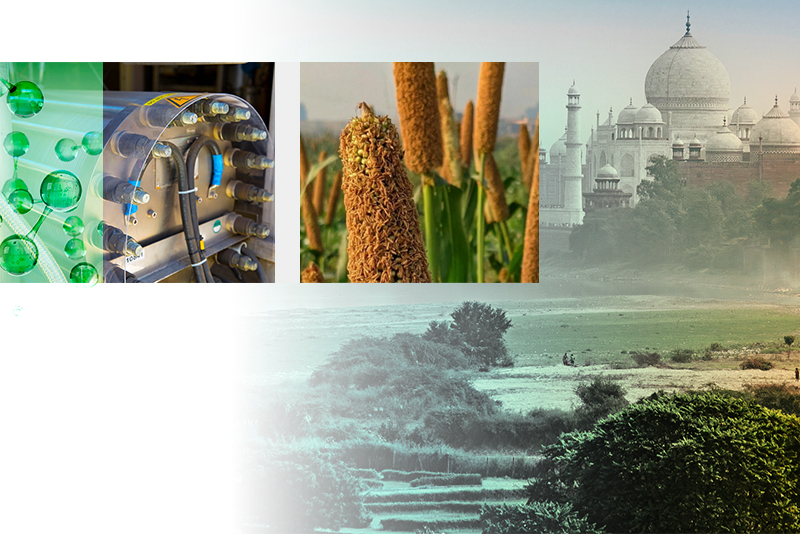
Electrolyzers are devices that use electricity to split water into hydrogen and oxygen. By using renewable electricity, such as from wind or solar, electrolyzers produce "green hydrogen" that can be used for a clean, affordable source for reliable power, while limiting new carbon emissions into the atmosphere. This zero-carbon energy carrier also can be used in making fertilizers, which are critical to global crop production and food security.
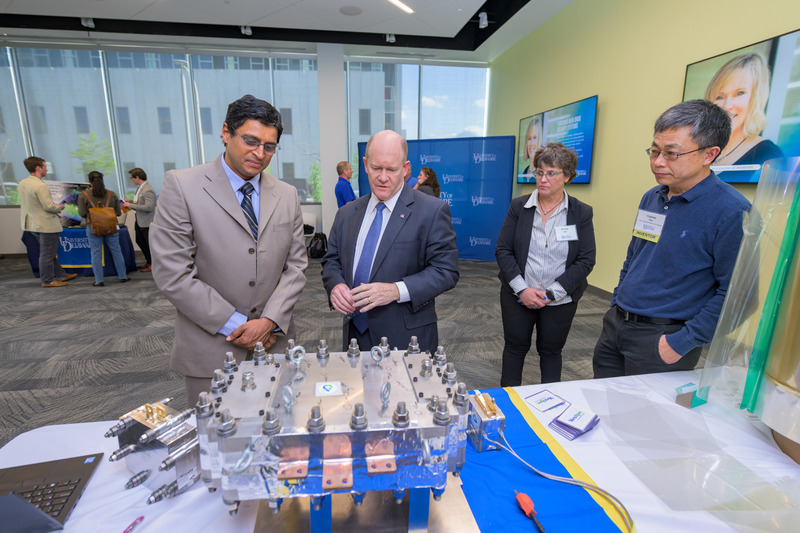
Early work at UD by Yan, Henry Belin du Pont chair of chemical and biomolecular engineering, on patented anode catalysts later became part of the large electrolyzer stack technology that Versogen developed and now has licensed to InSolare. The technology also leverages a patented membrane invented at UD and licensed and commercialized by Versogen, which is headquartered on the University’s Science, Technology and Advanced Research (STAR) Campus.
“India represents one of the most dynamic markets for green hydrogen,” Yan said. “Through this partnership with InSolare, we are bringing our patented PiperION® AEM-related technologies to enable scalable, efficient and affordable hydrogen production that will play a vital role in decarbonizing hard-to-abate sectors and meeting global climate goals.”
Strengthening India’s green hydrogen ecosystem
Worldwide, renewable energy use is increasing. In the first half of 2025, renewable energy outpaced coal as the leading source of electricity for the first time, according to statistics from the global energy think tank Ember.
In India, renewable energy use (including solar, wind and hydropower) accounts for over 20% of the country’s energy needs, Ember reports. Green hydrogen adoption across various sectors, including industry and agriculture, could further improve these percentages.
InSolare Energy plans to establish a 250- to 300-megawatt manufacturing facility, scalable up to 1-gigawatt for AEM electrolyzers in India, to meet domestic demand and select international market needs.
Hydrogen is essential to improve agricultural production, when it is used to make ammonia commonly used to fertilize crops such as corn, which is one of the top three staple crops worldwide. India is among the top producers of corn, accounting for about 3% of the world’s corn production annually.
Yan explained that a 1-gigawatt electrolyzer working at full capacity can produce about 1 million metric tons of ammonia and fertilize about 10 million acres of corn per year while avoiding more than 1.5 metric tons of carbon emissions, compared to conventional ammonia production processes.
The potential of many gigawatt electrolyzers working together—in India or elsewhere—is far greater.
These are important considerations as the world’s population continues to expand, even as the amount of viable agricultural land remains finite.
Expanding Versogen’s international footprint
Yan called the partnership with InSolare a promising step in growing the company’s market position internationally.
“In building Versogen, ‘locally integrated and globally recognized’ has been our philosophy from the very beginning. Our partnership with InSolare, and the fact that the announcement was made in India by our governor, reflect the success of that approach,” said Yan. “With this partnership, we now have a new, powerful engine to accelerate our membrane business.”
This type of cooperation shows how joining forces to move innovations to market can produce the gains needed to achieve sustainable societal impact.
The partnership is set to play a pivotal role in India’s energy transition, supporting India’s National Green Hydrogen Mission to decarbonize industry, foster innovation and build a robust domestic electrolyzer manufacturing ecosystem.
“This collaboration with Versogen is a significant step in advancing India’s clean energy future,” said Hemanshu Bhatt, founder-director of InSolare Energy. “By integrating Versogen’s world-class AEM technology with our manufacturing and project expertise, we are accelerating the adoption of cost-effective green hydrogen solutions that directly support India’s National Green Hydrogen Mission targets.”
India’s government has set a target of 5 million metric tons of green hydrogen production annually by 2030.
Developing the future workforce
Training the future workforce for this growing sector is an important part of bolstering the emerging green hydrogen economy.
Anil Bika, director of workforce development at UD’s Center for Clean Hydrogen, was part of a Delaware delegation led by Governor Matt Meyer that traveled to India on a trade mission. As part of the trip, Bika visited with leadership and professors at the Indian Institute of Technology (IIT) Delhi, IIT Bombay and IIT Tirupati, to discuss collaborations to foster greater progress on clean energy problems, and the potential for faculty, staff and student exchange.
Center for Clean Hydrogen University of Delaware: youtube.com/watch?v=LkTbUMRRQzM
Closer to home, Bika is focused on training opportunities for the future hydrogen workforce. This includes developing educational tool kits to expose K-12 students to the promise of clean hydrogen, through both course materials and test hardware for running water electrolysis experiments. The center offers undergraduate internship, research and work-study experiences, including experiential learning experiences, such as CCH’s HydroGenZ summer research program. UD also offers the nation’s first master’s degree in electrochemical engineering, as well as professional training programs for individuals already in the workforce looking to retool or improve their skills for this emerging field.
“We are creating an electrochemical engineering training pipeline that spans the educational spectrum to meet the needs of this emerging economy,” said Bika.
In addition to Bika, UD was represented by Ravi Ammigan, vice provost for global engagement; Suresh Sundaram, associate professor of marketing; Alok Patel, associate director of business development at The National Institute for Innovation in Manufacturing Biopharmaceuticals (NIIMBL); and Kristian Graves, senior associate vice president for development. The UD team focused on developing student mobility programs and fostering opportunities for faculty engagement, research collaboration and experiential learning initiatives. Other members of the Delaware delegation from Versogen included Jim Prendergast, chief commercial officer and a UD alumnus, and Balsu Lakshmanan, chief technology officer.
Contact Us
Have a UDaily story idea?
Contact us at ocm@udel.edu
Members of the press
Contact us at mediarelations@udel.edu or visit the Media Relations website