

A vision for good governance turns 25
Photos by Maria Errico and Evan Krape and courtesy of UD Archives December 15, 2025
UD’s Weinberg Center celebrates milestone anniversary with events honoring founder John L. Weinberg’s enduring legacy and Delaware’s leadership in corporate law
The University of Delaware’s John L. Weinberg Center for Corporate Governance was founded on an innovative vision: to create an academic venue where Delaware’s leaders could deliberate and advance corporate governance practices.
The idea originated with William Allen, former chancellor of the Delaware Court of Chancery, who envisioned a neutral forum to explore evolving issues in governance. With extensive board experience at companies such as DuPont and Goldman Sachs, John L. Weinberg shared that vision, endowing the center in 2002 to strengthen Delaware’s status as the foremost U.S. state for incorporation.
Over the past 25 years, the Weinberg Center, part of UD’s Alfred Lerner College of Business and Economics, has become one of the nation’s most esteemed governance centers to discuss and debate modern governance issues.
Having achieved its founding objective over the past quarter century, the Weinberg Center’s Director Lawrence Cunningham said it “is marking this milestone by continuing what such university programs do best, publishing materials that encourage intellectual conversations.”
That mission was on full display Oct. 9 as governance professionals, UD alumni and Delaware leaders gathered to celebrate the Weinberg Center’s 25th anniversary with a symposium, luncheon and gala dinner.
The day’s events centered on Boardroom Legacy, a forthcoming book on the evolution of corporate governance featuring the unpublished 1948 Princeton thesis of Weinberg and commentary from leading thinkers in the field on its ideas.
Cunningham first learned of Weinberg’s thesis through an online reference and located the manuscript at Princeton University. Impressed by its timeless ideas on the role of corporate directors, he saw its publication as an ideal cornerstone project for the anniversary year because it expressed a shared ideal that has guided both the ongoing efforts of the center and Weinberg’s boardroom leadership.
“John believed in what we now call ‘good governance’ — active, engaged boards that take oversight seriously, ask tough questions and act when they see problems,” said Cunningham. “That commitment continues to guide the center’s programs and publications.”
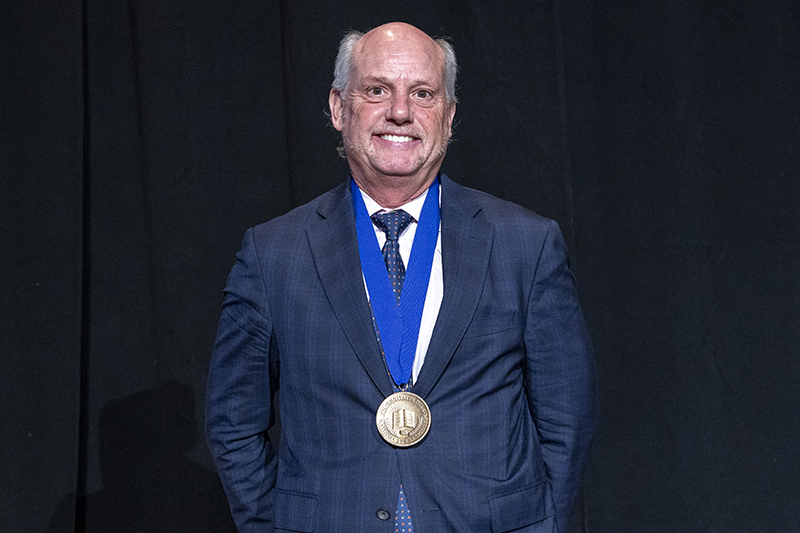
The symposium at UD’s Clayton Hall featured presentations by Boardroom Legacy’s contributing authors. During the luncheon, former Delaware Supreme Court Justice Leo Strine, a contributing author to the book and UD alumnus, was awarded the UD Medal of Distinction by the University’s Board of Trustees and delivered the keynote address.
Evening festivities followed at the Trabant University Center, hosted by Cunningham, UD Interim President Laura Carlson and Weinberg Center Chair Andre Bouchard. In her remarks, Carlson thanked the state's government, business and legal leaders in attendance for gathering to recognize the Center’s comprehensive impact.
“The Weinberg Center offers an important venue for research, dialogue, debate and learning about corporate governance that welcomes all perspectives,” said Carlson. “For the University, it gives our students, industry experts, corporate leaders and researchers an opportunity to collaborate, research and learn together. For the state and nation, it has served — and continues to serve — as an essential hub of thought leadership.”
Guest speakers represented diverse governance viewpoints and included Delaware Court of Chancery Chancellor Kathaleen McCormick; Delaware Supreme Court Chief Justice Collins Seitz; Goldman Sachs Executive Vice President John Rogers; and former U.S. House Majority Leader Richard Gephardt.
Paul Atkins, chair of the U.S. Securities and Exchange Commission (SEC), opened the evening with a policy speech exploring current state and national governance issues and how the Center, as an authority in the community, could help resolve them.

Atkins stressed his priority to encourage more firms to take their companies public and reverse the trend of decline in U.S. exchange-listed companies.
With the cooperation of Delaware’s leaders, Atkins proposed a few reforms to strengthen the U.S. markets, especially depoliticizing shareholder meetings and improving the efficacy of the litigation landscape.
Over the past few proxy seasons, Atkins noticed shareholder meetings have become more politicized through a rise in nonbinding proposals that reflect views immaterial to the company’s business.
“These proposals consume a significant amount of management’s time and impose costs on the company,” said Atkins, arguing that SEC Rule 14a-8 defers to state law, and Delaware law doesn’t confer any right to vote on such proposals, deeming it unnecessary for companies incorporated in Delaware to include it in their proxy materials.
He called for a reassessment of the rule to ensure its relevance in today’s markets.
Rogers echoed those concerns, citing his experience at Goldman Sachs, where shareholder proposals expanded from three to 14 in the span of two years in 2009, creating costly administrative burdens.

“The center has left a profound imprint on corporate governance, and its legacy calls on everyone anew to reflect thoughtfully, but without delay, on how we can update rules and practices to better serve U.S. capital markets, investors and business,” closed Atkins, reiterating the service the Weinberg Center provides during times of change.
In response to Atkins’s remarks, Seitz said the state would take his points under advisement. Gephardt then closed the evening on a topic at the forefront of the Center’s values: bipartisanship.
Sharing a story from his time in the Clinton administration, Gephardt recalled when the House of Representatives worked together to arrange a balanced budget by adhering to the “golden rule” — treating others how you'd want to be treated.
Acknowledging the lack of bipartisanship in the current political climate, Gephardt stated that even challenging reforms could be achieved by following the golden rule — essentially living by the culture and values of the Weinbergs.
The anniversary celebration will continue throughout the 2025–26 academic year. A historic exhibit developed in collaboration with UD’s Department of History and Museum Studies Program highlights the center’s history and accomplishments and remains on display in the Lerner Hall atrium. Additional events, including a launch party for Boardroom Legacy and a podcast featuring its authors, are also planned.
“It’s not a moment, but a movement,” said Cunningham, noting that the center’s next 25 years will continue to shape conversations that define corporate governance in Delaware and beyond.
Contact Us
Have a UDaily story idea?
Contact us at ocm@udel.edu
Members of the press
Contact us at mediarelations@udel.edu or visit the Media Relations website