




New Directions Early Head Start celebrates 20 years
Photo by Evan Krape November 28, 2018
NDEHS staff, parents reflect on the last two decades
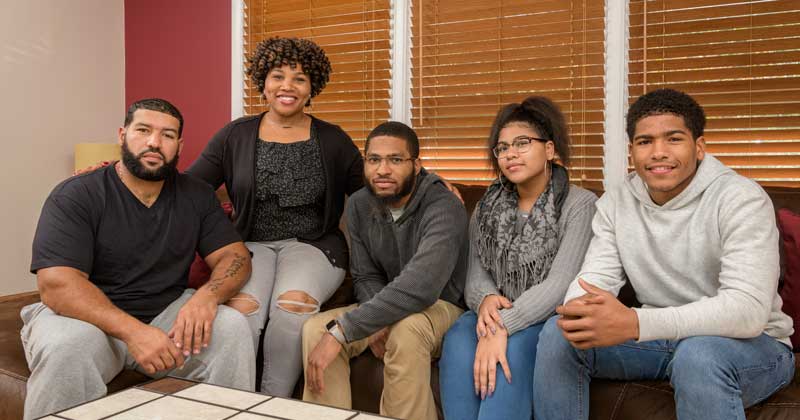
In 1998, when Nicole Smith was a junior in high school, she became pregnant with her first child. Cynthia Slater, a family friend, recommended Smith apply to the New Directions Early Head Start program.
New Directions Early Head Start (NDEHS) is a University of Delaware program which collaborates with a group of agencies that provide support for low-income pregnant women, children (from birth to age 3) and their families. They provide childcare, in-home visits and resources designed to promote children’s success and families’ self-sufficiency, through community collaboration and partnerships.
Slater, who worked at NDEHS, became Smith’s case worker and, during weekly home visits, the two worked together to set goals and develop strategies to help Smith succeed.
Smith was determined to finish high school and develop parenting and life skills that would benefit her son and his development.
“[Slater] helped show me things to do with my son and different activities,” Smith said. “If I needed to focus on cooking, we would do a cooking activity. Overall it was a great experience.”
Smith accomplished her goals, and then some. Not only did the program help her learn to support her child’s development but also how to be an advocate for her son and herself. She went on to serve on the organization’s policy council, where she became a voice for the NDEHS community.
Celebrating 20 years
NDEHS, established by the University of Delaware’s Center for Disability Studies in 1997 and now located in the Department of Human Development and Family Sciences, is celebrating 20 years of service.
While various facets of the program have shifted over time — such as the partners working under the NDEHS umbrella and expansions of their service area — the basic mission to offer support for low-income families has remained the same.
“We look at all aspects of the child and the family, realizing that the child doesn’t develop outside of the family,” said Heidi Beck, NDEHS director, “So we look at health and wellness, mental health, nutrition, dental, child development and then help the family identify goals for themselves and their children.”
During its 20 years, NDEHS has served 2,600 children, 365 pregnant women and 400 children with developmental delays/disabilities. The program partners with the Delaware Early Childhood Center, the Hilltop Lutheran Neighborhood Center Inc. and UD’s two Early Learning Centers based in Wilmington and Newark.
Beck said helping families is the best part of her job.
“The most rewarding thing about this work is seeing the growth and development of the young children,” said Beck, who has been with the program since its inception, when she was a graduate student. “It is wonderful seeing families reach their goals and learn that they have a voice in their child’s education and learning how to advocate for their children.”
Beck added that in addition to helping families, it’s been rewarding to see her staff grow, flourish and develop.
In addition to their 18 staff members, NDEHS programs are supported by UD students interested in pursuing a career in child and family services. Over the years, they have placed 22 graduate students, four of whom completed dissertation work, 37 interns and more than 1,100 undergraduates pursuing field experience.
Amy Harter, program coordinator, began working for NDEHS as a home visitor in 2000 after she graduated from UD. She said her passion for the work is inspired by the families’ drive to improve their lives.
“I have several families that I worked with that I still keep in touch with now,” Harter said. “One was a teen parent and she had three children. When I was working with her, she was continuing to go to school.”
Harter felt a great deal of accomplishment, as that young woman continued through the program and improved her situation.
Melia Anderson, a current parent and member on the NDEHS Board of Directors, first learned of the program about 10 years ago when her older daughter showed signs of developmental delays. She now has a 2-year-old daughter in the program. Having the experiences to compare has truly improved her parenting.
“I’m able to see things that I wasn't able to see eight or nine years ago, with [my 2-year-old] developmentally and even her social and emotional wellbeing,” Anderson said. “That’s a hard concept to see and I have to attribute a lot of that to Early Head Start and the home visiting.”
She found the home visits to be incredibly helpful. She recalled one of her favorite activities involved creating a racket out of paper plates and free paint stir sticks from a local hardware store.
“I enjoyed the one-on-one education every week. We got ideas about where our child should be, and if not, we got resources on how to help them,” Anderson said. “What I loved is the activities … usually made with low cost materials or free materials.”
As for Smith, she finished high school and went on to earn a college degree. The program helped her in various stages of her life. Her son — and twins who were born five years later — were all enrolled in NDEHS and attended one of the Early Learning Centers, where Smith worked for two and a half years.
Today, Smith’s first son is a sophomore at UD and her twins are in high school.
NDEHS always had a positive impact on her family.
“The program works if you work it,” Smith said. “They will do and help in any way they can to benefit you, your children and your family.”
Contact Us
Have a UDaily story idea?
Contact us at ocm@udel.edu
Members of the press
Contact us at mediarelations@udel.edu or visit the Media Relations website