
UDaB service
April 18, 2017
UD students rehab Laurel home through Alternative Breaks Program
Each spring, thousands of college students travel to faraway places for exotic spring break vacations. Hundreds of University of Delaware students choose to travel to faraway places to do service opportunities with communities through the UD Alternative Breaks Program (UDaB), and a number choose to give back locally.
This year, 14 UD students decided to use their spring break to travel only an hour and 40 minutes south of the Newark campus to Laurel, Delaware.
Spring Break: Laurel, Delaware
At one time, Laurel was the wealthiest town in the state of Delaware. With the Broad Creek offering transportation opportunities for goods before railroad and car were popularized, Laurel was necessary for transporting goods.
As technology changed over time, so did Laurel. Now, despite its rich history, it is one of the poorest towns in the state. While its agricultural offerings are plentiful – particularly the town’s watermelons, which are transported to the northern part of the country and Canada on watermelon buses as part of the east coast watermelon harvest line each summer – the population of Laurel is looking forward to revitalization and a second chance.
Part of the redevelopment that Laurel is undergoing is spearheaded by the Laurel Redevelopment Corporation. It partners with organizations like Sussex County Habitat for Humanity to rehabilitate and revitalize this small western Delaware town.
“There is a real sense of community pride in Laurel,” said Jay Gundy, development director of Sussex County Habitat for Humanity. “Towns like Laurel had a purpose that may not exist anymore, and now they need to be revitalized and re-purposed.”
Giving families a home and a purpose
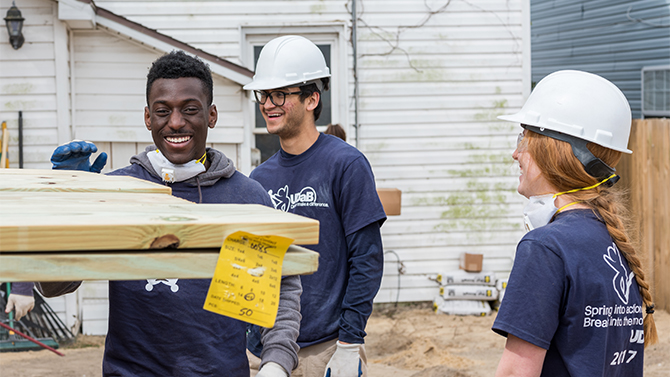
The 14 UD students who traveled to Laurel for spring break volunteered with Habitat for Humanity for five days to rehabilitate a home on Oak Street. This home, along with all other Habitat homes, is going to a family that earns and deserves it. While UD students were knocking down walls, painting fences, and moving lumber in an effort to get the house in living condition, the family was doing the exact same thing. They help pay for their home with what Gundy calls sweat equity.
“For the most part, the families are working on their own homes. They are required to put in 200 hours of sweat equity, along with taking both a pre- and post-homeownership course that teach them about finances, mortgages, budgeting, and pretty much everything you need to know about being a homeowner,” Gundy said.
With Sussex County host of the largest Guatemalan immigrant population in the country, these courses are offered in both Spanish and English. In fact, Sussex County Habitat for Humanity sends 10 percent of its unrestricted funds to Guatemala to build Habitat houses there as well.
The students got to meet the family that would be buying the home once rehabilitated, making the build all the more meaningful.
One of the things Habitat strives to do is bring people together. “It is a Christian organization,” said Gundy. “And Christianity is our core, but it is not our boundary. It’s a part of our mission to instill hope in the communities where we build. This isn’t just about providing affordable housing to families who need it; it’s about bringing a community together and increasing pride in the town.”
For students and Habitat, the partnership reaps reciprocal benefits. Habitat relies on the work of volunteers to continue on purchasing, building, rehabilitating, and selling homes to low-income families in the area. But the UD students gain something as well.
Gundy said, “This is good physical labor for the students.” They worked hard in the house with hard hats, tool belts and work gloves to really make improvements to the home. They learned about affordable housing in Delaware, the Habitat program and the community with which they are serving. Then, when they came back to campus, they brought this knowledge with them.
UDaB site leader Rebecca Robbins said, “The opportunity to represent UDaB within our home state was both a great privilege and an essential learning experience. We as college students are so consumed with what's going on within the few mile radius of campus, we often miss the bigger community picture; specifically, a community that we may never otherwise get to know throughout our four years here. It's really beautiful – the way we're able to return to campus with a new lens and sense of pride for the state that we then get to share with our classmates.” She’s a junior looking to continue with UDaB in her senior year.
UDaB is a student run program that provides direct service and experiential learning in partnerships with communities across the nation. Part of their mission is to “increase knowledge of social justice issues and encourage lifelong active citizenship.” This year, UDaB sent nearly 600 students on alternative break service trips.
Though UD is involved with Habitat for Humanity year-round, this is the first UDaB trip within Delaware. Those who are interested in getting involved with Sussex County Habitat for Humanity can visit the website.
For more information about UDaB, visit the website.
Q&A with Sussex County Habitat for Humanity
Q. How many homes has Sussex County Habitat for Humanity built to date?
A total of 115, and 17 of those were rehabilitation projects.
Q. Why are rehabilitated houses important?
With a town as historic as Laurel, many of the houses in town were built before 1939. Maintaining these old homes retains the history and character of the town, which is important to long-time community members and to its history.
Q. Does Habitat for Humanity just offer low-cost homes?
Affordable housing is a solution to increasing homeownership in communities, but Habitat for Humanity is also trying to change behaviors. They are about family empowerment and education, which is why they keep in touch with the families even after the papers are signed and the courses are finished.
Q. Who can buy a Habitat for Humanity home?
Not just anyone can buy a Habitat for Humanity home. The families that buy the homes go through a formula to see if they qualify. The family must make less than $35,000 per year, and have no delinquent debts. Once they qualify, no more than 30 percent of their income can go towards housing. Most of the jobs in the coastal communities are minimum wage jobs, so many families qualify.
Q. Where does the money go once a family buys a Habitat for Humanity house?
Proceeds from selling the home go right back into buying more homes. The more houses Habitat for Humanity builds and sells, the more they can continue to build.
Contact Us
Have a UDaily story idea?
Contact us at ocm@udel.edu
Members of the press
Contact us at mediarelations@udel.edu or visit the Media Relations website