



Getting a jump on discovery
Photos by Kathy F. Atkinson, Evan Krape and Maria Errico and courtesy of Lauren Genova September 03, 2026
Undergraduate research opportunities offer UD students new insight, new options
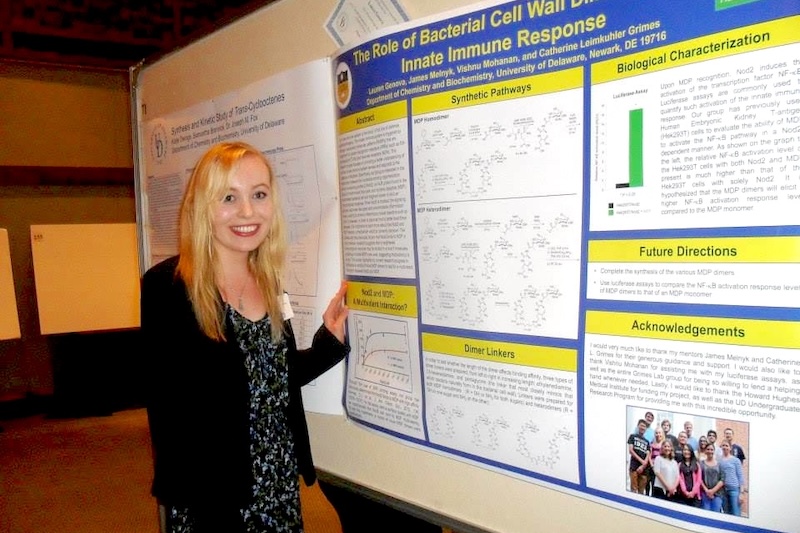
Lauren Genova discovered something life-changing while working in the lab of Professor Catherine Leimkuhler Grimes at the University of Delaware.
She was an undergraduate student at the time, majoring in chemistry education and planning to teach high school chemistry after graduation. Her work in Grimes’ research lab produced an important finding: Genova wanted to do research of her own.
Undergraduate research, a UD hallmark for many years, has had that kind of effect on thousands of students. Working with an expert mentor and learning how to ask good questions, design experiments and solve real problems offers students new windows on what the future can hold.
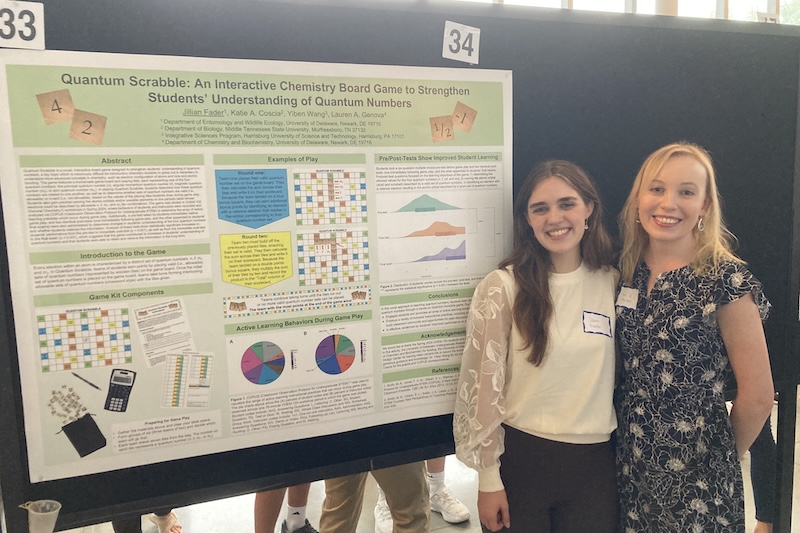
Now on UD’s faculty in the Department of Chemistry and Biochemistry, Genova teaches general chemistry to students majoring in STEM (science, technology, engineering and mathematics) disciplines and conducts education research in the chemical sciences. She has welcomed undergraduate students into her own research projects, which explore the effectiveness of game-based instruction.
“We’re finding ways to make chemistry fun and accessible,” she said. “And I can use the research skills I learned over the years to test these methods.”
More than 500 undergraduate students presented details of their research on Thursday, Aug. 13, at the 17th annual Symposium for Undergraduate Research and Creative Activity.
Eight of those students worked with biomedical engineer Jason Gleghorn. Since joining UD’s faculty in 2014, Gleghorn has welcomed 72 undergrads to his lab.
“Students arrive thinking science is a body of facts you memorize, and they leave understanding it as a process you do with your hands, one that includes being wrong most days and figuring out why,” Gleghorn said. “Helping students learn to think critically about the world around them and helping them figure out how they can contribute to the betterment of society is one of the highest-return things I do as a faculty member.”
The experience often leads to unexpected opportunities.
“This time spent out of the classroom is invaluable as it enhances interest and engagement in learning, provides a space to discover and explore students’ passions, and can open new career pathways,” said Rosalie Rolón-Dow, faculty director of UD’s Undergraduate Research Program (URP).

UD has many gateways to research for undergraduates “and students go all different ways,” said Lauren Barsky, associate director of URP, which serves as a matchmaker for students and mentors, provides training and organizes special events for participating students.
The Summer Scholars program, for example, is a 10-week session of full-time research, done under the supervision of an expert mentor. The $4,000 stipend allows students to focus on research instead of getting a summer job.
The Summer Fellows and Winter Fellows programs offer shorter, part-time research options between semesters. The UDRAW (Undergraduate Research Apprentice and Work-Study) program helps eligible students find paid opportunities to explore research. And students in the senior thesis program can be eligible for honors distinctions.

Additionally, thousands of students have worked with Delaware INBRE (biomedical research), Delaware EPSCOR (environmental research), Community Engagement projects (in partnership with non-profit, government and/or community-based programs) and McNair Scholars.
Gleghorn loves to see undergraduates gain traction as young scientists. He watches for the moment a student becomes self directed.
“It usually happens in junior year,” he said. “A student who initially was waiting for instructions is suddenly proposing the next control, catching a flaw in their own data, defending a result to a skeptical grad student. The specific technique they learned matters less than the fact that they now trust themselves to think through a hard problem without a safety net.”
Almost half of the undergraduate students Gleghorn has mentored have continued their research and pursued a senior thesis. Many go into industry, doctoral programs, medical, dental or joint professional and graduate programs.

“A number are now co-authors on published papers, and I still hear from them years later,” he said. “That ongoing connection is honestly one of the best parts of the job.”
Aimee Pearsall-Kramer learned about UD’s Summer Scholars program during her junior year when Suzanne Burton, professor of music education in the School of Music, suggested it. Then a music education major, Pearsall-Kramer said it was a unique opportunity not offered at most colleges.
“Summer Scholars and undergraduate research shapes the way you approach the world,” she said. “It allowed me to go into my first teaching job not thinking of the scenarios that are difficult — teaching 300 middle-school students — but how can I approach this like a researcher?”
Now a UD faculty member, Pearsall-Kramer mentors multiple students annually and sees many benefits for those who pursue research.
“Their writing skills improve beyond their peers,” she said. “They seem to be thinking more like a graduate student. They’re working alongside a professor and that one-on-one mentorship is invaluable. The research they’re doing is real research, not a little student project.”
Mekhi Williams got his first taste of research at Appoquinimink High School in Middletown, Delaware, when an encounter with a UD outreach program presented the chance to work with mechanical engineer Pierre Yao.
When Williams was later admitted to UD’s College of Engineering, an academic adviser urged him to contact chemical and biomolecular engineer Mark Blenner about student research opportunities.

“A lot of his research focused on sustainability and plastics recycling, which I feel passionate about,” said Williams, who conducted research at UD over winter session, as a Summer Scholar and as a McNair Scholar.
“Seeing how the research was directly contributing to broader societal issues was very impactful to me,” he said.
Williams is now pursuing a doctoral degree in chemical and biological engineering at Northwestern University.
UD alumna Nadia Thomas, who majored in business analytics in the Lerner College of Business and Economics, was an undergraduate research assistant, pursued a master’s degree in evaluation science, and worked as a graduate assistant in the McNair Scholars program. Now she is McNair’s program coordinator.
“There are so many different paths you can take,” she said.
Helping students find their path has long-term implications, Pearsall-Kramer said.
“My students, who are music educators, are going to teach thousands of students over their careers,” she said. “That’s the value. It’s not just about the one student participating. It’s about all of their future students.”
Contact Us
Have a UDaily story idea?
Contact us at ocm@udel.edu
Members of the press
Contact us at mediarelations@udel.edu or visit the Media Relations website