




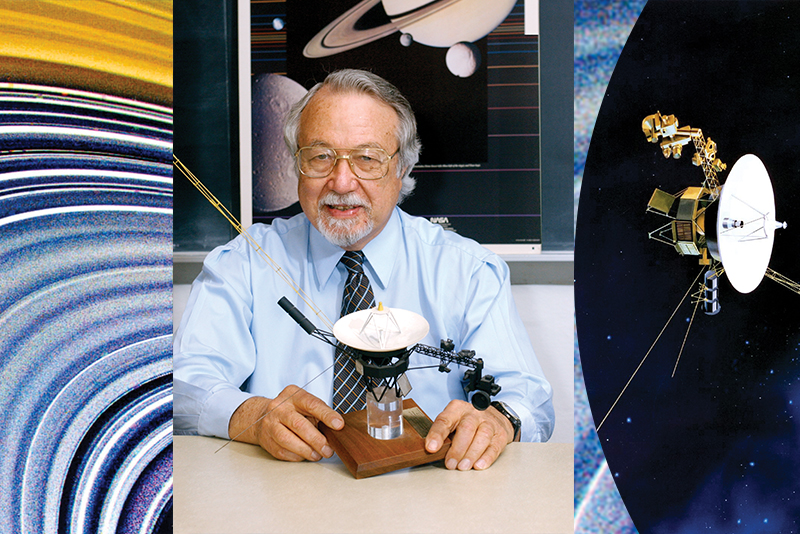
Reaching one light-day from Earth
Photo illustration by Jeffrey C. Chase November 17, 2026
Voyager’s historic milestone highlights lasting impact of UD physicist’s work
On Nov. 17, NASA is inviting people around the world to participate in “Shine Bright for Voyager’s Light-Day,” a celebration marking the moment the Voyager 1 spacecraft reaches a distance of one light-day from Earth. Participants are encouraged to shine lights skyward and signal “V-G-R” in Morse code in recognition of an achievement nearly 50 years in the making.
Just how far away is one light-day? It’s some 16 billion miles, the distance Voyager 1 has traveled since its launch on Sept. 5, 1977. Today, the spacecraft is so distant that a radio signal traveling at the speed of light takes a full day to reach it, and a radio dish in NASA’s Deep Space Network comparable in size to a 20-story building laid on its side is needed to catch the spacecraft’s faint signals.
For the University of Delaware, the milestone is also a reminder of the contributions of physicist Norman Ness, professor and former director of the Bartol Research Institute, whose work helped make Voyager one of the most successful scientific missions in history.
A scientific mission extended
Launched into space a few weeks apart in 1977, Voyager 1 and Voyager 2 were originally designed to explore the outer planets. The twin spacecraft transformed scientists’ understanding of Jupiter, Saturn, Uranus and Neptune, revealing active volcanoes on Jupiter’s moon Io, providing unprecedented views of Saturn’s rings and expanding humanity’s knowledge of the solar system’s outer frontier. The mission proved so successful that NASA repeatedly extended it, allowing both spacecraft to continue their journeys toward and beyond the edge of the solar system.
A key part of that exploration came from the magnetometers carried aboard each spacecraft. Ness served as principal investigator for Voyager’s magnetometer experiment, overseeing instruments measuring magnetic fields around planets, moons and, eventually, the boundary between our solar system and what lies beyond: interstellar space.
Bill Matthaeus, the Martin A. Pomerantz Chair of Physics and Astronomy at UD, was a postdoctoral researcher at NASA’s Goddard Space Flight Center when Ness was there and recalls the team’s ingenuity.
"One of the tricks of the magnetometers on the Voyagers was that they used four of them — two were mounted at different positions on the boom extending more than 40 feet out from the spacecraft and the other set was mounted directly on the spacecraft," Matthaeus said. “By comparing the measurements of these instruments, scientists could separate the spacecraft’s own magnetic influence from the magnetic fields in the surrounding plasma.”
For decades, Ness and his team analyzed data returned from billions of miles away, helping researchers understand the magnetic environment of the planets, the solar wind and the farthest reaches of the vast magnetic bubble — the heliosphere — surrounding our solar system.
Ness joined UD in 1987 as director of the Bartol Research Institute, remaining closely involved with the mission throughout his career. In a 2012 interview for the UD Research magazine, he described Voyager as “the 20th century’s robotic spacecraft” and reflected on its longevity with characteristic understatement: “It’s been a hell of a good ride.”
When that interview was published, Voyager 1 was nearing interstellar space. Today, more than a decade later, the spacecraft and its twin are continuing their journey beyond our solar system, while the scientific value of their observations continues to grow.
Fueling pioneering research
Matthaeus, a member of the prestigious National Academy of Sciences and an expert in space plasma physics, said he and his students still use Voyager data alongside measurements from NASA’s Parker Solar Probe to better understand the solar wind, a stream of charged particles that can disrupt satellites, communications systems and power grids during massive flares.
“While the recent Parker Solar Probe has come closest to the sun, Voyager has traveled farthest from the sun,” Matthaeus said. “The heliosphere is our neighborhood, but the interstellar medium, where Voyager is now, is beyond our solar system. We are able to do pioneering exploratory work thanks to the Voyager spacecraft.”
The Voyagers themselves remain engineering marvels. Nearly half a century after launch, they continue operating on gradually diminishing power supplies — Matthaeus equates it to the power that runs a flashlight — while transmitting information across billions of miles of space.
“It’s somewhat miraculous that this mission is almost 50 years old and still going,” said Ben Maruca, associate professor of physics and astronomy at UD, whose students also continue to use data from the twin spacecraft in their research. “For many people, what’s incredible is that they’re the only thing we’ve got ‘out there,’ in interstellar space.”
As the world celebrates Voyager’s latest milestone, UD can claim a lasting connection to one of humanity’s greatest explorations. Nearly 50 years after launch, data from instruments overseen by Ness continue to help scientists probe the frontier between our solar system and the vast interstellar space beyond.
Contact Us
Have a UDaily story idea?
Contact us at ocm@udel.edu
Members of the press
Contact us at mediarelations@udel.edu or visit the Media Relations website