


MAJOR FINDER
Filter by College
Filter by Program Types
Filter by Subject
Biochemistry
Explore the chemistry of life
Understand living systems at the molecular level
How do proteins carry out essential functions? What chemical changes lead to disease? How can scientists design molecules that improve human health? Biochemistry uses the principles of chemistry to understand the processes that occur within living organisms.
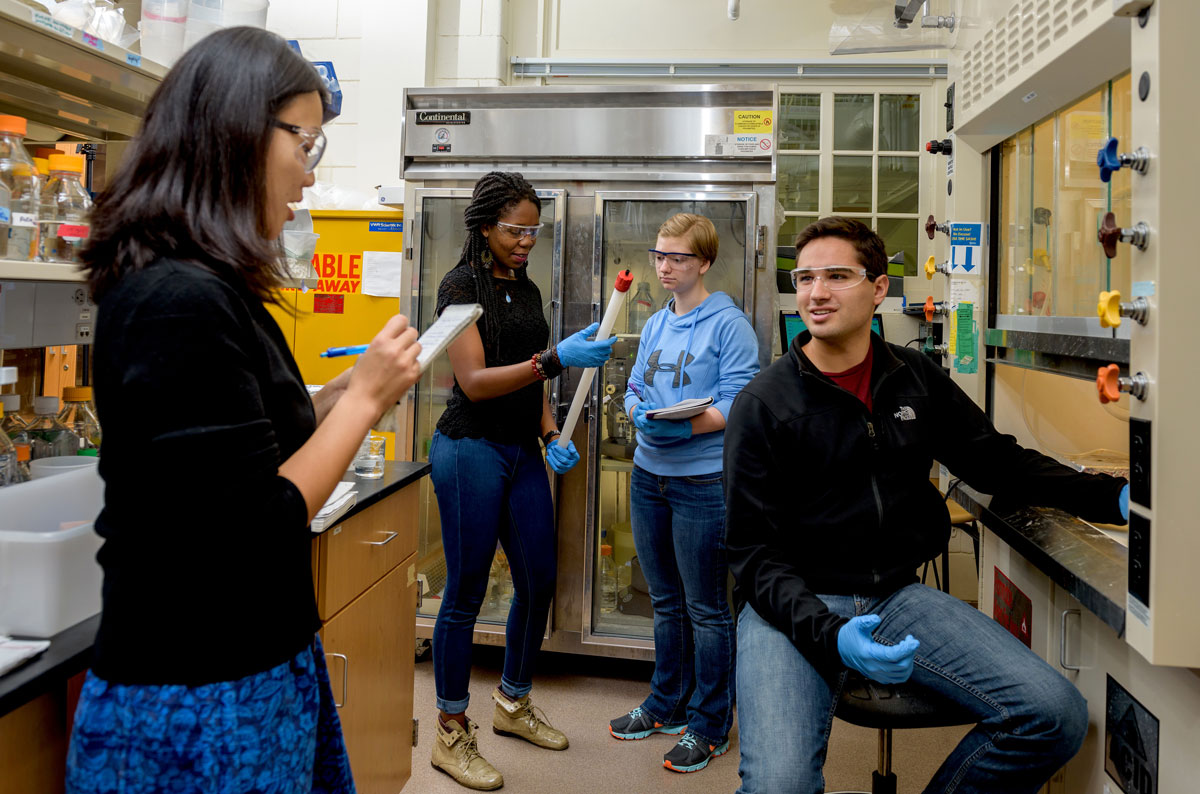
As a biochemistry major at the University of Delaware, you will build a strong foundation in chemistry and biology while studying metabolism, protein structure and function, biochemical genetics, cell and molecular biology and medicinal applications. Through laboratory work, you will learn to analyze biological molecules, investigate chemical reactions and use scientific evidence to answer complex questions.
Prepare for science and health careers
This interdisciplinary STEM degree prepares you for careers in biotechnology, pharmaceutical development, health care, laboratory research and other science-based fields. It also provides a strong foundation for medical school, pharmacy school and graduate study in biochemistry, chemical biology, molecular biology and related disciplines.
Topical Areas of Study
- Metabolism
- Proteomics
- Chemical Biology
- Materials and Polymers
- Complex Biochemical Systems
- Bacterial Studies
- Biochemical Genetics
- Cell and Molecular Biology
- Microbiology and Wirology
- Thermodynamics and Kinetics
- Forensics and Quantitative Analysis
- Biomedical Applications
- Environmental Monitoring
- Sustainability
- Spectroscopy and Physical Methods
- Imaging
- Data Processing and Analysis
CAREER OPTIONS AND FIELDS
- Research Scientist
- Drug Discovery and Biopharmaceutical Development
- Medicine, Pharmacy and Health Care
- Public Policy
- Law and Intellectual Property
- Entrepreneur
- Forensic Analyst
- Toxicologist
- Quality Control Specialist
- Laboratory Specialist
- Scientific Communication, Consulting and Education
- Engineer
- Cosmetic Researcher
- Microbiologist or Virologist
- Molecular or Cell Biologist
- Geneticist
GRADUATE PROGRAMS
- MS or PhD in Chemistry, Biochemistry or Chemical Biology
- MS or PhD in Chemical or Biomedical
- Pharmacy School
- Dental School
- Medical School (MD, DO or PA)
- Veterinary Science of Medicine
- MBA
- Law School (Patent Law)
- Public Policy
- Nutrition
- Science Education
- Environmental Science
- Data Science
- Science Communication
What’s special about this program?
At UD, biochemistry majors can move from learning scientific principles to contributing to new discoveries. Students may join faculty research projects as early as their first year, working alongside researchers in areas such as chemical biology, biomolecular interactions, therapeutic agents and disease-related processes. Departmental programs and alumni-supported fellowships help eligible students pursue funded summer research, and some undergraduate projects lead to presentations or published work.
Eligible students interested in teaching can pursue the Biochemistry/Secondary STEM Education 4+1 program, earning a bachelor of science in biochemistry and a master of science in secondary STEM education through an accelerated course of study.
See how a biochemistry student connected laboratory research with public policy and healthcare.
Get Involved
American Chemical Society Student Affiliates
American Society for Biochemistry & Molecular Biology
NOBCChE Student Chapter: National Organization for the Professional Advancement of Black Chemists and Chemical Engineers
Chemistry of Baking Club
Alpha Chi Sigma (AXS)
Cosmetic Chemist Society
Sample curriculum
| FALL | SPRING |
|---|---|
| CHEM 111, General Chem. (Majors) | CHEM 112, General Chem. (Majors) |
| CHEM 135, First-Year Majors Chem. Lab. I | CHEM 136, First-Year Majors Chem. Lab. II |
| CHEM 164, Freshman Majors Seminar | CHEM 165, Intro. to Chem. Research (optional) |
| MATH 231, Integrated Calc. IA | MATH 232, Integrated Calc. IB |
| ENGL 110, First-Year Writing | BISC 207, Intro. Biology I |
| UNIV 101 First Year Seminar | BISC 217, Intro. Biology Lab I |
| Group A/B/C Elective | Multicultural Requirement |
| FALL | SPRING |
|---|---|
| CHEM 331, Organic Chem. I | CHEM 332, Organic Chem. II |
| CHEM 333, Organic Chem. Lab. I (2 credits) | CHEM 334, Organic Chem. Lab. II |
| BISC 208, Intro. Biology II | CHEM 342, Intro. to Biochem. |
| BISC 218, Intro. Biology Lab II | PHYS 202 OR PHYS 208, Intro. Physics II |
| PHYS 201 OR PHYS 207, Intro. Physics I | PHYS 222 OR PHYS 228, Intro. Physics Lab. II |
| PHYS 221 OR PHYS 227, Intro. Physics Lab. I | Group A/B/C Elective |
| Group A/B/C Elective |
| FALL | SPRING |
|---|---|
| CHEM 418, Intro. Physical Chem. I OR CHEM 443, Physical Chem. I | CHEM 419, Intro. Physical Chem. II OR CHEM 444, Physical Chem. II |
| CHEM 445, Physical Chem. Lab. I | CHEM 338, Analytical Chem. Lab. I |
| CHEM 337, Analytical Chem. I | CHEM 642, Biochemistry |
| CHEM 641, Biochemistry | Second Writing Requirement |
| CHEM 343, Biochemistry Lab. | Group A/B/C Elective |
| Group A/B/C Elective | Group A/B/C Elective |
| Group A/B/C Elective |
| FALL | SPRING |
|---|---|
| CHEM 465, Senior Seminar (University Capstone) | CHEM 465, Senior Seminar |
| CHEM 437, Analytical Chem. II | CHEM 438, Analytical Chem. Lab. II |
| CHEM 6XX, Advanced Biochem. Elective | CHEM 6XX, Advanced Chemistry Elective or approved Biology Course BISC XXX |
| CHEM 6XX, Advanced Chemistry Elective or approved Biology Course BISC XXX | CHEM 468, Undergrad. Research (opt.) or Elective |
| Discovery Learning Experience (CHEM 468, Undergrad. Research or approved Biology Lab Course optional) | Elective |
| Elective | Elective |