
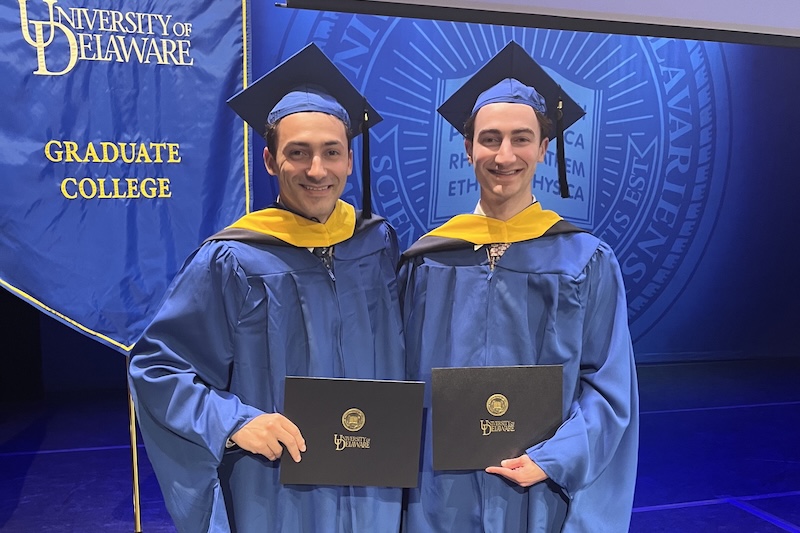
Mutual support leads to quantum success
Photo by Wendy Feller September 16, 2026
Manfre brothers complete M.S. degrees together
Beginning at orientation, the University of Delaware Graduate College emphasizes the importance of building a support system through academic advising, student organizations and campus resources. While earning their master’s degrees, Michael Manfre and Tyler Manfre also had the benefit of each other’s support — a second driver for long commutes to campus, a sounding board to practice presentations and a study partner to review complicated lessons. As brothers who are three and a half years apart in age, however, their academic journey together wasn’t always a given.
When Tyler began his college search, his older brother Michael — who withdrew from Ocean County College in New Jersey to build a business in California — surprised him when he decided to return to academia and reenrolled in OCC’s engineering program alongside him. After completing their associate degrees, they researched bachelor’s programs and discovered a 3+2 dual-degree program that grants a bachelor of science in physics from West Chester University in three years followed by a master of science in quantum science and engineering from UD in two years.
“Brandon Mitchell [professor of physics and engineering at WCU] and I established the 3+2 program as a faster and more cost-effective path to a master’s degree that provides both core technical knowledge and hands-on experience in the emerging discipline of quantum information science,” said Matthew Doty, professor of materials science and engineering and director of the quantum science and engineering program at UD. “Tyler and Michael were the first two to take advantage of [the program], so they were blazing a trail coming from West Chester to UD.”
Pursuing the same degree alongside a brother gave them a unique way to navigate the program. As students with different learning styles, they found that their varying approaches to studying the same material made them better students overall.
“Mike is a quick learner, and he was great at helping me visualize concepts that I was struggling with. Explaining those ideas helped reinforce his own understanding, and the same thing happened in reverse when I grasped something before he did. We really pushed each other to learn more deeply and came out stronger because of it,” said Tyler. In between brainstorming on homework assignments and preparing for exams together, the Manfres also gained a deeper appreciation for each other’s strengths.
“Tyler [learns through] implementation. He’ll start working with the equipment or the code and learn by doing. I tend to map out the full problem and understand why each step matters before I start. His approach kept us moving, and mine helped us figure out what the results meant,” said Michael.
One of the most valuable aspects of the program for the Manfre brothers was the experiential requirement — a six-credit capstone research project or industry internship — that shaped the trajectory of their careers and prepared them to enter the workforce.
“The nanotechnology track of the program is designed to meet an industry need,” said Doty, who consulted with various quantum companies when creating the program. “The single biggest problem they have is finding enough skilled technicians with hands-on experience in nanofabrication (the manufacture of devices with components on nanometer-length scales.).” To address that need, the program established the experiential requirement to provide students with practical problem-solving and technical skills.
After forming an interest in photonics — the science of generating, manipulating and measuring light particles (photons) — as an undergraduate, Tyler was inspired to choose the research pathway. He joined Doty’s photonics lab, where he began researching a nanofabrication engineering phenomenon in which the tools tend to produce a device that’s bigger than intended.
To solve this problem, Tyler developed an automated image analysis tool that compared nanometer-scale designs to the device actually produced in fabrication tests held at the UD Nanofabrication Facility. He then created a correction table that planned for these fluctuations in advance, aiming to improve the fabrication process of photonic devices. Tyler not only gained firsthand experience and confidence in Doty's lab, but confirmed the specialty he wanted to pursue.
“Being able to take what I learned in class and apply it to real research using nanofabrication tools and electron microscopy made everything feel tangible. It showed me that I really enjoy hands-on experimental work,” said Tyler.
For his experiential requirement, Michael completed an internship at Northrop Grumman, a global defense contractor. He spent the summer of 2025 assisting with the performance tests of quantum chips using dilution refrigerators, a cooling system that operates at extreme temperatures.
“At one point, I managed a full manual cooldown largely on my own, monitoring valve sequences and chamber pressure and catching a pressure excursion before it caused damage. Seeing coursework concepts translate into something I was physically responsible for is what made it click that this was the right field for me,” said Michael, who discovered he wanted a career in quantum hardware through the internship.
Although they’re entering different segments of the field, Michael and Tyler both share a similar ambition to advance quantum technologies.
“I hope my work helps bridge the gap between research and real-world technology. I’d like to contribute to developing reliable photonic and quantum systems that eventually make their way into practical applications,” said Tyler, who started that goal when he was hired as a photonic assembly and test technician at CACI International Inc. in July.
Michael, who recently began a position as a field service engineer at Oxford Instruments, similarly wants to contribute to the practical application of quantum hardware by improving its dependability outside of the lab.
Despite entering the next chapter of their careers, the brothers expect that some habits they formed at UD will remain the same — the most significant continuing to support one another.
“Even when we're not literally working together, I want us to keep doing what we did in the program — comparing notes, sharing leads and calling each other out when one of us is settling for less. We don’t need to be in the same building to continue that,” said Michael.
Contact Us
Have a UDaily story idea?
Contact us at ocm@udel.edu
Members of the press
Contact us at mediarelations@udel.edu or visit the Media Relations website