





Solving for x
Photo by iStock and courtesy of the University of Pennsylvania Graduate School of Education and Katelyn Zimmerman September 28, 2026
UD Associate Professor Erica Litke works to close algebra achievement gap in Philadelphia
Here’s a tricky word problem:
Schools introduce algebra earlier. More students get access to the course. Educators devote years to addressing timing and equity barriers.
And yet, only 22% of 12th graders nationwide score at or above proficiency in mathematics.
Solve for x: What’s missing?
University of Delaware Associate Professor Erica Litke believes the answer may lie not only in when students take Algebra, or even who gets access to it, but in something more fundamental.
“The arguments about timing, access and equity are important, but they leave the actual teaching of algebra unaddressed,” said Litke, who studies mathematics education in UD’s College of Education and Human Development (CEHD). “We have to attend to how it’s being taught.”
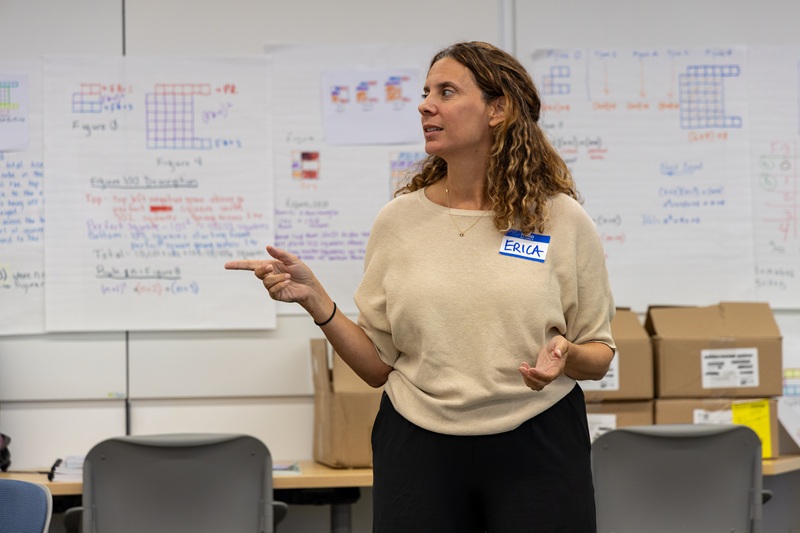
Litke has spent the last 10 years studying hundreds of real-world algebra lessons with ninth grade teachers. The results have been significant: she has identified five key instructional practices that specifically support students’ learning in algebra, and her research serves as the foundation for a $5 million, three-year professional learning initiative to improve algebra in Philadelphia, where just 15.5% of students meet proficiency standards.
Now in its second year, the program could be a model for closing the algebra achievement gap in Philly, Delaware and beyond.
Let’s focus on the teaching
Led by the University of Pennsylvania Graduate School of Education (Penn GSE) and funded by the Neubauer Family Foundation, the collaborative Algebra 1 Teaching Fellowship provides algebra teachers in the School District of Philadelphia with a yearlong fellowship of professional learning and sustained coaching in partnership with the district. With Penn GSE partners Janine Remillard, Caroline Ebby and colleagues from the Penn Learning Network, Litke helps teachers learn algebra-focused instructional practices from her research and translate those practices into tangible teaching routines in the classroom.
“Erica’s research has been central to the Algebra Teaching Fellowship, particularly because of its relevance for teachers,” said Remillard, professor and associate dean for community, climate and doctoral education at Penn GSE. “The instructional frameworks and routines she developed are pillars of the professional learning we offer, and are usable tools they can take with them into the classroom.”
For example, one instructional practice highlighted by Litke’s research is helping students give meaning to the series of steps or procedures that they use to solve an equation or math problem.
“For students to develop algebraic understanding, they need to develop both conceptual understanding and procedural fluency,” said Litke. “So we’re not teaching algebra like it’s a recipe, where you just do step 1, step 2 and step 3 to get an answer. Instead, we’re asking students, ‘Why do those steps work? What does the solution generated by this procedure actually mean?’’’
Similarly, Litke helps teachers support the development of procedural flexibility, the understanding that there’s more than one way to solve a problem and the ability to choose which strategy to employ and when.
“We can help students look at a problem and think about which method to use and why, encouraging them to compare methods,” she said.
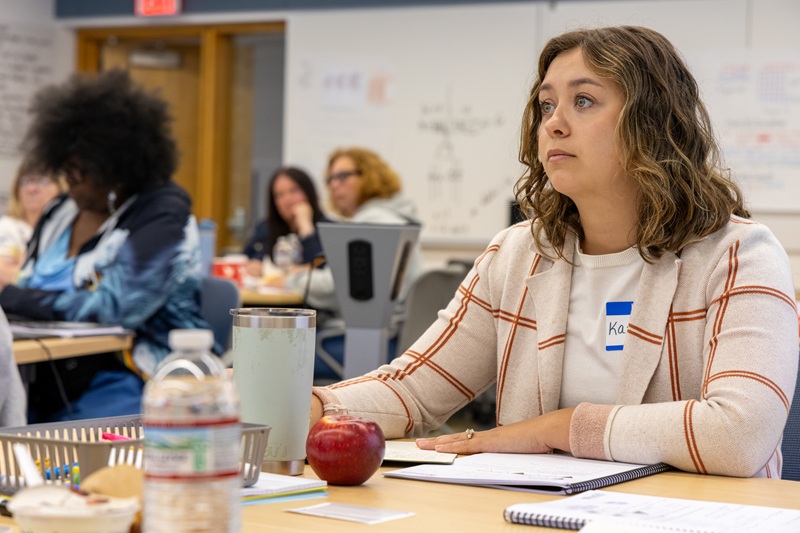
But how do teachers do this in the classroom? Litke emphasizes that small changes can yield big results. Teachers don’t need to overhaul their entire curriculum or lesson plan to incorporate these instructional practices. Instead, they can use instructional routines like what Litke has developed — 15-minute activities teachers work through with students.
“These routines always unfold the same way, and what changes is the content that you insert,” said Litke. “For example, you might do an ‘annotate and explain’ with a lesson on solving equations, but you might do it again later with a system of equations or something else.”
That familiarity reduces the “cognitive load” that students may experience with algebraic tasks. Rather than devoting brainpower to deciphering a teacher’s expectations or figuring out how to do an activity “right,” students can focus on the mathematical ideas.
“One of the fellows this summer pointed out that none of these instructional routines involve solving problems,” Litke said. “It's a different kind of cognitive work. It's a lot more like analysis or discussion. In those conversations, really critical math ideas come out. It also serves as a scaffold for teachers to help their students do more talking and thinking.”
Small changes, big rewards
To date, more than 100 School District of Philadelphia teachers have learned these routines through the fellowship, and many have shared positive feedback with Litke — including Katelyn Zimmerman, a ninth-grade algebra teacher and CEHD alum.
“One of my students didn’t understand linear equations when we did them at the start of the year, but later, when we compared linear equations to exponential ones, she was like, ‘I get the linear equations now,’” said Zimmerman, who graduated from CEHD’s elementary and middle school teacher education program. “And I thought, ‘Yes, that’s one of the essential features of algebra that we’re putting into practice — connecting different representations, but also making connections across topics.”
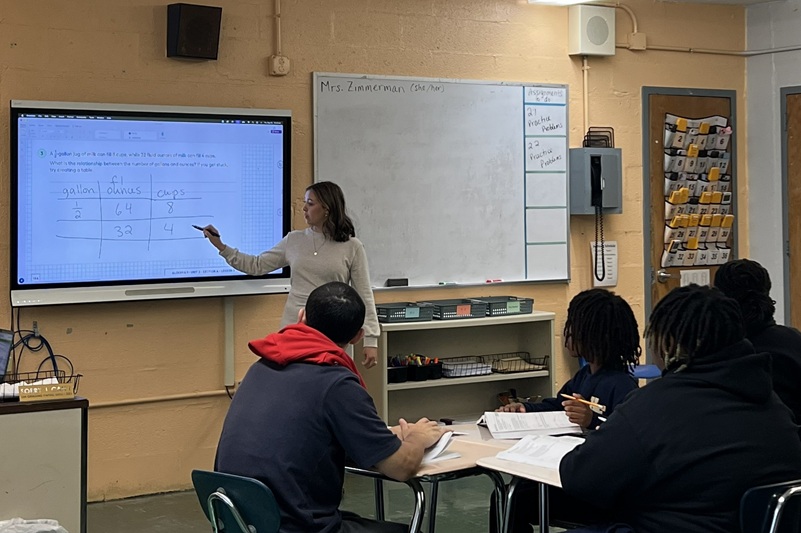
By the end of last year, she noticed that her students were more comfortable discussing and building out their ideas with peers.
“One of my goals is to build my students’ confidence in themselves, especially as mathematicians,” said Zimmerman, who recalled from her UD coursework that many children decide whether they are a “math person” by second grade. “One of the nice things about the instructional routines is that they really do lower the floor [so that] students are more willing to try.”
Zimmerman’s principal, Anthony Majewski, has also observed the impact of fellowship, commending both the program and Zimmerman’s “passion for [her] students.”
"The impact of the Algebra 1 Teaching Fellowship has boosted the delivery of algebra instruction at Hill-Freedman World Academy,” Majewski said. “If you are so lucky, you will see students supporting each other, collaborating, owning productive struggles as something good and connecting math to the real world."
Litke, too, feels “lucky” to have seen the program’s impact firsthand.
“A lot of the fellowship is focused on [helping teachers] see that opportunities for engaging in these practices are already in [their] curriculum,” said Litke, who received the 2026 Early Career Award from the Association of Mathematics Teacher Educators in February. “I’ve had teachers invite me into their classrooms, and I get to see this happen with kids. I get to watch mathematical discussions unfold, and it’s really been powerful.”
To learn more about CEHD research in STEM education, teacher preparation or professional development, visit its research webpage. To learn more about the Algebra 1 Teaching Fellowship, visit Penn GSE’s webpage.
Contact Us
Have a UDaily story idea?
Contact us at ocm@udel.edu
Members of the press
Contact us at mediarelations@udel.edu or visit the Media Relations website