




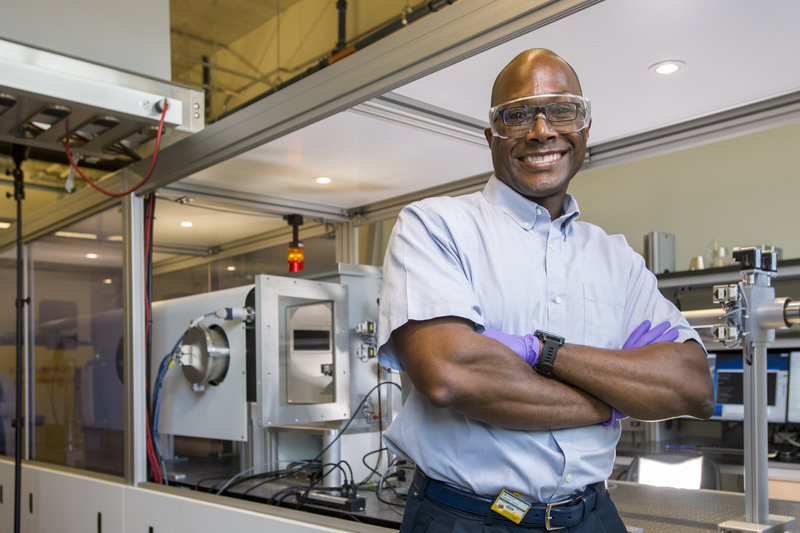
U.S. Department of Energy honor
Photo by Kathy F. Atkinson October 14, 2026
UD’s Thomas H. Epps, III one of nine recognized with E.O. Lawrence Award
University of Delaware chemical engineer Thomas H. Epps, III, is one of nine U.S. scientists and engineers selected to receive the prestigious 2026 Ernest Orlando Lawrence Award, the U.S. Department of Energy announced Tuesday, Oct. 13.
Established in 1959, the Lawrence Award recognizes exceptional scientific and engineering achievements across nine research categories that reflect DOE’s broad mission. It is among the nation’s highest honors for mid-career researchers.
Epps, the Allan and Myra Ferguson Distinguished Professor of Chemical and Biomolecular Engineering, was selected for “fundamental contributions to chemistry and materials science with applications in the chemical upcycling of polymeric waste, generation of high-performance materials from biomass feedstocks, and development of membranes for lithium-ion battery technologies.”
“It is an immense honor to be a recipient of an E.O. Lawrence award. Receiving this recognition alongside other esteemed scientists and engineers is a testament to the creativity and dedication of my research group, as well as the knowledge gained from many wonderful collaborators over the years who have nurtured my curiosity,” said Epps, who also is a professor of materials science and engineering and mechanical engineering at UD.
According to U.S. Secretary of Energy Chris Wright, this year’s Lawrence Award recipients exemplify the ingenuity and determination that drive America’s leadership in science and technology.
“From achieving fusion ignition to advancing critical materials and high-performance computing, these scientists and engineers are tackling some of our nation’s most complex challenges and translating groundbreaking research into real-world capabilities,” said Wright. “Their work strengthens our nation’s energy security, drives American innovation and ensures the United States remains at the forefront of scientific discovery.”
A pioneer in driving forward innovative polymer systems
At UD, Epps is a trailblazer whose research has focused on designing, building and characterizing new polymers to address pressing problems in materials design, use, recycling and upcycling.
Polymers are large molecules made up of smaller units strung together like beads on a necklace to create a long chain. Epps has worked to advance the chemistry and physics of polymers to generate new materials with improved performance that are derived from sustainable feedstocks, cost-competitive and readily manufacturable.
His work has had major influence in advancing the creation of novel soft materials, from thermoplastic rubbers and materials for car tires and rubber bands to inexpensive, flexible membranes for lithium batteries.
For example, Epps’ expertise in designing and fabricating conducting membranes useful in energy generation led to patented methods to improve battery performance by introducing tapers into the polymer membrane electrolytes that help lithium ions inside batteries travel more quickly. His work has the potential to improve both the speed and safety with which we charge devices including mobile phones, tablets and computers.
Epps also is a pioneer in discovering new ways to convert waste into high-value materials.
As deputy director for UD’s Center for Plastics Innovation, an Energy Frontier Research Center (EFRC), Epps leads work exploring ways to transform plastic waste into useful products, such as fuels, lubricants and advanced polymers.
Meanwhile, at UD’s Center for Research in Soft Matter and Polymers (CRiSP), he directs efforts aimed at creating sustainable materials from plant-based waste, including pressure-sensitive adhesives or tapes, 3D-printed plastics and alternatives to petroleum-based precursor molecules. His research group’s work on lignin, a component of plants left behind as a byproduct of the paper industry, led to several licensed technologies, as well as a startup, Lignolix, to convert lignin waste into biobased adhesives and specialty chemicals for cosmetics, flavors and fragrances.
Highly esteemed in his field, Epps is a fellow of the National Academy of Inventors, the American Association for the Advancement of Science, the American Institute of Chemical Engineers, the American Chemical Society, the American Institute of Medical and Biological Engineering, the Royal Society of Chemistry and the American Physical Society. He is the recipient of the Percy Julian Award for science excellence, among other career accolades. A prolific innovator, Epps is an inventor on 16 patents and eight patents pending.
Epps and his fellow awardees will be recognized by the U.S. Department of Energy at a hybrid ceremony in Washington, D.C., on Nov. 13. The event will be livestreamed.
Contact Us
Have a UDaily story idea?
Contact us at ocm@udel.edu
Members of the press
Contact us at mediarelations@udel.edu or visit the Media Relations website