

Cracking the ice age code
Photos courtesy of Sian Proctor, IODP, Tim Fulton and Anieke Brombacher June 25, 2026
UD research discovers the driver behind global glacial pacing
To understand where the Earth might be headed, it’s important to know where it’s been.
Throughout its existence, especially over the last couple million years, the Earth has experienced periodic cold and warm intervals, known as glacial and interglacial time periods.
These cycles used to occur every 41,000 years. But somewhere between 1.2 million and 700,000 years ago, the cycle shifted to occurring every 100,000 years, a transition period known as Mid-Pleistocene Transition (MPT).
Recently published research in Science Advances from the University of Delaware sheds new light on how and why this change occurred.
The work was led by Chandranath Basak, assistant professor in the Department of Earth Sciences, and made possible through the International Ocean Discovery Program (IODP) Expedition 383 in 2019. IODP was a multi-country consortium that concluded in 2024 after multiple years of enabling scientists to study the seafloor.
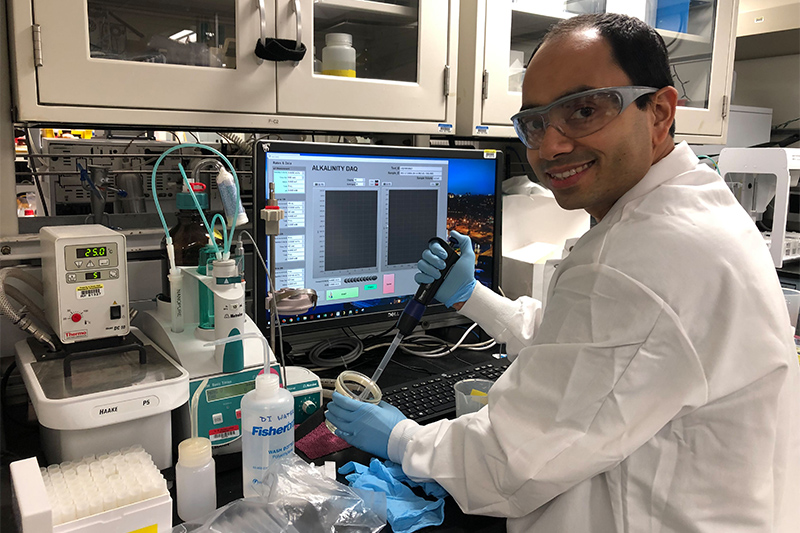
Basak said this work is critically important for understanding how Earth’s future climate might unfold. As the ice melts due to rising global temperatures in the northern and southern high latitudes, future predictions are heavily reliant on past observational data.
“Every bit of past observations that we make helps us to understand how these different climatological factors interact with each other and how they respond to certain forces to bring about the changes in a world that had no human input,” Basak said.
How Earth’s climate behaved through geologic time is believed to have been strongly controlled by the amount of carbon stored in deep ocean waters. This deep ocean carbon storage is, in turn, controlled by how water in the deep ocean moves around, which scientists call “deep ocean circulation.”
Basak said the purpose of this study was to investigate the changes that occurred to the deep ocean circulation, an important component of Earth's climate.

“Whatever changes are happening in these records are completely driven by natural changes,” Basak said. “That helps us to better parameterize climate models to eventually give us insight into future changes that we can expect moving forward in a rapidly changing world.”
Basak’s team analyzed different forms of the rare-earth element neodymium preserved in fossil fish teeth found in sediment samples. These data carry information about how deep circulation changed through time.
There had been a long-standing idea that this change in Earth’s deep-ocean circulation originated in the Northern Hemisphere, but this study's results showed it was actually triggered by the Southern Hemisphere and then supported by the Northern Hemisphere, highlighting the importance of Antarctic glaciation in heralding these changes.
“What happened in and around Antarctica played an important role in controlling global deep ocean circulation,” said UD doctoral student Kapuge, who co-authored the paper along with UD graduate Emily Symes. “It is the same deep ocean circulation system we're actively monitoring today for signs of modern weakening. So, in that regard, this study has modern relevance.”
Contact Us
Have a UDaily story idea?
Contact us at ocm@udel.edu
Members of the press
Contact us at mediarelations@udel.edu or visit the Media Relations website