




How do you measure something almost impossible to detect?
Photos by Kathy F. Atkinson June 23, 2026
A five-year NSF-funded project aims to uncover hidden magnetic activity that could lead to advances in wearable devices, brain imaging and other technologies
Magnets are used in everything from cars to computers. But some advanced materials produce magnetic fields so short-range and fleeting that today’s sensors cannot get close enough to measure them, leaving researchers unable to fully understand how those materials work or how to harness them for new technologies.
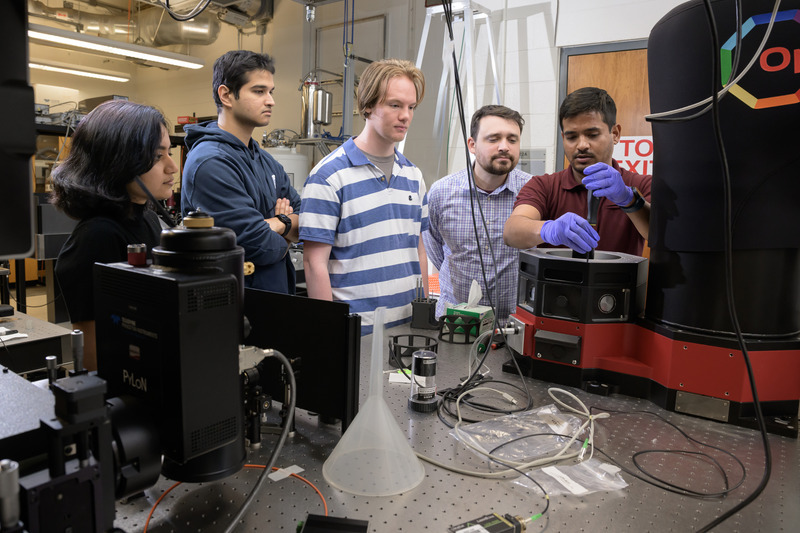
With support from the National Science Foundation, the University of Delaware’s Chitraleema Chakraborty is exploring fundamental principles for magnetic sensing at scales of just a few billionths of a meter. The $500,000 award is part of NSF’s Faculty Early Career Development (CAREER) program, which supports early-career faculty poised to lead in both research and education.
“This award is the result of many people's work," said Chakraborty, an assistant professor of materials science and engineering. She credits her mentors, students and programs such as UD's NSF CAREER Proposal Academy.
She plans to pay that forward by incorporating student training and community outreach into the five-year project as she and her team lay the foundation for future sensor technologies that could one day advance fields from biomedical imaging to wearable devices.
Closing the gap
Today’s magnetic sensors are usually embedded within a bulk material, leaving a small but significant gap between the sensing element and the source of the magnetic field. Many emerging magnetic materials generate short-range fields that decay within three to four angstroms. That’s just a few atoms wide, a distance so small that existing sensors cannot physically get close enough to measure signals directly.
Researchers are pursuing two strategies to bridge this gap: increasing sensor sensitivity or bringing the sensor closer to the source. There are physical limits to how far sensitivity improvements can go, Chakraborty said, which is why her team focuses on proximity.
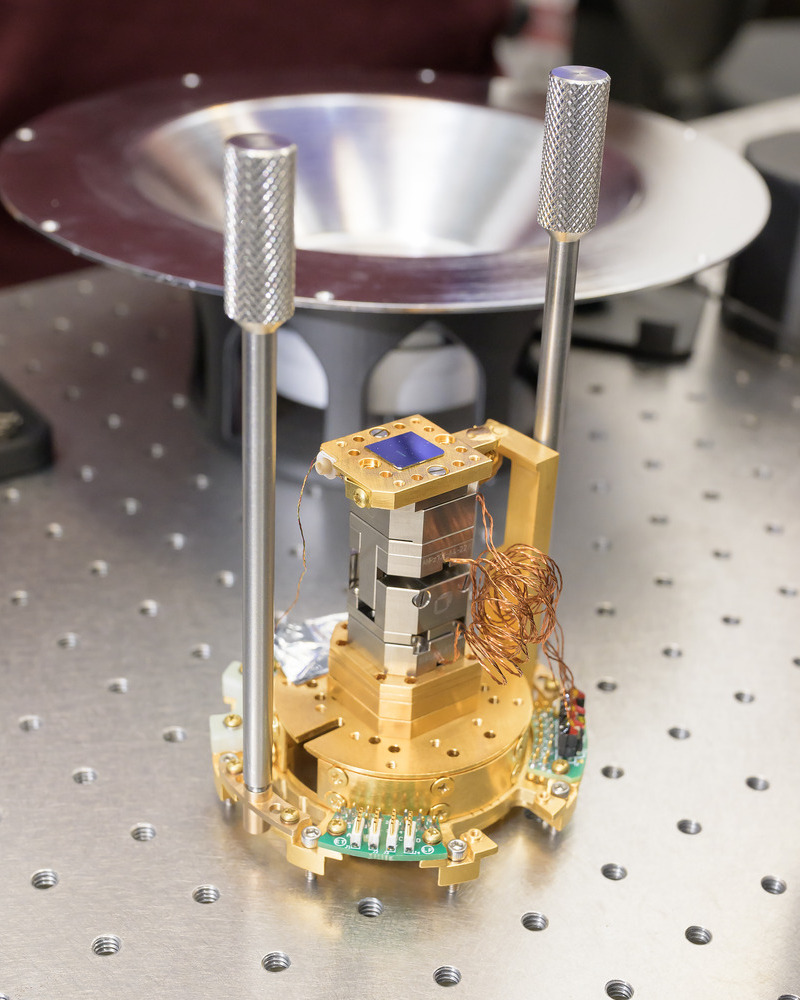
They have developed atomically thin semiconductor materials that can be laid directly on top of a magnetic material, getting far closer than a conventional sensor. The next step is identifying features within that ultra-thin layer that can serve as the sensing element.
Recent work from the Chakraborty lab demonstrated how tiny crystal defects in the semiconductor layer can act as light-emitting sensors, providing information about magnetization and local magnetic field.
Now, the team is working to deliberately introduce and stabilize such defects. Early results suggest these engineered defects can survive at room temperature — an important step toward practical use. The researchers will next test whether the defects respond predictably to magnetic fields by applying controlled fields and looking for measurable optical changes such as shifts in brightness or color. The approach will be tested across different materials and temperatures to establish its robustness.

“If successful, this could lead to devices that function as sensors and extend beyond magnetic materials,” Chakraborty said. One example she pointed to is flexible sensors in wearable systems that could make brain imaging more precise and adaptable than today's one-size-fits-all devices.
The interface between the atomically thin semiconductor and nearby material may also prove important. When materials are brought into close contact, they can exhibit new magnetic and electronic behaviors that could open further doors in sensing or computing.
Building well-rounded researchers
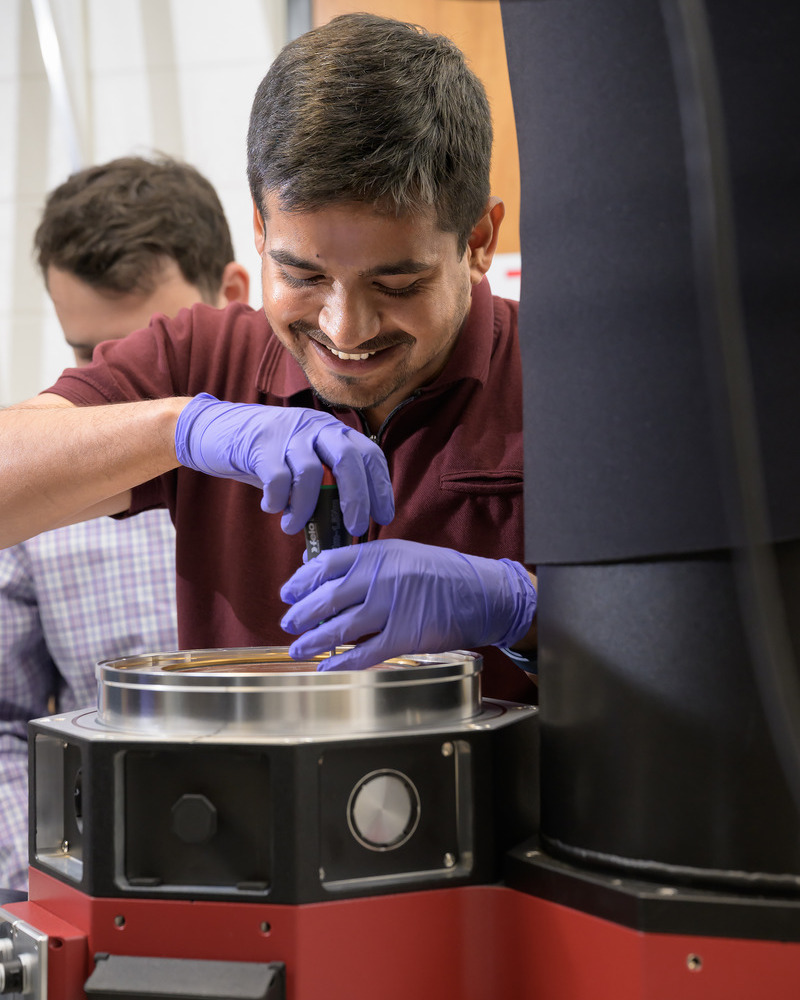
The project also includes a strong focus on training and outreach. Chakraborty, who holds a joint appointment in the Department of Physics and Astronomy, said many of her lab’s advances have been driven by graduate students, who are gaining hands-on experience in areas like quantum imaging and sensing, materials science, optical measurement and condensed matter physics.
With the CAREER grant, Chakraborty plans to expand those training opportunities and push beyond purely technical skills.
“Students need to develop communication and professional skills alongside technical expertise,” she said.
In her graduate course on quantum hardware, she will incorporate research-based modules that challenge students to explain complex concepts to different audiences, ranging from peers to middle school students.
She is also planning a new workforce development program in collaboration with UD’s Office of Economic Innovation and Partnerships and the UD Career Center. Expected to launch in year three of the grant, the program would offer two- to three-week job-shadowing experiences with industry partners.

“Many students don’t have the flexibility to do long internships while completing their degrees,” she said. “This would give them a way to see what industry is like and start building those connections.”
Chakraborty said the emphasis on professional skills is shaped by her own early-career experiences navigating interactions with industry and the broader research community.
Ultimately, her work aims to make previously inaccessible magnetic signals measurable while preparing the next generation of scientists to turn those insights into real-world technologies.
Funding is provided under NSF award number 2543219.
Contact Us
Have a UDaily story idea?
Contact us at ocm@udel.edu
Members of the press
Contact us at mediarelations@udel.edu or visit the Media Relations website