
From screen to sensation
Photos by Evan Krape July 17, 2026
A UD materials science researcher is working to bring the sense of touch to digital screens
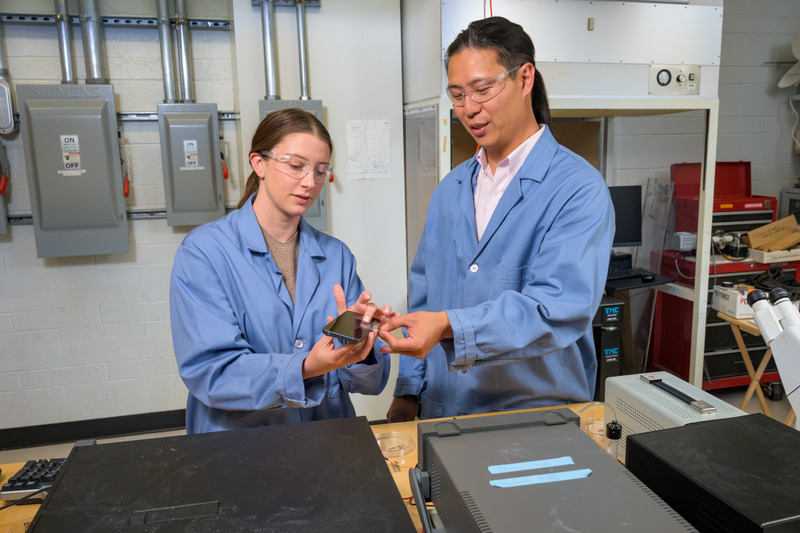
Imagine shopping online for a T-shirt and being able to feel the fabric’s texture through your phone before you buy it. At the University of Delaware, Charles Dhong is developing tactile technology designed to bring physical sensation to digital screens.
Beyond consumer smartphone applications, the work could support accessibility tools for blind and low-vision users, new educational approaches, and future applications in virtual reality and medical training.
“Current devices simulate sensation only through vibration,” said Dhong, an assistant professor of materials science and biomedical engineering. “Our ultimate vision is immersive touch experiences.”
A five-year, nearly $700,000 grant from the National Science Foundation will help Dhong and his team advance toward that vision. The award is part of NSF’s Faculty Early Career Development (CAREER) program, which supports faculty poised to lead in both research and education.
Beyond vibration
When you touch a table or a piece of clothing, its feel comes from a combination of physical and chemical patterns on its surface. Some are microscopic — a fraction of the width of a human hair — and some, like the fibers in a piece of cloth, are large enough to see.
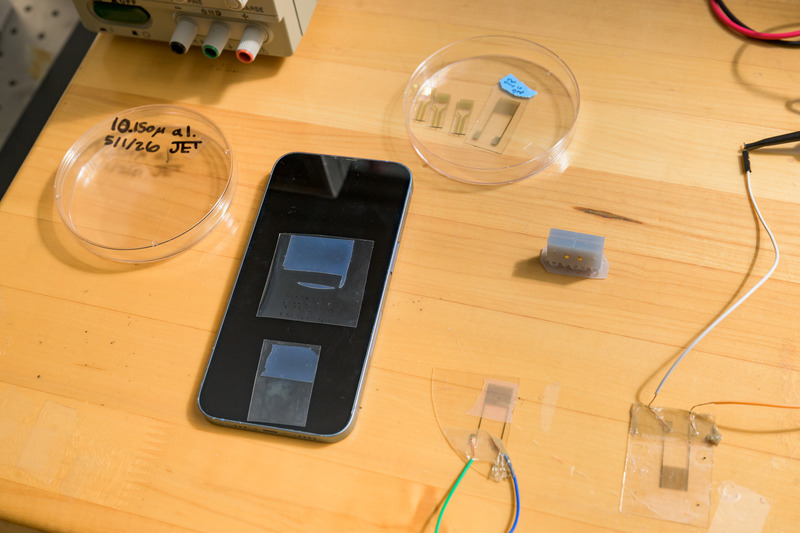
Dhong's team is designing a thin device that can change how surfaces feel by controlling patterns at the molecular scale, shifting the orientation and arrangement of individual molecules to alter how a surface is perceived through touch. The goal is to extend that control to larger scales, where richer and more nuanced textures may be possible.
Placed on top of a smartphone screen and controlled through an app, the prototype will build on patent-pending technology developed in Dhong’s lab at UD.
Designing for human touch
One challenge in developing tactile devices is that touch perception varies widely from person to person.
Dhong’s team has built custom tools and analysis methods to characterize how their materials will perform in human studies. This allows them to refine their design before recruiting participants to evaluate a prototype’s performance. The goal is something that works reliably across many different hand sizes and sensitivities, much like a television screen that serves nearsighted, farsighted and colorblind viewers alike.
“We’re trying to make something robust for a lot of people. It has to work across many scenarios,” Dhong said.
Teaching through touch
Education and outreach are central to Dhong's NSF CAREER project. One effort involves developing a two-week undergraduate module on human-centered materials design. Dhong noted that tactile design already shapes industries from cosmetics to packaging, where texture and physical experience can influence consumer perception.
Consider the smooth coating on an iPhone box. That texture is intentional, helping create a sense of quality. By introducing students to these ideas early, Dhong hopes to help future engineers think more intentionally about how people physically experience the materials they design.
The project also explores how tactile technologies themselves could become educational tools. Planned efforts include developing STEM learning modules in collaboration with teachers of the visually impaired and creating touch-based activities to help students understand abstract scientific concepts.
The goal is to make education in science, technology, engineering and mathematics more accessible for students who benefit from non-visual learning pathways, while broadening how abstract concepts are taught more generally.
“Even for non-blind learners, some concepts may be easier to grasp when experienced physically, rather than just seen on a screen,” Dhong said.
Product-level technologies remain years away, but Dhong hopes touch will eventually become a richer part of how people experience digital technology — expanding how people learn, communicate and experience information through screens.
Funding is provided under NSF award number 2543315.
Contact Us
Have a UDaily story idea?
Contact us at ocm@udel.edu
Members of the press
Contact us at mediarelations@udel.edu or visit the Media Relations website