
AI meets advanced manufacturing
Photo illustration by Jeffrey C. Chase July 22, 2026
UD researchers join national energy initiative to bring AI into advanced manufacturing
Researchers at the University of Delaware will explore how artificial intelligence can help manufacturers improve the production of advanced composites — the lightweight, durable materials used in products ranging from automobiles to energy infrastructure — as part of the U.S. Department of Energy’s Genesis Mission.
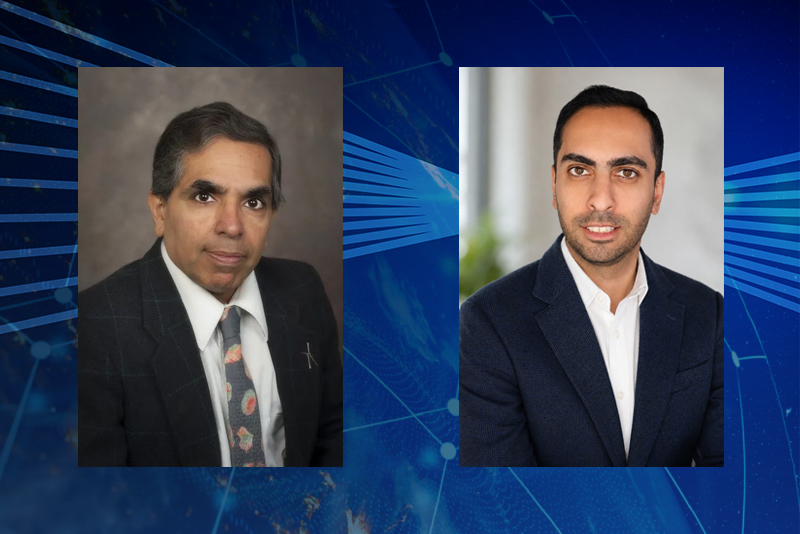
Led by Suresh G. Advani, the Unidel Pierre S. du Pont Chair of Engineering, and Navid Niknafs, research associate III at UD’s Center for Composite Materials, the team has been selected for Phase I of the program. Working with GE Vernova, a global energy technology company that spun out of General Electric in 2024, researchers will develop an AI-driven framework for manufacturing composite materials.
The team’s project is part of the Genesis Mission, a historic national initiative led by the U.S. Department of Energy that is building the world’s most powerful integrated science discovery platform. By uniting government, industry, academia and philanthropy, it is accelerating breakthroughs in energy, scientific discovery and national security through a new platform that combines AI, supercomputing, quantum systems and advanced scientific instruments.
The goal of the Phase I awards is to identify promising pathways toward transformative scientific capabilities and establish a foundation for future investment and scale. The selected researchers will design and demonstrate research workflows that integrate AI with scientific investigation, while rigorously evaluating whether those approaches can accelerate discovery, improve predictive capabilities, enhance experimentation or reveal new scientific insights.
As part of that effort, the UD-led team will develop a framework that incorporates AI to improve the advanced manufacturing of fiber-reinforced polymer composites, which combine high-strength fibers with a polymer resin. These materials are increasingly used in automotive, energy, and infrastructure applications.
“Being selected for the DOE Genesis Mission is a tremendous opportunity to accelerate the integration of artificial intelligence into composite manufacturing,” said Advani. “This project allows us to bring together computer simulations, real-time process monitoring and AI-driven decision-making in a single closed-loop framework, moving our field from offline, pre-planned processing toward intelligent and adaptive manufacturing.”
Advanced composite manufacturing is challenging because even small variations in constituent materials, temperature or processing conditions can influence the quality and performance of the finished component. Many defects cannot be detected until production is complete, when correcting them may be costly or impossible. The UD team wants to overcome this challenge by giving the manufacturing process the ability to recognize emerging problems and respond before they become permanent defects.
The project will connect sensors, process monitoring systems and computer simulations to support autonomous, real-time decisions. The team will concentrate on two critical stages of advanced composite manufacturing: controlling how liquid resin flows through reinforcing fibers and managing curing, the process through which the polymer hardens into its final form.
By integrating process data, material characterization, simulation results and machine-learning models, the team aims to develop an intelligent system capable of predicting manufacturing outcomes, assessing defect risks and autonomously adapting to process conditions. The long-term goal is to enable more reliable manufacturing of large-scale composite structures despite variability in materials and processes.
In addition to this UD-led award, researchers from UD’s Department of Computer and Information Sciences received three Genesis Mission subawards. Xu Yuan, associate professor, is participating in “Bridging Genomics and Reactive Transport Models with AI for Subsurface Prediction,” a project led by the University of Maine. Dong Dai, associate professor, is involved in two projects: “Automatic Performance Portability for Distributed Scientific Workflows on the Genesis Mission Platform,” led by the U.S. Department of Energy’s Pacific Northwest National Laboratory, and “CASCADE: Composable Assurance for AI-enabled Scientific Computing with Agentic Error Governance,” led by the University of North Carolina at Charlotte.
About the Center for Composite Materials
Founded in 1974, the University of Delaware Center for Composite Materials is one of the first university-based centers dedicated to composites. CCM brings together interdisciplinary research, education and technology transfer to advance composite materials from discovery to deployment. Working with industry, national laboratories and federal agencies, its faculty, researchers and students solve complex materials challenges and move innovations toward manufacturing-ready solutions for critical industries.
Contact Us
Have a UDaily story idea?
Contact us at ocm@udel.edu
Members of the press
Contact us at mediarelations@udel.edu or visit the Media Relations website