




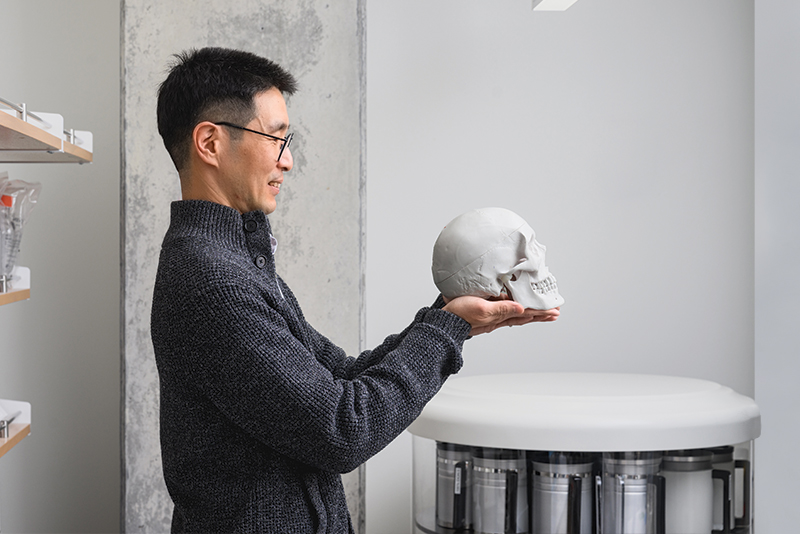
Aching jaw? UD scientist works to unlock mystery
Photos by Evan Krape February 25, 2026
UD developmental biologist studies genetics of jaw joint disorder with NIH funding
If you have ever experienced a sore jaw from grinding your teeth, too much chewing gum or a long session in the dentist chair, it’s likely you know where the temporomandibular jaw joint is located.
For the rest of us, this tiny little joint is situated just under the ear, and it acts like a sliding hinge that enables our ability to talk, laugh, chew, swallow and yawn. Made up of tissue, muscle and tendons, it is considered one of the most used joints in the human body, opening and closing over 2,000 times per day.
It’s not something we think about, of course, unless we run into trouble.
For those living with temporomandibular joint (TMJ) disorders, however, this hinge can cause immense pain when the disc that enables its sliding action gets caught between the top and bottom of the jaw. With no cure and few treatment options, these joint disorders can substantially affect quality of life.
Joohyun (Jason) Lim, a developmental biologist at the University of Delaware with an interest in human genetics, hopes to change this by advancing understanding of the disease process at the molecular level. Armed with an R01 grant from the National Institutes of Health, Lim is particularly interested in osteoarthritis of the temporomandibular joint (TMJ-OA), a degenerative disease that contributes to jaw problems affecting over 11 million people in the United States annually, including TMJ.
“It’s a tissue that's been largely ignored, and there isn’t really a standard of care,” said Lim, assistant professor of biological sciences. “You either take general pain medication, rest, don't chew in an area, and that’s about it. And yet TMJ is so common, but it’s not really discussed.”
Leveraging genetics to better understand osteoarthritis
Osteoarthritis (OA) typically occurs due to trauma or genetic consequences that emerge later in life. For people with OA in the knee, which is also a hinge joint, the solution is often a joint replacement as they age. Timed appropriately, it’s a solution that can last many years.
But for those with TMJ-OA, disease onset often occurs in younger individuals, particularly women ages 20 to 40 years old. Here, non-invasive therapies are considered best, since jaw joint replacement early in life would require regular updating every 10 to 20 years.
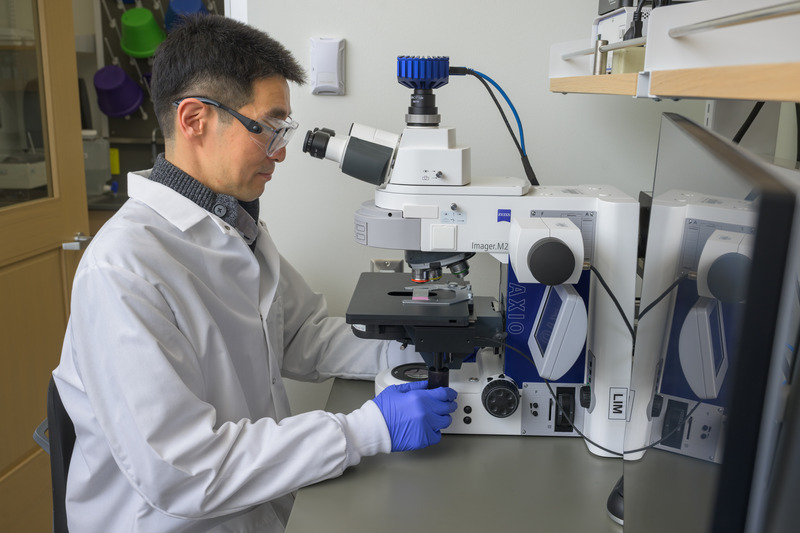
Lim is eager to understand how jaw joint tissues are formed and maintained throughout life. He also wants to know how cells in this small but important area differentiate into various cell types and how changes in this mechanism contribute to the development of TMJ osteoarthritis. He hypothesizes that cells in the fibrous surface layers on the back of the lower jawbone, called the mandibular condyle, may play a role.
It’s not an easy problem to solve.
“With the jaw joint, the components are so small that it becomes particularly difficult to separate out what is the driver or the consequence of a disease,” he said. “This is because people go to see a doctor when they feel pain, when things go wrong or when things are not working. Meanwhile, the jaw joint may have already degenerated over time, creating a situation where the joint is not in the same state as when the initial trigger occurred.”
Typical methods to understand how a particular cell type behaves during development or injury have used cell culture models and animal models, where researchers study the genetics by either deleting a gene, increasing the expression of a gene, or targeting a specific tissue to see what happens as a result. New tools in the field are enabling cutting-edge genetic approaches that will allow researchers to explore even more complicated questions with these small tissues. This is where Lim intends to focus.
“In a given tissue, there is this idea of cellular heterogeneity. This means that even if cells look all the same on a tissue section, their molecular nature — or their cell states — can be vastly different,” he said. “Because of tools like single-cell RNA sequencing, and now spatial transcriptomic approaches, we’re beginning to find that each individual cell can be represented by their collective gene expression profile. This was not possible before.”

A quick primer: ribonucleic acid (RNA) is a single-stranded molecule that is synthesized from our DNA — the code of life — and translated into proteins that perform certain functions in our cells. RNA sequencing is a tool for analyzing all the RNA molecules in a given cell. Collectively, these molecules are called a cell’s “transcriptome.” Spatial transcriptomics lets researchers examine the transcriptomes of various cell types in tissue samples, which can be used to identify cells, cell-to-cell interactions and localized changes that cannot be detected using traditional approaches.
Lim likened this type of spatial transcriptomic data to a clear, crisp photograph versus a pixelated image.
“Maybe you can see details that you were not able to decipher with the pixelated version to get a clearer vision for what’s happening at the cellular level,” Lim continued. “We want to understand localized changes, how the cell types are changing, especially in response to disease or injury.”
Having this kind of information could shed light on whether certain genes are turned on or off during TMJ development and disease and whether it’s possible to regulate the environment in any way. If so, perhaps there is hope for developing therapies to delay or stop TMJ-OA from progressing. Ultimately, Lim hopes to apply what he learns about the genetics of temporomandibular joint disorders to shed light on similar health problems in other areas of the body, for instance, osteoarthritis in the knee or hip, or in other joint diseases such as rheumatoid arthritis.
These cutting-edge single-cell and spatial transcriptomics tools are available right on campus, Lim said, thanks to the Delaware Biotechnology Institute’s (DBI) Bio-Imaging Center. Other core facilities and support critical to his work include the Flow Cytometry and Single Cell Core, DBI’s DNA Sequencing and Genotyping Center, the Delaware Center for Musculoskeletal Research, and Delaware INBRE.
“We are very excited about our interdisciplinary collaborations to get a better picture of the molecular and cellular landscape in joint diseases. This is largely uncharted territory, and there is much to be explored,” said Lim.
Contact Us
Have a UDaily story idea?
Contact us at ocm@udel.edu
Members of the press
Contact us at mediarelations@udel.edu or visit the Media Relations website