
Robotics help solve Deep Sea Mysteries: youtube.com/watch?v=iCB9oCdeWqc
Deep sea exploration
Video and photo illustration by Jeffrey C. Chase March 03, 2026
UD’s College of Earth, Ocean and Environment uses robotics to study the depths of the ocean
From the East Pacific Rise in the Pacific Ocean to the Mid-Atlantic Ridge in the Atlantic, researchers from the University of Delaware’s College of Earth, Ocean and Environment led the charge of underwater discovery this past year, steering research cruises that each employed one of the three underwater vehicles currently operated by the National Deep Submergence Facility (NDSF).
By utilizing these vehicles, scientists can help unravel the mysteries of the deep and answer complicated scientific questions.
The NDSF is sponsored by the National Science Foundation, the Office of Naval Research and the National Oceanic and Atmospheric Administration and charged with operating, maintaining and coordinating the use of deep ocean and seafloor exploration vehicles in the U.S. Academic Research Fleet.
Investigating the carbon chemistry of the deep ocean
Andrew Wozniak and Sunita Shah Walter, both associate professors in UD’s School of Marine Science and Policy, as well as David Christopher, marine education specialist with Delaware Sea Grant at UD, were among the participants that joined faculty, staff and students from Rensselaer Polytechnic Institute, Middle East Technical University, McGill University and Millersville University of Pennsylvania on a voyage to the East Pacific Rise. George Luther, professor emeritus, is also involved in the project but was not on board for this cruise.

The group worked aboard the Research Vessel (R/V) Atlantis with the Human Occupied Vehicle (HOV) Alvin along the East Pacific Rise, a section of the global mid-oceanic ridge system where the Pacific and Cocos plates are pulling away from each other, creating new oceanic crust.
At these locations are hydrothermal vents ecosystems, some of which emit fluids rich in minerals from below the seafloor, creating features called “black smokers.” The UD researchers studied the organic compounds being emitted from these black smoker vents, with a specific focus on how the vent emissions influence the carbon chemistry of the deep ocean.

Inside the Alvin, the science crew was able to dive to the seafloor to collect samples.
On one of those trips to the seafloor, Wozniak and Alyssa Wentzel, an undergraduate who graduated from UD in 2025, were able to witness an underwater volcano erupting before their eyes.
“The really amazing thing was that we were able to get back on the ship and deploy some instruments over the side so soon after the eruption to collect data on what was happening,” Wozniak said. “Hopefully, that will be valuable for understanding the impacts of these eruptions on the sea water.”

Studying methane on the seafloor
Later in the year, Shah Walter planned a research expedition to the edge of the Mid-Atlantic continental shelf, where the research team worked off the R/V Endeavor and used the Autonomous Underwater Vehicle (AUV) Sentry to investigate areas where bubble plumes have been detected, specifically looking for methane seeping out of the seafloor.
The AUV Sentry is about the size of a motorcycle and can carry out a pre-programmed mission, using its sensors and detectors to collect data autonomously. Because Sentry can dive and work close to the seafloor, the researchers were able to get high resolution images of methane bubble plumes, which tell them where the methane is seeping out. This methane seepage is interesting because, as Shah Walter explained, researchers aren’t sure why it seeps out at these locations.

“There’s no hydrocarbon reservoir like there is in the Gulf of Mexico, and there aren’t any tectonic plates moving like you would see in the Pacific,” Shah Walter said. “We don’t have a good understanding of why methane is coming up from the seafloor in this location. It could potentially be microbial methane, produced by microbes that are degrading organic matter, or it could be geological methane, produced by high heat interacting with organic matter.”
Kaleigh Block, a doctoral student at UD who also participated on the earlier cruise to the East Pacific Rise, was one of the UD representatives on board the ship. For this excursion, she oversaw sample collections. As the Sentry “mowed the lawn,” or mapped the underwater area by driving back and forth, Block and other graduate students on board the ship looked at which plumes seemed to be the most active for sampling.
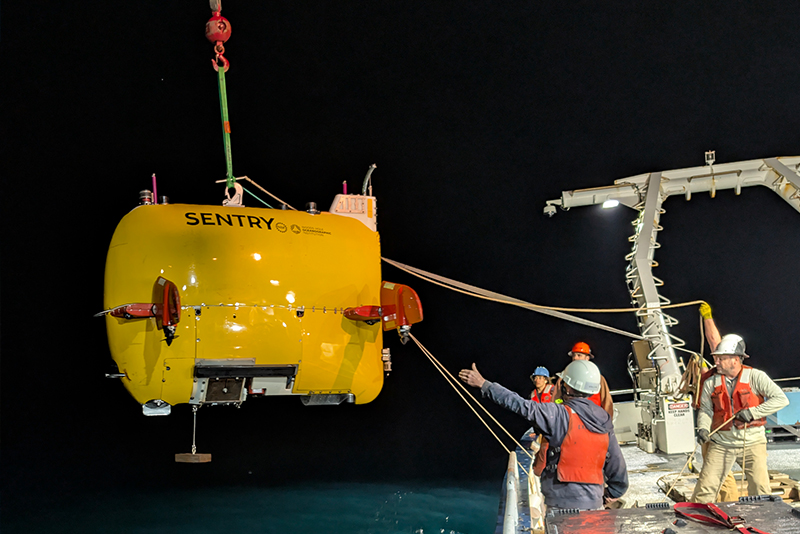
Block is hoping to use these samples in her dissertation work and said both the cruises, and getting to work with HOV Alvin and AUV Sentry, were invaluable experiences.
“It was great to learn just how these instruments are used and how they can help us learn more about the underwater environment,” Block said. “Getting to see what the engineers and the crew members do with these instruments was really interesting, and I learned a lot from the crew of the Sentry and the Alvin.”

Collaborating so the ‘very best deep-sea science gets done’
Jonathan Cohen, professor in UD’s School of Marine Science and Policy, also led a research expedition to the Mid-Atlantic Ridge, to the Lucky Strike hydrothermal vent field, for a National Science Foundation-funded project studying the vision of deep-sea hydrothermal vent shrimp.
The month-long cruise aboard the R/V Neil Armstrong utilized the Remotely Operated Vehicle (ROV) Jason, which is about the size of a car and has sensors, claw arms and a suction system that allowed the researchers to collect organisms into canisters and bring them onto the ship.

“These systems are very deep and are populated by organisms with interesting adaptations,” Cohen said. “One of them, which is common at a lot of vents, are shrimp that don’t have prominent stalked eyes like the typical shrimp or crab. Instead, they have eyes on their backs. This makes us wonder why they have eyes on their backs, first of all, and then why they have eyes at all, because they're basically living in a dark environment that isn’t penetrated by sunlight.”
Using a camera mounted to the Jason vehicle, the researchers recorded videos of the shrimp moving around under different light conditions, seeing how the shrimp react to different colors of light.
The research team also used Jason to collect shrimp and investigated the functioning of cells in the eye, performing different light experiments on board the ship.
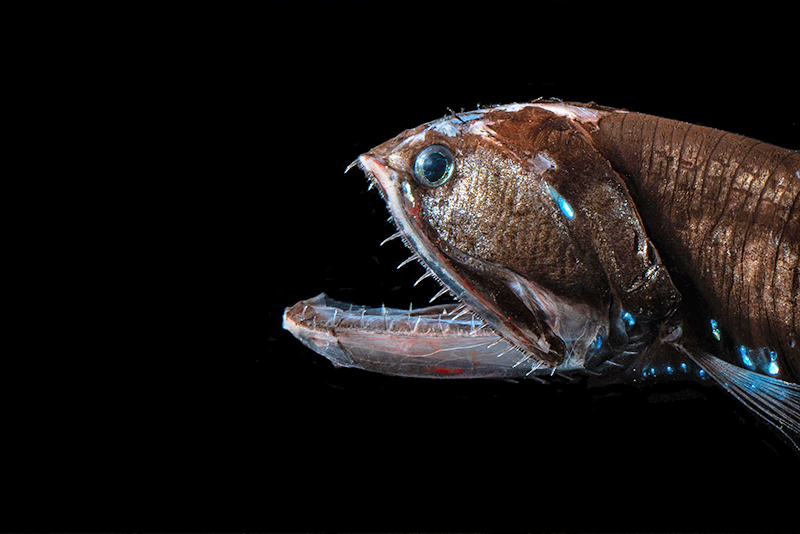
None of this research would have been possible had it not been for the ROV Jason.
Jason is controlled from the ship. The scientific group and the ROV team collaborate on where to send the vehicle.
“The ROV team is driving the vehicle. They're giving you control of the cameras so you can record images that you want, and it's this great interactive scientific experience where you're working with them to get the science done,” Cohen said. “It's a really fun and productive way to work, both in terms of that interaction with the Jason technology but also what it allows the scientific team to do. For these large collaborative projects, it's an excellent tool to make sure the very best deep-sea science gets done.”
Contact Us
Have a UDaily story idea?
Contact us at ocm@udel.edu
Members of the press
Contact us at mediarelations@udel.edu or visit the Media Relations website