





Monitoring sand movement
Photos courtesy of Robin Mattheus April 27, 2026
Delaware Geological Survey installs cameras up and down the Delaware shore to document patterns of sand movement and beach change
Delaware shorelines are constantly changing, largely driven by storms that erode the shoreline and move sand away from the beach, depositing it elsewhere. Every year, the state works to mitigate erosion and keep beach communities safe and beaches thriving. A new study from the University of Delaware supports these efforts by deploying simple trail cameras along the Delaware coast to better understand sand-transport patterns. More than a dozen have been set up so far.
The study is led by Robin Mattheus, scientist with the Delaware Geological Survey, who said the aim is to eventually have cameras along the whole Sussex County.
Currently, camera boxes are deployed at Lewes, Kitts Hummock, the Indian River Inlet, Cape Henlopen and Prime Hook Beach. They provide continuous coverage of the dynamics that shape the coast by taking photographs every 30 minutes.
The cameras are placed at high vantage points, such as a homeowner's deck, the fishing pier at Cape Henlopen and the Indian River Inlet Bridge. Mattheus said the homeowners and municipalities have been incredibly accommodating.

“We benefit from having elevated viewsheds, and we have been lucky to find many willing camera hosts with high decks that provided useful views down the shoreline,” said Mattheus. “Some municipalities have given us permission to use lamp posts located close to the shoreline. We have had access to a lot of different types of infrastructure near the shoreline, and none of our deployments have made any permanent modifications.”
Mattheus hopes that these cameras will generate a useful supplement to Delaware's other coastal monitoring datasets, which already include information from tide-gauges, weather stations and other surveying records.
“The goal is to provide visual documentation of the processes that shape the coast and, with regional camera deployment, be in a position to help address how different parts of the coast connect from a sand-transport perspective,” said Mattheus.
Insights from camera deployments can be further enhanced with citizen science efforts that are already taking place in Delaware, such as CoastSnap DE, an online community effort that allows beach visitors to take pictures from a fixed camera mount. Integrating this data into regional monitoring efforts will provide a more holistic view of coastal sand transport patterns.
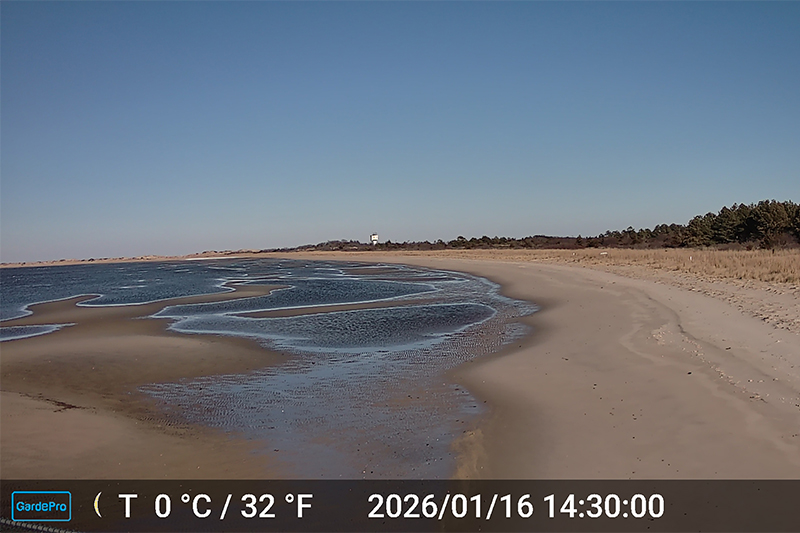
The photos captured by the cameras could also aid organizations such as the Army Corps of Engineers, which engages in a variety of activities along the coast, including coastal mapping, erosion monitoring and determining where to place sand.
The winter was a good time to have the cameras up, as there are few beach goers when the weather is stormy and cold. Mattheus noted this will help fill some of the coverage gaps from citizen scientists when there aren’t many people at the beach.
For instance, the cameras have already captured a Nor’easter that passed through, and the footage from that wave event is currently under review. With that data, DGS researchers hope to see how waves are approaching Delaware’s coastal communities, addressing both similarities and differences in related shoreline behaviors.

Repeat images can be used for a variety of analyses, Mattheus said. With machine learning, one can automate the tracing of the shoreline, as “water pixels” can be distinguished from “beach pixels.”
During storms, the consistent breaking of waves can be mapped and used to inform on where sandbars are located. This might change from storm to storm and help researchers keep track of developments in front of the shoreline.
“If waves start breaking differently during storms, this might be linked to changes in the elevation of the nearshore or the shifting of sand bars,” said Mattheus. “Changes to the shoreline relate to what is happening just offshore, so keeping track of the arrangement of sandbars through camera-based analysis could be very useful. We also stand to learn more about regional sand-transport processes.”
Contact Us
Have a UDaily story idea?
Contact us at ocm@udel.edu
Members of the press
Contact us at mediarelations@udel.edu or visit the Media Relations website