
Predicting Alzheimer’s earlier
Photos by Ashley Barnas Larrimore and courtesy of Alyssa Lanzi December 09, 2025
UD’s DementiaBank outshines global competitors, driving machine-learning advances in early dementia prediction
Could the way we speak — from subtle stutters to repeated words — reveal the earliest signs of Alzheimer’s disease? Researchers and data scientists worldwide think so, and their quest for answers just led to a major win for the University of Delaware.
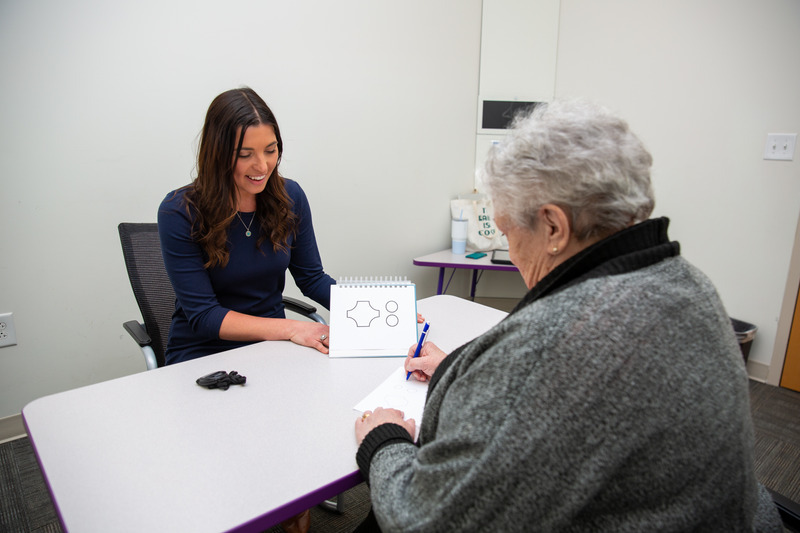
Alyssa Lanzi, assistant professor of communication sciences and disorders (CSCD) in UD’s College of Health Sciences, leads efforts to expand and diversify DementiaBank, a shared database of multimedia interactions for studying communication in dementia.
Her research, supported by a $3.7 million National Institute on Aging (NIA) grant, has recently earned national recognition after being selected among thousands of databases for use in the NIA’s Pioneering Research for Early Prediction of Alzheimer's Disease & Related Dementias EUREKA (PREPARE) Challenge. The two-year challenge aims to develop novel and inclusive approaches for the early prediction of Alzheimer’s disease and related dementias through three phases that build upon one another.
Phase I of the challenge, called FindIT!, focused on identifying or building a representative open science dataset that addresses biases in Alzheimer’s research. Among thousands of datasets, Lanzi’s DementiaBank emerged as the standout winner.
“If we really want to take a crack at early detection and make advancements, we need a team-based, collaborative approach—something much larger than a single research lab at any university,” Lanzi said. “To see data scientists from all over the U.S. with industry backgrounds from Google and Amazon come together and use the data we’re collecting at UD to build analytical approaches that will drive the early detection field could not be more motivating.”
DrivenData, which organized the challenge, called DementiaBank impressive.
“We were looking for that unicorn dataset,” said Christine Chung, a senior data scientist with DrivenData. “Dementia Bank is a well-structured, accessible dataset with diverse representation. It’s an underexplored area, and machine learning and artificial intelligence now allow us to extract richer features from audio samples.”
Phase II, BuildIT! focused on advancing state-of-the-art, ethical, and inclusive algorithms and analytical approaches for early detection and prediction. Phase III, Put IT All Together! brought top teams together to demonstrate their models and pitch solutions.
DementiaBank was the sole database selected for acoustic analysis and was used throughout the challenge.
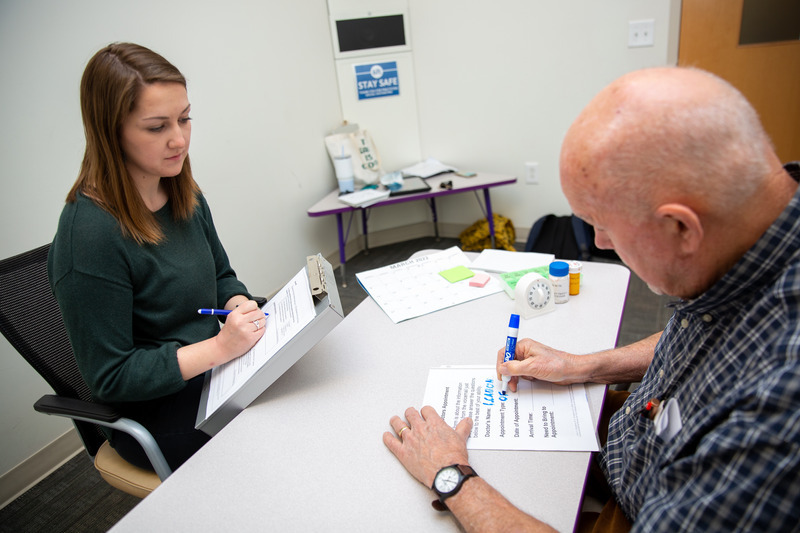
“Recruiting participants and collecting data in a standardized way is hard work,” said Lanzi. “We’re still in active data collection – and not even close to finished, so to see the impact of our work beyond publications, paving the way for leading scientific approaches, is incredible.”
Anna Saylor, a fourth-year student in the CSCD doctoral program, has been working in Lanzi’s Resilient Cognitive Aging Lab since the project's inception. Having watched her late grandparents progress through Alzheimer’s, the work feels deeply personal.
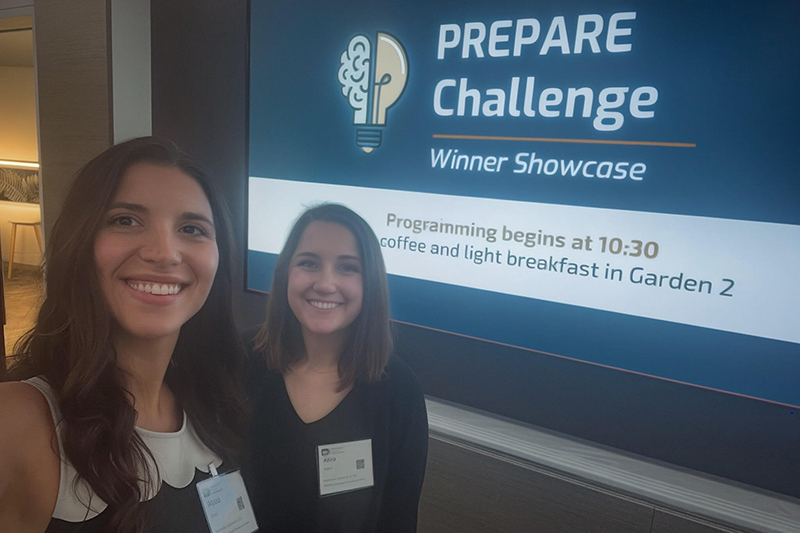
“I collected the very first data sample,” Saylor said. “To think about all the older adults who’ve dedicated their time to this research and that these two-hour sessions can now be used for sophisticated approaches to early detection is mind-blowing.”
Her experience underscores the importance of understanding biomarkers in the voice.
“DementiaBank breaks down how vocabulary changes over time and introduces disfluencies, including stutters, pauses, and changes in pitch,” Chung said. “I’d love to see this research evolve into a product that can help detect Alzheimer’s 20 years earlier in a way that’s cost-effective and accessible for everyone.”
Current diagnostic tools for detection, like MRI, are costly and invasive, and Lanzi believes that language, while not a single predictor, could be a powerful piece of the puzzle.
“I hope language becomes a marker that bridges the gap and gets people involved in treatments as early as possible. That could change their trajectory or help them better manage their function as Alzheimer’s progresses,” Lanzi said.
The challenge has also opened new doors for collaboration.
“I’ve had the chance to educate these innovators on mild cognitive impairment and give them a glimpse into the people behind the data, to humanize it,” said Lanzi. “Data scientists must understand that these are real humans – someone’s grandmother – behind the language they’re analyzing.”
Talking with data scientists has also helped Lanzi refine her data collection process.
“Too often, we operate in silos,” said Lanzi. “Bringing everyone together to understand what they need, to learn how I can refine my processes, and explain why some elements can’t be changed is pivotal.”
Challenge organizers say UD’s contributions to open science are setting a national standard.
“There’s no question that UD is a leader in open science and early detection efforts,” said Chung. “DementiaBank is a clear leader in this field — it’s a wealth of data, and I don’t think there’s another resource like it out there.”
This kind of crossover between industry and academia is rare; it’s a partnership Lanzi wants to see grow.
“One day, I hope we have teams comprised of clinicians, patient-centered researchers, and data scientists,” she said. “When the best of the best problem-solvers come together, anything is possible.”
Contact Us
Have a UDaily story idea?
Contact us at ocm@udel.edu
Members of the press
Contact us at mediarelations@udel.edu or visit the Media Relations website