




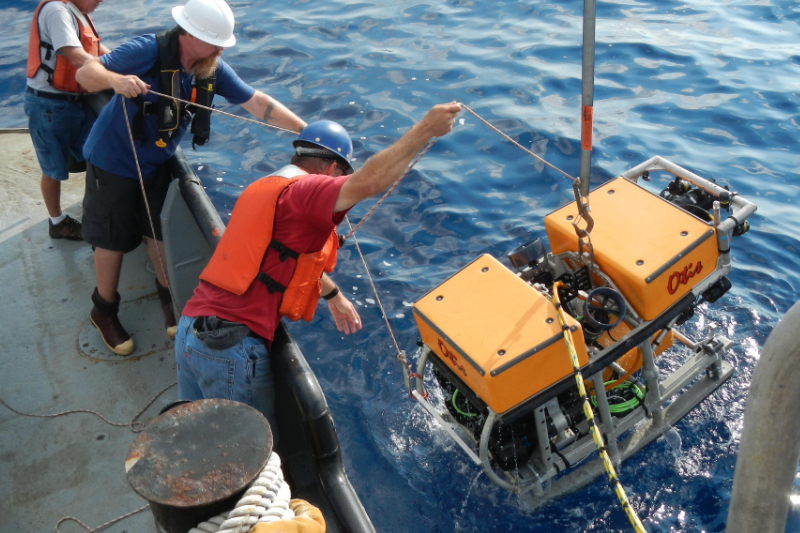
Advancing Underwater Robotics at UD
Courtesy of Tim Taylor, Christine Dennison, and Art Trembanis December 10, 2025
Renowned explorers donate OTIS remotely operated vehicle to help train next generation
For Christine Dennison and Tim Taylor, pioneering ocean explorers and power couple in the world of underwater exploration, OTIS is more than just a remotely operated vehicle (ROV). It’s a labor of love and a machine that they custom built and personally funded. Now, the internationally renowned couple who founded the Lost 52 Project, Ocean Outreach Non-Profit and Tiburon Subsea, Inc., a marine robotics company, have generously donated OTIS to the University of Delaware.
Taylor, renowned for his ocean exploration and technological innovation, has led major underwater expeditions and was honored with the U.S. Navy’s highest civilian medal, the Distinguished Public Service Award, for his discoveries and mapping and documentation of lost submarines and 700 lost WWII sailors. Dennison, as co-founder and president of Mad Dog Expeditions, has spearheaded international technical diving operations, contributed to high-profile media campaigns, and earned recognition as a Fellow of the Royal Geographical Society. Together, their leadership, media presence, and dedication to marine science and conservation have made a lasting impact on ocean exploration and help inspire future generations of adventurers.
Dennison and Taylor had long been aware of UD and were especially impressed by the robotics program. Given UD’s stellar research and highly involved student body, Dennison and Taylor are confident OTIS will be put to good use.
“OTIS is a platform for people to ask questions,” Taylor said. “If you have the right tool, you ask different questions. OTIS may allow everybody in different departments in the University to ask new questions. As a platform, it opens itself up to the ability for UD to develop payloads for it, sensors, different sleds that can collect samples. There's a whole host of things that can be asked and done with that.”
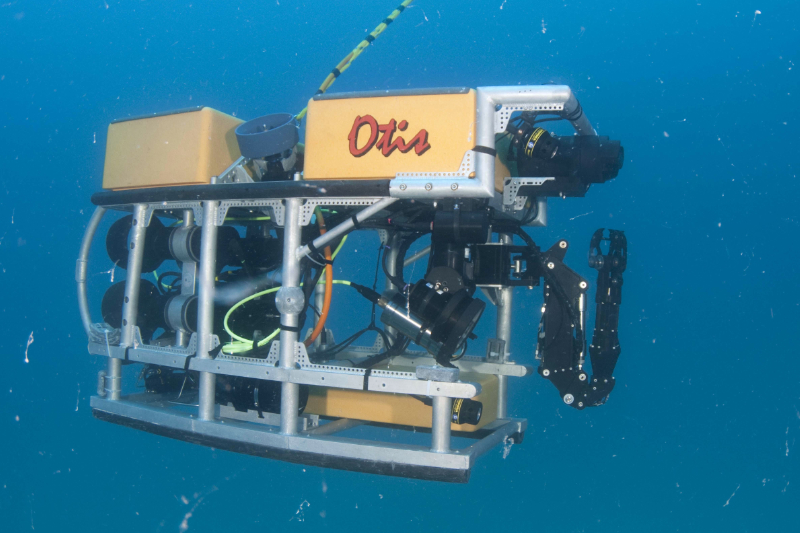
OTIS is equipped with a high definition, cinematic camera that has been used for video production work, a multi-functional manipulator arm to grab objects and take core samples of the seabed, lights and a multi-beam imaging sonar to give an acoustic picture of areas underwater. OTIS offers a level of machine capability previously unseen at UD, says Art Trembanis, professor in the School of Marine Science and Policy.
“In fact, very few universities in the United States have access to this kind of capability,” said Trembanis. “It's usually reserved for government labs or industry groups. Having OTIS here immediately catapults UD into a new league for underwater exploration.”
Trembanis stressed that while OTIS will be housed in the Robotics Discovery Laboratory (RDL) at UD’s School of Marine Science and Policy, the machine is available for anyone interested in conducting underwater research and exploration.
“We're looking for partners and collaborators in this,” said Trembanis. “This is an exciting asset for UD and Delaware, in general. We want to make the most of it.”
Named after Otis Barton, a deep-sea explorer who designed the bathysphere submersible that he and naturalist William Beebe used for groundbreaking underwater exploration in the 1930s, OTIS has played a vital role in many of Dennison and Taylor’s exploration projects, including finding sunken WWII submarines as part of the Lost 52 Project.
But as their explorations expanded, Dennison and Taylor needed to use larger vessels, leaving OTIS sidelined. They agreed that OTIS deserved a new life where it could explore and make new discoveries, preferably somewhere close to their New York City home so they could visit and mentor the aspiring oceanographers using it.
Now, OTIS is at UD’s campus in Lewes, doing exactly that.
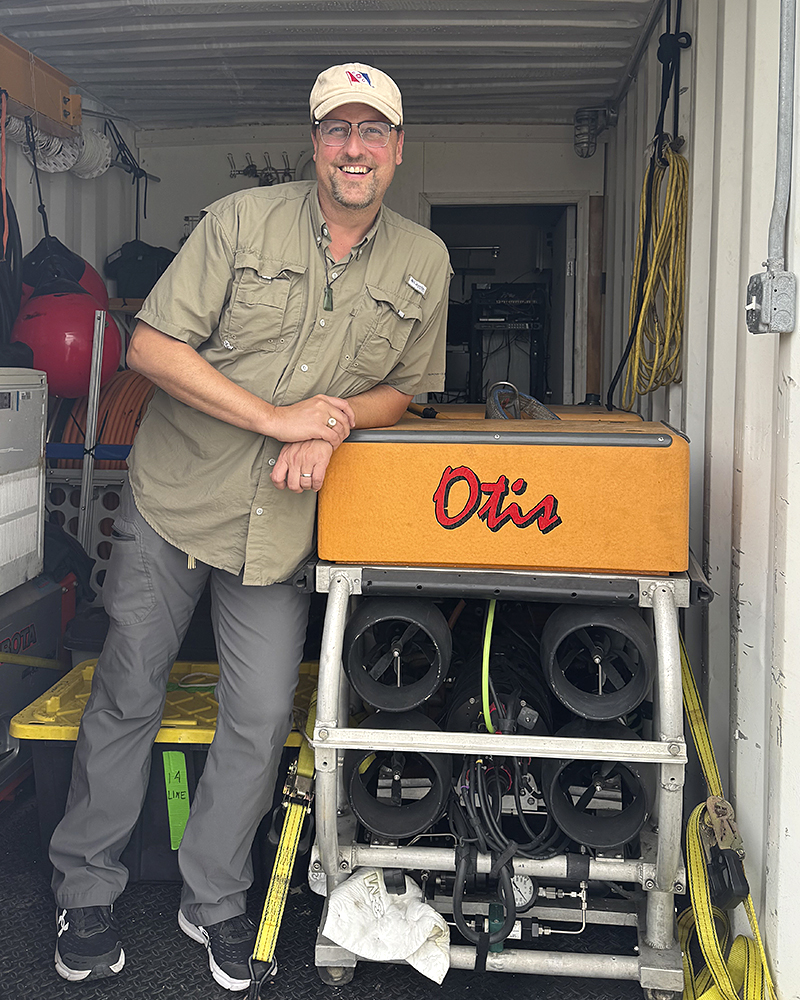
OTIS was recently on display at Coast Day, the annual flagship event of the College of Earth, Ocean and Environment, where more than 5,000 visitors had the opportunity to tour the RDL and meet the students working with some of UD’s most cutting-edge technology.
“It's passing the torch to the next generation,” Dennison said. “I think the UD student body seems so excited and is doing such genuinely great work underwater that a tool like this will take it to the next level. We feel strongly about giving back at any level to support students, to support the next generation. That's very personal to me, and I believe in it strongly, because I've grown up with that in business and in industry.”
Ophelia Christoph, a doctoral candidate in geology, is currently working on updating the equipment for OTIS and said she is looking forward to making more underwater discoveries.
“OTIS is a really exciting endeavor that our lab group is fortunate to work on,” said Christoph. “It would be cool to learn how to be an ROV pilot as this is a very useful skill aboard mapping, research and exploration vessels.”
Trembanis believes OTIS can play a key role in helping promote the Blue Economy, the sustainable use of ocean resources to promote economic growth and improve livelihoods and jobs, in Delaware.
“The Blue Economy is a big driving effort of what we're trying to do here in Delaware,” said Trembanis. “OTIS allows us to be a hub for training, research and partnerships with government and industry. This donation helps open the door for us to bring in new funding, attract new collaborators and showcase Delaware as a leader in ocean technology. I'm honored that Tim and Christine chose to entrust us with OTIS for its next life.”
Contact Us
Have a UDaily story idea?
Contact us at ocm@udel.edu
Members of the press
Contact us at mediarelations@udel.edu or visit the Media Relations website
ADVERTISEMENT

Resources
Office of Communications & Marketing 162 The Green, Newark, DE 19716 ocm@udel.edu Phone: 302-831-2792