
Kickstarting Mid-Atlantic Kernza
Photos by Kathy F. Atkinson October 09, 2026
UD researchers team up with U.S. Department of Agriculture, MIT to understand the crop’s roots
The University of Delaware College of Agriculture and Natural Resources’ Newark Farm hosts a smorgasbord of crops Alexandra Huddell studies: a couple plots of corn, an alfalfa plot and one unplanted plot. But the star of the show is her plot of Kernza, the nutty, earthy grain cousin of wheat — an intermediate wheatgrass crop developed by the Land Institute.
The world’s first commercially available perennial grain has been picking up steam in regenerative agriculture, a conservation approach focused on improving soil and ecosystem health. Kernza doesn’t die off in winter, so farmers don’t need to replant it. It also has environmental benefits.
“Kernza’s roots can improve soil health by adding organic matter, which enhances soil fertility and water retention,” said Huddell, a UD assistant professor of agroecology. “We’re also looking at its ability to improve water quality.”
The crop’s heavy roots can extend far into the ground and can exert a strong hold on contaminants like nitrate, helping to prevent it from washing into waterways by over 90% compared to annual crops. That’s been shown in Minnesota. And preliminary results from Huddell’s own research show similar success. But, while Kernza is grown commercially in the Midwest, it’s currently only grown for research in the Mid-Atlantic.
Could this crop some day be a major player in improving the Chesapeake Bay’s water quality?
Huddell thinks it’s possible. It’s been two years since she planted her Kernza plot, so she suspected the crop’s roots would be well established — the perfect place and time to explore this question.
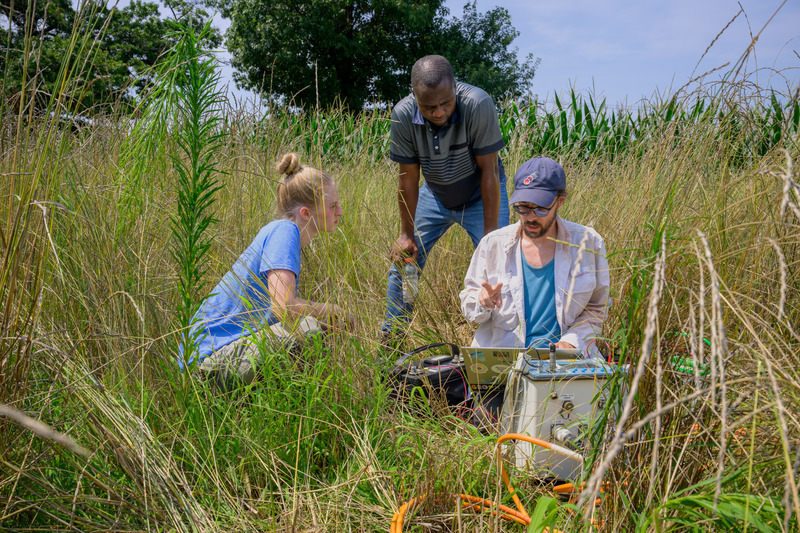
UD scientists teamed up with scientists from the U.S. Department of Agriculture’s Agricultural Research Service (USDA-ARS) and the Massachusetts Institute of Technology to study and compare Kernza’s roots with the roots of common crops. The researchers used geophysical imaging, which is similar to an MRI or a CAT scan in medicine, but for the Earth, to measure the roots to determine how many there are and how deep they go. This data could give researchers insight into soil health and initial impressions of Kernza in the Mid-Atlantic, especially as they continue to collect data next summer to see how things change.
Rooted in data
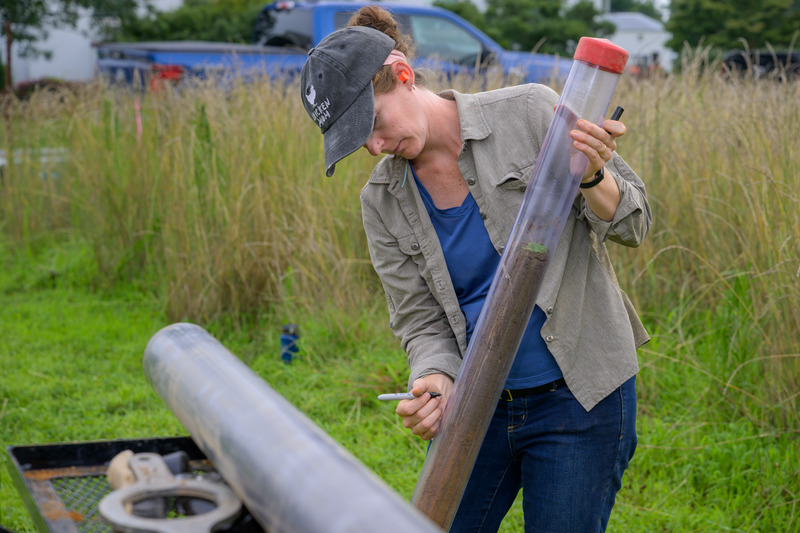
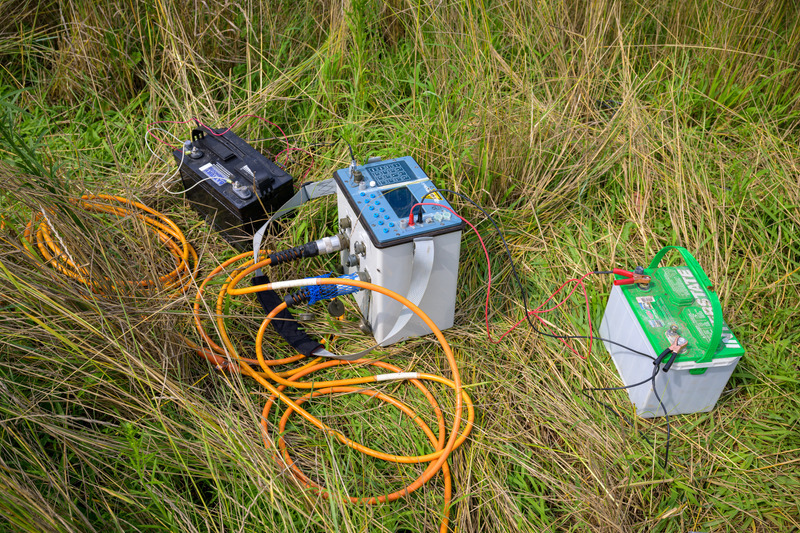
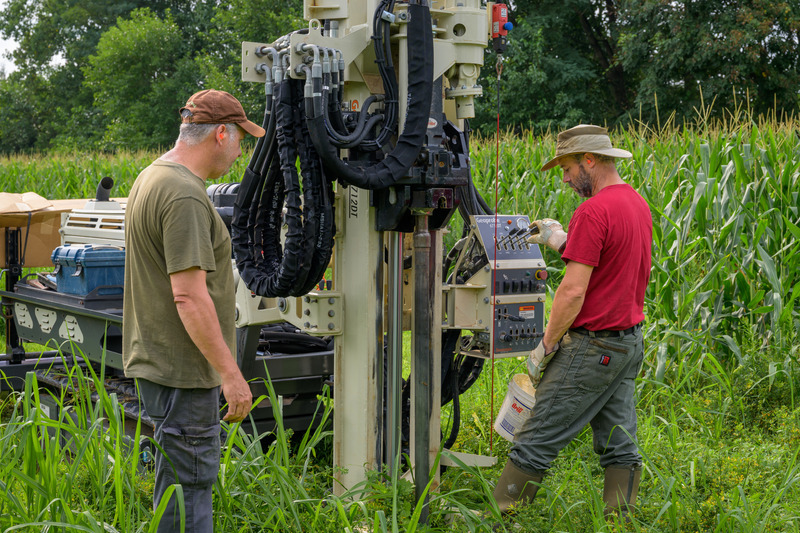
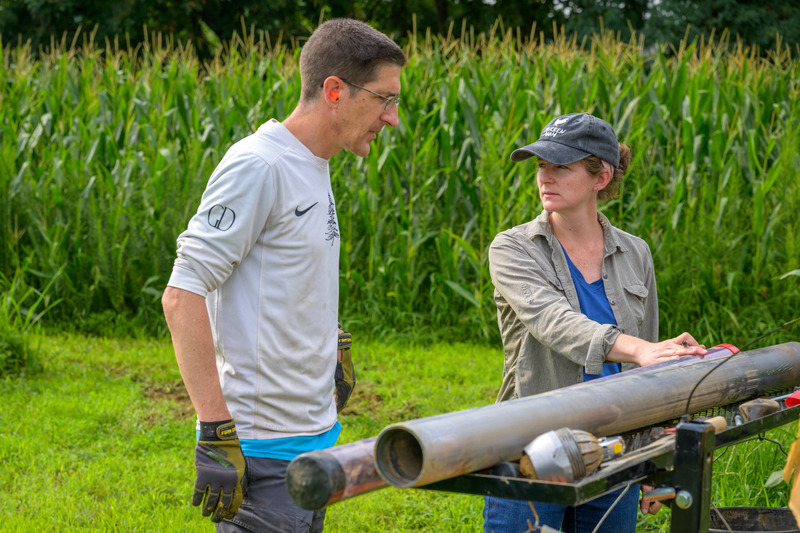
The researchers pushed 72 metal tent stakes into the ground, weaving a cable among the crops and connecting it to each stake. They sent an electrical current through two stakes at a time and measured a voltage drop (similar to testing a battery with a voltmeter), collecting 3,000 measurements across them. The data will be used to create a picture of the ground below the crops. Soil samples collected using a remote-controlled coring machine will help validate the geophysical data.
“We’re mostly interested in the top 10 feet,” said Joshua Thompson, a postdoctoral associate at MIT’s Department of Civil and Environmental Engineering, who studies the electrical properties of plant roots. “That’s the depth Kernza roots are most likely to interact with the nutrients, soil and water.”
Imaging plants and soil can help scientists understand what soil looks like across various farmland plots and what that might mean for how well crops can grow across a field. How deep the Kernza roots grow strongly depends upon the type of soil they're growing in, according to Thompson.
Kernza’s roots can grow 10 feet or more down into the soil in the Midwest, far deeper than a common crop like corn, with roots that typically extend about 2 feet.
Thompson said some farmers in Delaware and Maryland can point to a spot in their fields where certain crops can’t grow well. The research can help them understand how soils change across their fields, potentially allowing farmers to optimize their planting strategies. It’s also possible Kernza could grow where other crops can’t.
Thompson said it’s clear soil properties change across a field and with depth.
“For this study, the Kernza and some of the corn was in a very sandy region,” Thompson said. “And some of the corn and the other plots were in a very clay-rich region. We would expect those to have different rooting depths based on that, but we don’t know just yet until we examine the data from this study.”
In the long term, if researchers and farmers know where Kernza’s and other crops’ roots are and how far down they extend into the soil, they can determine if they are in locations where there are a lot of nutrients like nitrogen and phosphorus, said Anthony Buda, a hydrologist with the USDA-ARS.
“Kernza is a focal point because there is a lot of interest in perennial grasses and using them in marginal lands or places where you might not plant conventional crops. Could these grasses also serve to take up nutrients that could later be removed from the site through harvest?” Buda said. “Such a strategy might help to decrease excess nutrient levels in soils and soil waters over the long term.”
Improving impaired water quality
The Chesapeake Bay watershed encompasses Delaware, five other states, and the District of Columbia. It is a drinking water source for about 13 million people, but is impaired by poor water quality, due in large part to nutrient runoff from farm fields.
Some farmers fertilize their crops with animal manure, which contains nutrients such as nitrogen and phosphorus. When rain hits, nutrients can wash off fields and seep into waterways.
Kernza still needs fertilizer to grow, but its roots can often absorb most of the nutrients from fertilizer, preventing them from leaking into groundwater. Once grown, its roots act like the flipper on a pinball machine.
“Picture a pinball of nutrients in the soil and it’s bouncing around and moving down,” Huddell said. “It’s more likely to be intercepted by Kernza because it has deep roots.”
In Minnesota, where most residents get drinking water from groundwater, a study showed Kernza could absorb up to 96% more nitrate pollution compared to corn and soybeans, helping residents access safer water.
Huddell has studied how Kernza compares to cover crops such as cereal rye and winter wheat for water quality benefits. Farmers plant cover crops to hold soil down and reduce erosion. Huddell found Kernza was even more effective than cover crops at protecting water quality.
“Especially in places on the landscape that are most vulnerable, Kernza could be a real sponge for nutrients and help further water quality goals,” Huddell said.
The researchers hope to further study Kernza’s, corn’s and alfalfa’s roots next summer — when the growing season peaks for all three crops — to look at how things change while the crops are growing.
This research is funded by the U.S. Department of Agriculture's Agricultural Research Service and the University of Delaware’s College of Agriculture and Natural Resources.
Contact Us
Have a UDaily story idea?
Contact us at ocm@udel.edu
Members of the press
Contact us at mediarelations@udel.edu or visit the Media Relations website