





Bassoonists under the microscope
Photos by Kathy F. Atkinson and courtesy of Julia McDonnell October 02, 2026
UD senior’s summer research focused on female composers for bassoon
Julia McDonnell was in fourth grade when she told her mother she wanted to stop taking piano lessons. Her mother was clear: The lessons would continue.
Now a senior at the University of Delaware, McDonnell looks back on that ruling with deep gratitude.
She not only continued those piano lessons, she added the clarinet in fifth grade, the bassoon in ninth grade and the mellophone as a high school senior.
Music is center stage now for McDonnell, a cross-cultural medium that offers promising career opportunities in the future and a lifetime of expressive artistry.
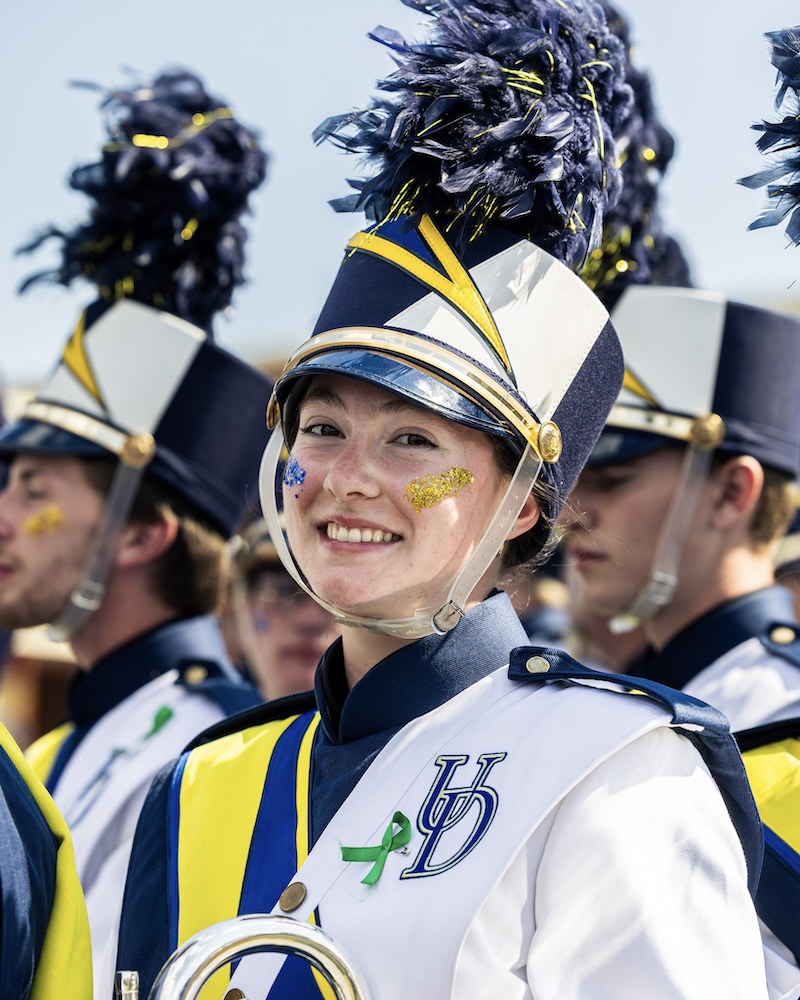
As an applied music major at UD, McDonnell is focused on bassoon performance, learning how to arrange music, expanding her music repertoire, planning a recital and developing other skills professional musicians need. She also plays in UD’s marching band (on the mellophone, not the bassoon).
This past summer, she added a new dimension to her studies: Research. That wasn’t on McDonnell’s radar, but as she was considering what to do with the summer her friend, an art major, told her about UD’s Undergraduate Research Program. She could apply to be a Summer Scholar, work full-time for 10 weeks, earn $4,000 and advance her studies in the bassoon. It sounded better than getting a summer job in a restaurant.
Her mentor, professional bassoonist Zachary Feingold, loved the idea.
“The fact that this program exists at the University of Delaware — I was so happy to hear it,” said Feingold, a member of the Chamber Orchestra of Philadelphia and adjunct instructor at UD. “Any situation where a university is going to support a student in independent research, especially at the undergraduate level, plus a performer pursuing research — this is not typical. I immediately said yes.”
McDonnell decided to study female composers of solo works for bassoon. She didn’t expect to find many. But by mid-July she had a list with more than 70 names on it. As part of her project, she planned a livestream recital with selected pieces composed by some of those women.
The bassoon is a versatile instrument. It is sometimes called “the clown of the orchestra,” a stereotype Feingold is not fond of. But it could also be described as the cello of woodwinds, providing a broad range of expression. Its tone can be somber, contemplative, whimsical, dramatic, mournful, and, yes, humorous.
As she studied the work of female composers for the bassoon, she found much new ground to test.
She especially appreciated Adrienne Albert’s “Serenade for Solo Bassoon” and Libby Larsen’s “Jazz Variations for Solo Bassoon” and she included them in her recent livestreamed recital.

“Both of these works stood out to me, because I feel that they demonstrate the bassoon's capabilities quite well, while still being accessible to all kinds of listeners, no matter how much classical or bassoon music knowledge they have,” she said.
The best part of the work was studying the backgrounds of the composers and the musical pathways they took, she said.
“It's interesting to see the directions the composers have taken their music based on what other life experiences they have. Some actively play one or more instruments, some had previous performing careers they had to retire from due to injury, some have experience in theatre, singing, or compose for film or video games or create multimedia projects instead of only writing ‘classical’ instrumental music.”
It was research that introduced McDonnell to these composers — and she is glad of it.

“It has been a much more musically fulfilling summer than it would have been otherwise,” she said, “and the research has been meaningful to me. I have had a good time learning about all of the composers I have looked into, and I'm looking forward to playing their music.”
McDonnell, who grew up in Macungie, Pennsylvania, explored multiple universities to find the one most likely to deliver the experience she wanted. Her top choice would have:
- Good science and engineering programs. (Coming from a family with many engineers in it, she planned to pursue a double major in engineering and music.)
- A good music school.
- A Division 1 football program.
- A good marching band.
UD checked all the boxes. After enrolling, though, McDonnell decided to narrow her focus to one major — applied music.
The bassoon is a challenging instrument and the only woodwind that employs all 10 fingers. Like the oboe, it has a double reed and musicians often spend a great amount of time crafting and refining their own reeds to achieve the precise tone and responsiveness they want.
She first met the bassoon as a ninth-grader, when the high school concert band director asked if anyone wanted to play it. She was getting bored with the clarinet, she said, and her mom’s best friend happened to be a bassoon teacher. McDonnell went for it.
“I knew how music worked from the piano and I knew how woodwinds worked from the clarinet,” she said. “It was not that hard to switch.”
She soon was told that her personality matched the stereotype of a bassoonist, too.
“Some stereotypes are a little bit true,” she said with a smile. “We’re silly people and we like to make puns. I think you have to be a little bit weird, a little nerdy, pensive.”
After learning of her migration to the bassoon, her middle-school band director told her it was “the best instrument-person combination I could have come up with.”
As for research, McDonnell doesn’t anticipate pursuing life as a bassoon investigator — “I definitely enjoy playing and performing more than doing the actual research.” she said.
But she does have one piece of advice for undergraduates considering such an opportunity.
“I would tell them to absolutely go for it,” she said, “but to make sure to be disciplined about setting a schedule for their project. If they’ve found a topic they enjoy, researching it won’t be hard, but balancing the time commitment of research with the rest of their summer can be.”
Contact Us
Have a UDaily story idea?
Contact us at ocm@udel.edu
Members of the press
Contact us at mediarelations@udel.edu or visit the Media Relations website