
24 hours to build
Photos courtesy of Kacey Dove and Ikechukwu Ogbonnia | Photo illustration by Jeffrey C. Chase March 20, 2026
At UD’s HenHacks, students collaborate to quickly turn ideas into working prototypes
As morning dawned on March 1, junior Kacey Dove felt calm.
A second-time participant in HenHacks, the University of Delaware’s beginner-friendly hackathon, Dove was familiar with the pressure the final hours could bring. Instead of scrambling to add new features, this year she and her teammates used the time to add finishing touches to their project and prepare their presentation for the judges.
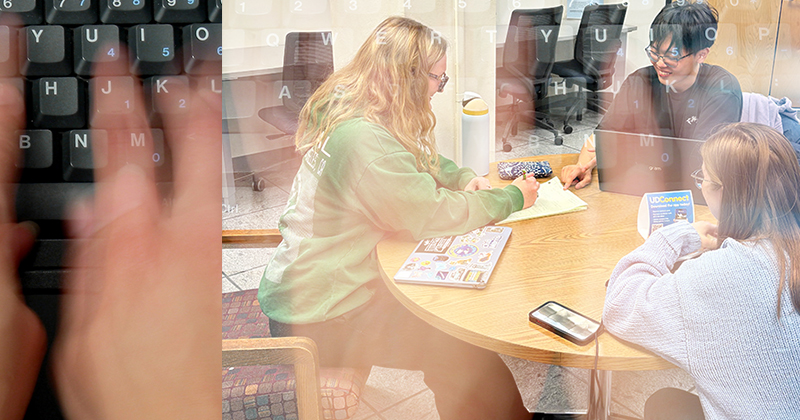
HenHacks returned for its fourth year Feb. 28–March 1, bringing together more than 470 undergraduate students from 45 universities for 24 hours of fast-paced innovation. Working in teams, participants spent the weekend turning ideas into functional prototypes addressing challenges ranging from security and safety to community wellness and social connections. This year’s event generated 137 project submissions.
Organized and run by a team of computer science undergraduates, HenHacks has more than doubled in size since its inception in 2023. The event offers a compressed version of real-world software development: deadlines, shared responsibility and rapid decision-making.
Learning to work together
For Dove, a junior computer science major with a concentration in cybersecurity, the high-pressure environment reshaped her attitude toward teamwork.
“HenHacks made me more comfortable working on a team,” she said.

Before participating last year, she preferred to work independently. The intensity of building — and fixing bugs — under deadline pushed her to rely more fully on her teammates.
This year, she teamed up again with senior Emma Szydlow, her collaborator from the 2025 event. Junior Alex Sohn, a first-time participant and honors student, rounded out their group. Keeping with the 2026 theme, “Hack the Wild West,” the trio envisioned and built an application called Bandit Board, inspired by the wanted posters historically displayed at police stations and post offices.
For sophomore Ikechukwu Ogbonnia, a second-time participant, HenHacks reinforced the value of collaboration under pressure. This year, he and his teammates created a marketplace app for students to buy and sell items.
“Everyone was contributing in an equal way,” Ogbonnia said, adding that this year’s project ran more smoothly than last. “We all were able to pitch in ideas and work.”

Returning HenHacks participant Varsha Danduri, a sophomore honors computer science major, agreed.
“You start to realize each other’s strengths and understand how to communicate and how to distribute work among each other,” she said.
Danduri, who has participated in other hackathons, said what sets HenHacks apart is its fun, community-focused atmosphere. The weekend includes workshops and mini-events that offer a break from the competition.
Last year, Dove and her team skipped those activities and focused solely on their project. This year, she was determined to approach the weekend differently. Her team agreed to intersperse work on Bandit Board with attending workshops and activities of interest. They visited therapy dogs, helped prepare puppy care packages and painted mini-canvases.
The breaks proved useful. This year, Dove made it until 1 a.m. on Sunday before going home to sleep, whereas in 2025, she left at 10 p.m. on Saturday.
“I feel that I was able to stay longer because I wasn't as quickly burned out as I was last year,” she said.
Building under pressure
The 24-hour format has also helped Dove learn to prioritize and accept “good enough” solutions.
This year, her team focused on core features for Bandit Board, designing the platform for two types of users: “sheriffs,” who could add new bandits to a shared database, and members of the public, who could view wanted or captured individuals. They created a map showing each bandit’s last known location and a feature allowing users to calculate their distance in real time. Then they stopped adding new elements and focused on refining what they had.
Learning to balance ambition with practicality is a lesson many HenHacks participants take away. For Jasnoor Saini, a previous HenHacks winner who graduated with a computer science degree in December, participating helped change how he approaches building applications.
“A big skill it gave me was not rushing for perfection,” Saini said. “The end product may not be what you envisioned at the start, but something functional and something to be proud of.”
The time-limited format, he added, makes hackathons especially satisfying.
The apps built in 24 hours at HenHacks may be prototypes, but the skills and confidence participants gain over the weekend are lasting.
Contact Us
Have a UDaily story idea?
Contact us at ocm@udel.edu
Members of the press
Contact us at mediarelations@udel.edu or visit the Media Relations website