
Combatting a crisis of hope
Photos by Evan Krape December 15, 2025
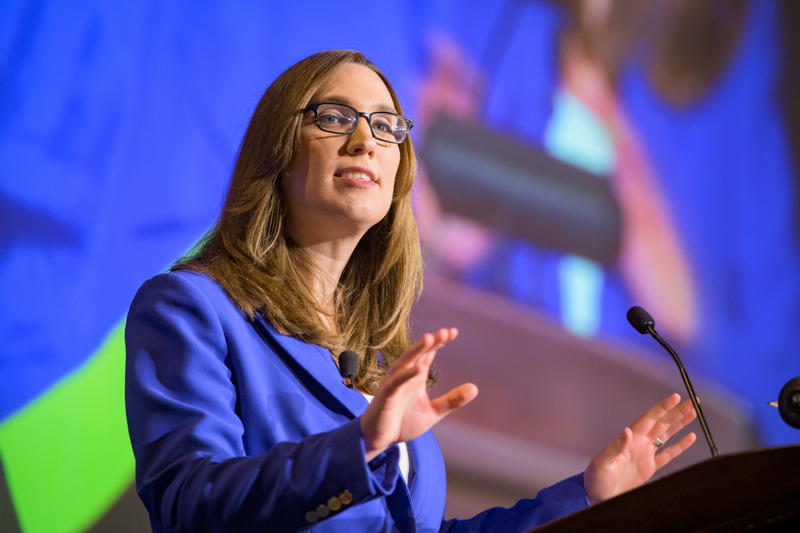
Sarah McBride urges collaboration over cynicism during annual Soles Lecture
Cynicism, disinformation, fear and a lack of faith in our government’s ability to meet the challenges ahead are leading some Americans to give up on our political system and ignore attacks on the Constitution. But despite what she calls a “crisis of hope,” Congresswoman Sarah McBride believes democracy will survive.
“I'm going to tell you something that might feel unbelievable when you turn on the news or open social media. I have seen that we are not as divided as the algorithms make it seem,” Delaware’s sole official in the House of Representatives told the huge audience at the University of Delaware’s annual James R. Soles Lecture on the Constitution and Citizenship on Dec. 5.
The lecture was held two days before Delaware Day, the anniversary of Delaware becoming the first state to ratify the Constitution. McBride urged the nearly 600 people in attendance at Clayton Hall to reject suggestions that progress in government is impossible or that we should “give up” on those who don’t share our politics.
“Cynicism is tempting,” she said. “It protects us from disappointment. It offers the short term satisfaction of saying, ‘See, I told you so.’ But in democracy, cynicism is not neutral. It's corrosive.”
She warned that economic anxiety, rising inequality and disinformation is being exploited by what she called “destroyers” — politicians and institutions that benefit from public despair.
The result, she said, is a growing openness to authoritarian alternatives.

McBride noted the country has faced periods of deep division and what seemed unsurmountable challenges before, from the Civil War to Reconstruction to the Great Depression. She said progress is possible when Americans come together to work on specific issues, even when they disagree on others.
“There has never been a movement for social progress that was a monolith,” she said. “They were coalitions, messy, diverse, imperfect and impure, divided on strategy, but united in common purpose, and they succeeded, not because one side shamed the other side into submission, but because enough people were persuaded.”
She pointed to the movement for marriage equality as an example.
“We welcomed imperfect allies,” she said, “not through shunning or shaming, but with space and with grace.” Public opinion shifted dramatically over a decade, and same-sex marriage was legalized in 2015.
McBride urged the audience to build political coalitions broad enough to defend our democratic institutions.
“If democracy is truly on the line in this moment, then we need all the help that we can get,” she said.
She also urged young voters in the audience to embrace “a willingness to be uncomfortable,” noting that meaningful political engagement requires patience, persistence and direct human connection.
“Touch grass,” McBride said. “Have political conversations in real life with real people.”
The message resonated with senior Megan Zalinkanskas, an honors political science and public policy double major.
“The ability to have political conversations and being uncomfortable and not just cutting people off immediately is definitely something that I think a lot of young people struggle with,” she said. “But being able to have those difficult conversations is a strength and while it's not easy, it is part of how we make progress.”

Nivedita Prahbu, a senior honors student double majoring in political science and biochemistry, said attending the lecture was a good first step.
“Putting ourselves out there at events such as this one, and networking and getting to meet people from all over Delaware, is a really valuable opportunity to actually put into practice a lot of what the congresswoman was talking about,” she said.
As America approaches its 250th anniversary next year, McBride said, the nation again faces a profound choice: whether to “destroy or build” the next chapter of our democracy. “Hope,” she said, “joyful, infectious, disciplined hope, is the only way forward.”
About the Soles Lecture
The Department of Political Science and International Relations hosts the annual James R. Soles Lecture around Constitution Day, which commemorates the signing of the U.S. Constitution in Philadelphia on Sept. 17, 1787.
The lecture honors the lasting impact Soles had on generations of UD students, faculty, staff and the state of Delaware. Soles, a political science faculty member for more than 34 years, died in October 2010. He received the University’s Excellence in Teaching Award twice and its Excellence in Advising Award, as well as the University’s Medal of Distinction. He received many honors and recognitions in his distinguished career, but he is still best remembered for his personal dedication to his students, hundreds of whom have served or continue to serve the public and their communities throughout the United States.
Contact Us
Have a UDaily story idea?
Contact us at ocm@udel.edu
Members of the press
Contact us at mediarelations@udel.edu or visit the Media Relations website