
UD’s strong ties to the Physics Nobel Prize
Photos courtesy of Frank Schröder, Gerald Poirier, Serap Tilav and Ilya Bodo, IceCube/NSF. October 07, 2026
UD researchers play key role in pioneering research that helped launch Laureate’s extraordinary IceCube Observatory
Scores of University of Delaware researchers, engineers, students and alumni cheered Tuesday morning when the announcement came that Belgium-born physicist Francis Halzen of the University of Wisconsin had won the Nobel Prize in Physics.
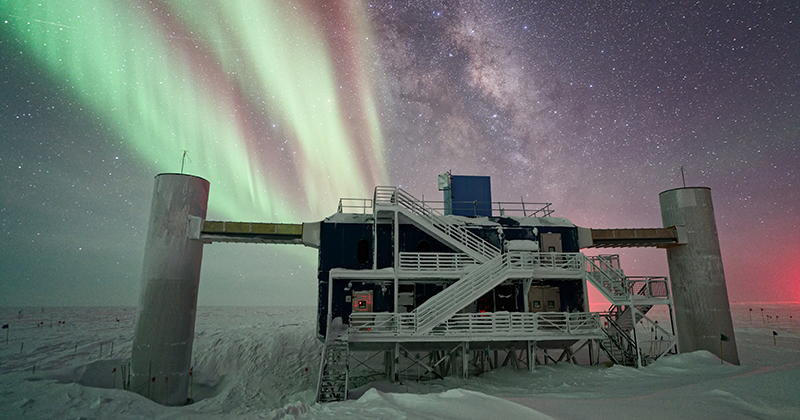
The cheers could be traced directly to UD’s founding partnership in the IceCube Neutrino Observatory, where Halzen and his collaborators detected high-energy astrophysical particles called neutrinos using sensors planted deep in the ice of Antarctica, about a mile from the Amundsen–Scott South Pole Station.
UD scientists, led by the late Professor Thomas Gaisser in the Department of Physics and Astronomy’s Bartol Research Institute and colleague Todor Stanev, were essential to high-energy neutrino astronomy research and among the founding partners of the IceCube Collaboration. UD continues to hold leadership roles as the next generation of IceCube experiments take shape, using advanced technology and the accelerated data analysis made possible by artificial intelligence.
Two years after Gaisser’s death in 2022, Halzen published a tribute to his pioneering contributions for the journal Astroparticle Physics.
Neutrinos are tiny subatomic particles, sometimes called “ghost particles” because they leave little evidence of their presence. They have almost zero mass and pass through all kinds of matter virtually undetected, unfazed by magnetic fields because they have no electrical charge. Scientists say billions of neutrinos pass through our bodies every second.
High-energy neutrinos — the sort accelerated by extreme events far from Earth and beyond our solar system — have been especially difficult to trace. As Halzen predicted, the pristine, deep ice of Antarctica has proved to be an ideal location for detection, with little interference and improved sensitivity.
The IceCube experiment, which took seven years to build and began official operations in 2011, aims to trace the origins of high-energy neutrinos to their sources in the distant reaches of the universe, such as supernovas (exploding stars), black holes, pulsars and gamma-ray bursts. It is in those violent events that these particles are accelerated at speeds impossible to duplicate on Earth. Understanding their origins can help us better understand the universe.
By 2013, IceCube researchers had discovered 28 high-energy neutrinos, but did not know where they came from. Later, scientists reported evidence of neutrinos from two galaxies and then — in 2023 — announced the discovery of neutrinos from our own Milky Way galaxy.
Building IceCube was an extraordinary engineering feat, and UD scientists were critical to its success.
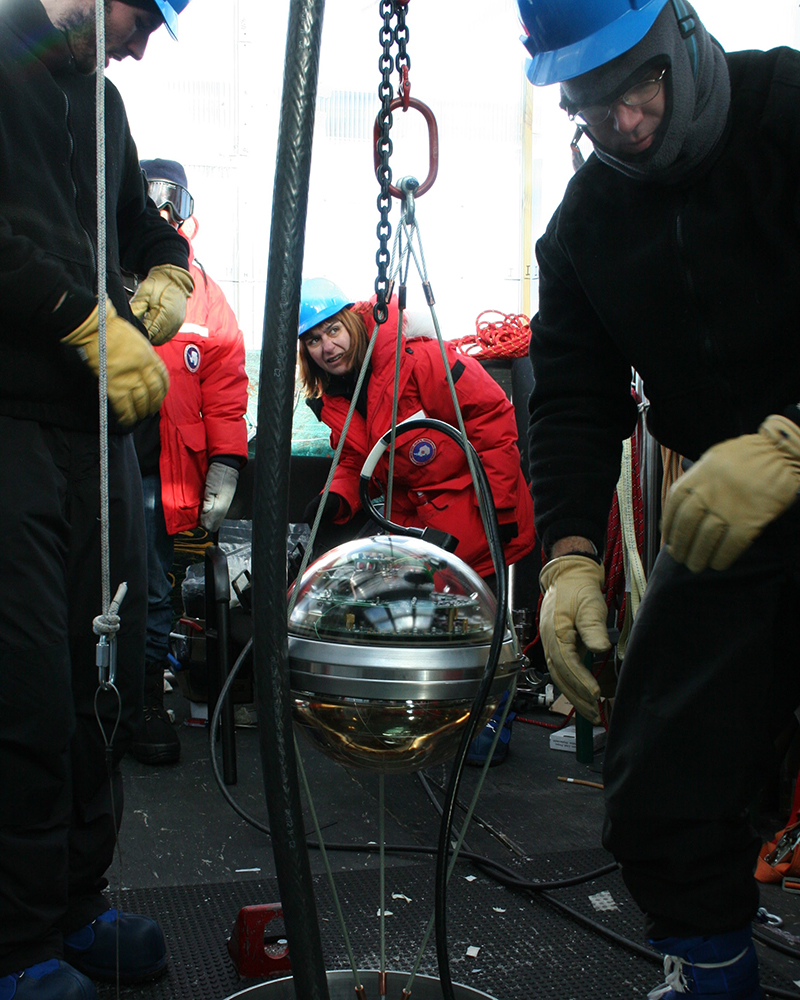
Essentially, they turned a cubic kilometer of ice into a telescope by drilling 86 holes into the ice — at depths beyond which bubbles would interfere with visibility — then sunk strings holding more than 5,000 sensors into those holes. Researchers pumped hot water into the holes to melt the ice, allowing the drills to operate.
Many UD researchers were on site for this work, including Gerald Poirier and James Roth, research project engineer.
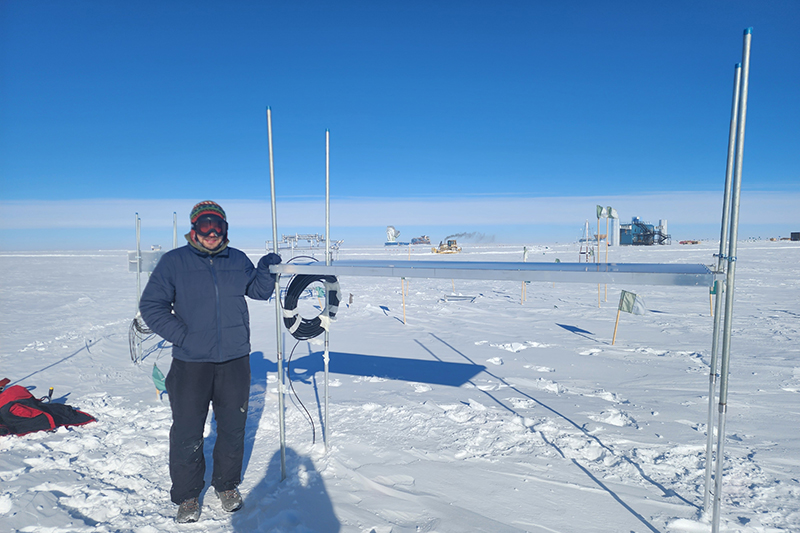
Poirier, now director of UD’s Advanced Material Characterization Lab, was there in 2000 to help develop the logistics of getting teams to the South Pole, how to work there and see if the prototype experiments would work.
It was an extremely challenging environment, Poirier said.
“The physical limitations when it’s minus-50 or minus-80 [degrees Fahrenheit] outside — it’s very grueling,” he said. “You try to work with layers and layers of clothes on, and you’re digging trenches and laying cables. And you can’t run to the local store and buy something you need. We set up the protocols, and James Roth saw the final product through.”
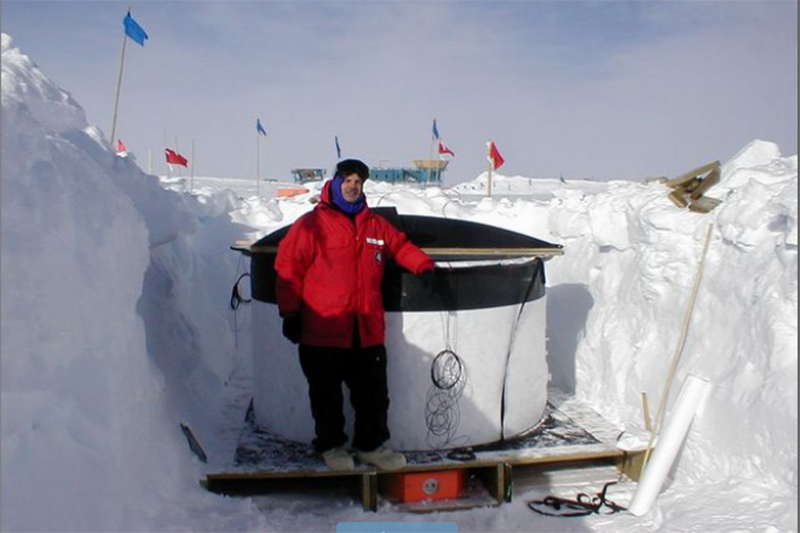
UD led the IceTop component, installing surface arrays atop the IceCube Lab to capture data from cosmic rays. UD Professor Emeritus Paul Evenson managed that project, and UD scientist Serap Tilav often worked on-site with Evenson and Gaisser. She now leads IceTop operations.
David Seckel, professor of physics and astronomy, leads UD’s IceCube work today, connecting the University with more than 450 scientists from 58 collaborating institutions in 14 countries. Seckel and UD physicists Frank Schröder and Spencer Axani serve in leadership roles in current IceCube research. Schröder, who studies cosmic rays, is leading the group preparing the surface array for the next generation of IceCube, known as IceCube-Gen2. Axani is leading an IceCube project looking at neutrinos produced in the Earth’s atmosphere, studying the properties of neutrinos, while Seckel is leading a project analyzing legacy data from neutrino science and astrophysics.
All of this produces great benefit beyond collecting and analyzing data, Schröder said.
“Humans want to understand the world we live in,” he said. “Students get excited; they learn new technology — including the use of AI in our data analysis. And many of these students propagate to industry to make other uses of their skills.”
For those reasons and many others, the National Science Foundation and other international agencies have provided funding for the project.
"Foundational science and discovery requires extraordinary human grit from the dedicated engineers, instrument builders and field crews who constructed and continue to operate a massive observatory a mile beneath the Antarctic ice," said Brian Stone of the NSF. “NSF is proud to support the IceCube collaboration and every individual in the U.S. Antarctic Program who helped turn this daring vision into reality."
Contact Us
Have a UDaily story idea?
Contact us at ocm@udel.edu
Members of the press
Contact us at mediarelations@udel.edu or visit the Media Relations website