




Connection through cognition
Photo illustration by Cindy Dolan January 05, 2026
Mentorship shapes postdoctoral research
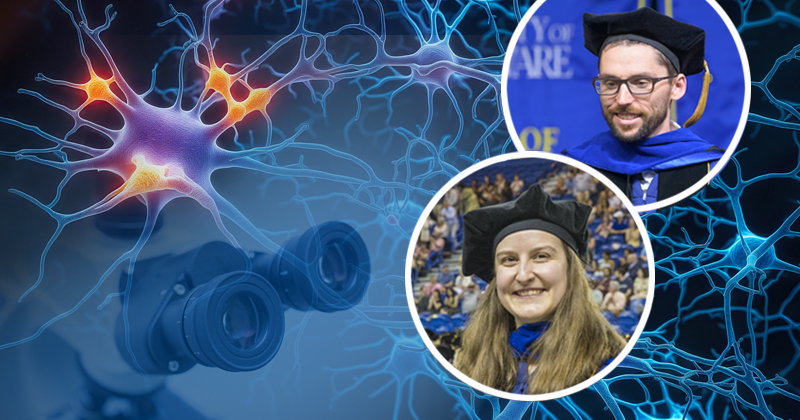
It’s true, earning a doctorate can feel overwhelming and at times isolating. But for students in the University of Delaware’s interdisciplinary neuroscience graduate program, community and connection are the norm. Alumni Mary Beth Hall and John Stout discovered this firsthand.
As two of the program’s first graduates, the Blue Hen alumni had immediate access to faculty mentors, a staple for all students.
“Each student has somebody in their corner wanting them to succeed,” said Philip Gable, program director of the interdisciplinary neuroscience graduate program. “That is one of our strongest features for student success.”
Launched in 2021, the program prepares students for research-oriented careers by combining traditional neuroscience training with a flexible, personalized curriculum. Along with core courses, students can explore interdisciplinary interests through campus-wide electives, such as Developmental Neurobiology, Affective Neuroscience and Computational Neuroscience.
Because the program is spread out across multiple colleges, Gable prioritizes building a supportive environment through student organizations, mentorships and campus events.
Hall, a 2024 graduate, has long been fascinated by the brain-body connection. As an undergraduate, she studied the impact pharmacological compounds can have on behavior and how it varies by sex — research that led her to pursue her doctorate at UD.
While researching various Ph.D. programs, she discovered Jaclyn Schwarz, associate professor in the Department of Psychological and Brain Sciences, who explores how the immune system impacts the development and behavior of offspring.
Hall began studying how the immune system affects brain development in young animals, and then moved on to her own research interests with Schwarz’s support.
“Jackie is an amazing mentor,” Hall said. “She encouraged us to take whatever project we were working on and make it our own.”
Taking that advice to heart, Hall focused her dissertation on maternal immune activation during pregnancy and its impact on offspring. Now, she’s investigating how immune interactions contribute to psychiatric disorders during development, hoping to inform intervention methods.
As a postdoctoral researcher in Schwarz’s lab, Hall took on a facilitator role alongside other key scientists to investigate how IL-33 can reduce inflammation-related brain damage in neonatal animals. Working with Elizabeth Wright-Jin at Nemours Children’s Health and Brian Kwee, assistant professor in the Department of Biomedical Engineering, Hall stepped seamlessly into a leadership role under Schwarz’s guidance.
“Having all that extra training on how to run a lab — planning a project, executing it and communicating those results with your lab and the public are all skills you learn during the Ph.D. that support you in being an independent researcher,” said Hall, who helped coordinate the project between the three labs. Currently seeking new research opportunities, she hopes to expand into science outreach to educate and encourage the public to support scientific research.
Stout, a triple Blue Hen who previously earned a bachelor of science and master of science in neuroscience, discovered his passion for neuroscience research at UD. As an undergraduate, he planned to enter the medical field when he took Brain and Behavior, taught by Amy Griffin, associate professor in the Department of Psychological and Brain Sciences. His experience in Griffin’s class clinched his decision to switch to neuroscience.
“That course really helped shape my path,” said Stout, who worked in Griffin’s lab during his undergraduate, graduate and doctoral programs.
One of the most valuable aspects of the program for Stout was Griffin’s mentorship, a relationship he believes was integral to his success as a researcher.
Working with her for nearly a decade, Stout credits Griffin for teaching him the hands-on process of scientific research as he studied how the neocortex and hippocampus interact to support learning and memory. For his dissertation, he developed a brain-machine interface that measured the synchronized activity between the hippocampus and prefrontal cortex, allowing him to discover through animal models that performing tasks during these moments improved memory recall.
Considering Griffin's impact, Stout hopes to emulate her mentorship with his students when he starts his own research lab. In the meantime, Stout is continuing his postdoctoral research at the University of Connecticut in Timothy Spellman's lab, investigating how the prefrontal cortex interacts with the thalamus to support executive function — a transition Stout notes was seamless after Griffin’s lab. Using photon microscopy to view brain cells in real time, Stout hopes to identify the specific group of neurons that contribute to behavior and, in the long term, develop therapies for cognitive disorders.
Along with the one-on-one mentorships, Hall and Stout valued the program's scientific community. Stout benefited from informal weekly meetings in which fellow students would share their research progress and provide feedback. Similarly, Hall recalled being inspired by the program’s monthly colloquia, a series of seminars where faculty, guests and students present their research at the Science, Technology and Advanced Research (STAR) Campus. The seminars exposed Hall to research outside of her home department that helped adjust her own scientific approach.
“You never know what new perspective you’re going to get on your own research by hearing about what other people are studying,” Hall said. “Hearing about the research performed by scientists in other departments can help you gain a fresh perspective on your own work. Interacting with other neuroscience colleagues at UD on a consistent basis really fosters organic discussion and collaboration across disciplines.”
About UD’s interdisciplinary neuroscience graduate program
The interdisciplinary neuroscience graduate program at the University of Delaware is designed to develop a unified atmosphere to expose students to the exciting developments in brain function, providing interdisciplinary training to current and future graduate students and prepare them for a research-oriented career in academics or industry.
Contact Us
Have a UDaily story idea?
Contact us at ocm@udel.edu
Members of the press
Contact us at mediarelations@udel.edu or visit the Media Relations website