




Finding the right balance
Photos by Ashley Barnas Larrimore and courtesy of Kaley C. Hayes | Photo illustration by Jeffrey C. Chase December 01, 2025
UD, Brown researchers’ study aims to inform national blood pressure guidelines for aging adults
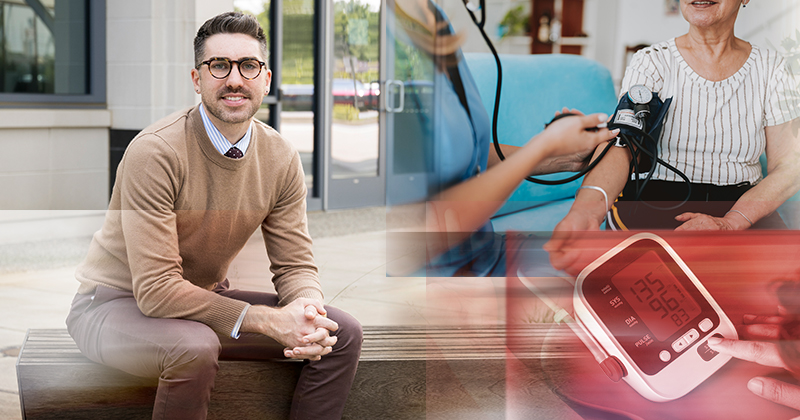
Managing blood pressure in aging adults in nursing homes can be tricky. Geriatricians like Dr. Sarah Berry aim for a “sweet spot” where blood pressure isn’t so high it leads to a heart attack or stroke, but not so low that it causes dizziness and falls.
She recalls a patient with dementia enrolled in a clinical trial, who had suffered a fracture.
“Her blood pressure was too low, often around 90-100 systolic, so we stopped the medication,” said Berry, associate professor of medicine at Harvard University and gerontology division chief at Beth Israel Deaconess Medical Center.
The patient felt less dizzy and fell less often.
“It was powerful evidence to suggest that deprescribing helped her,” Berry said.
That same question — when to treat blood pressure more aggressively and when to step back — is driving Daniel Harris’ research. Harris, assistant professor of epidemiology at the University of Delaware College of Health Sciences, wants to determine whether more nursing home patients with hypertension, particularly those with Alzheimer’s Disease and Related Dementia (ADRD), could benefit from individualized hypertension management.
Harris and co-principal investigator Kaley Hayes, assistant professor of health services, policy and practice at Brown University School of Public Health, have been awarded a $2.6 million grant from the National Institute on Aging (NIA) to evaluate real-world hypertension treatment strategies.
“These residents often get multiple blood pressure checks per day,” said Harris. “We want to learn what thresholds drive treatment decisions, how well those decisions align with existing guidelines, and whether nursing home residents need different guidelines.”
Harris and Hayes will use data from the Long-Term Care Data Cooperative Electronic Health Record and link it to administrative claims, including doctor visits and hospitalizations.

“Nursing home residents are a heterogeneous population with a lot of different physical and clinical complexities,” Hayes said. “We’re trying to find a happy medium between overtreating and determining whether less aggressive treatment still protects against cardiovascular events and falls.”
Investigators will employ causal inference methods to examine trends in patients, including those with a prior history of stroke or other adverse medical events. With up to 80% of nursing home residents diagnosed with hypertension and many on multiple medications, the stakes are high.
“Outside of the nursing home, it is not uncommon for an older patient to be cared for by several different physicians and specialists, all of whom may be prescribing different medications,” Harris said. “The use of multiple medications, also known as polypharmacy, adds another layer of complexity when assessing hypertension management, blood pressure, and risk of adverse events.”
Patients with ADRD, 90% of whom have hypertension, are a primary focus of the research.
“There’s evidence that tighter blood pressure control can prevent some cognitive changes years down the line, but there’s no evidence it slows cognitive decline in persons with dementia,” Berry said.
For those patients, she often targets a systolic pressure closer to 150 — much higher than guidelines typically recommend.
“Those at risk for falls or who have a limited life expectancy need different goals,” Berry said.
Berry hopes this research will help clinicians feel more confident in making changes to antihypertensive regimens for nursing home residents.
“There’s a tendency in nursing homes to say, ‘If it’s not broke, don’t fix it.’ Whatever drugs the patients came in on, they stay on, and I’m not sure it’s the best strategy, particularly for those with dementia,” said Berry.
Harris hopes the findings inform future hypertension guidelines.
“We want to identify a clear, evidence-based, and data-driven solution to managing a common condition in older nursing home residents with dementia,” Harris said. “We aim to identify prescribing patterns and treatment strategies that strike the balance between reducing major cardiovascular events while not increasing the risk of falls. Ultimately, our goal is to improve quality of life and care for aging adults.”
Contact Us
Have a UDaily story idea?
Contact us at ocm@udel.edu
Members of the press
Contact us at mediarelations@udel.edu or visit the Media Relations website